 Journal of Global Trade, Ethics and Law
1. Introduction
The right of workers to organize freely and to undertake collective negotiations with their employers is considered a fundamental right, reflected in two of the ten fundamental Conventions of the International Labour Organization (ILO)1: Freedom of Association and Protection of the Right to Organise Convention (No. 87) and the Right to Organise and Collective Bargaining Convention (No. 98). The fundamental character of these two international instruments means that all 187 Member states of the ILO have an obligation, arising from the very fact of membership in the organization, to respect the rights which are the subject of those Conventions (ILO, 1998).
As a specialised, normative agency of the United Nations (UN), the ILO monitors adherence to international labour standards through its supervisory mechanism, which forms part of the larger international system of human rights2. This supervisory system –composed of the regular system of supervision and the special procedures – provides an important source of information to international actors concerned with human rights, including aid donors, by whom it can be used as an element in funding decisions. In particular, the complaint process, established under the special procedure of ILO supervisory mechanism, and the dedicated Committee on the Freedom of Association (CFA), allow for gathering detailed insights into violations of the right to freedom of association and collective bargaining (ILO 2018). The CFA conducts detailed examinations of specific complaints filed with the ILO in connection with the alleged violations of this fundamental right and makes its findings known to the ILO’s member states and broader public through a set of dedicated mechanisms.
This paper examines whether the observations and recommendations made by the ILO’s supervisory system have any bearing on the behaviour of OECD/DAC donors. More precisely, it tests whether violations of Trade Unions’ (TU) core rights – a major obstacle to the ILO’s main delivery method of social dialogue – provoke any adjustments to donors’ selection of recipient countries in the ILO’s voluntary funding portfolio. Beyond the empirical testing, the paper provides a theoretical discussion on adequate funding responses by the multi-bi aid donors to violations of TU rights in aid recipient countries.
2. The Context: Aid Allocation and the Multilateral System
Numerous specialized agencies of the UN, including the ILO, had been created prior to the emergence of aid and – during their initial period of existence – relied exclusively on assessed contributions.3 The rapid decolonization of the 1960s brought about the phenomenon of Official Development Assistance (ODA), with which came donor agencies, aid budgets and the overall US$185 billion per year “aid industry” that we know today. Faced with the stagnation of their core funding, most UN agencies developed systems to capture such additional financial resources. As a hybrid between bilateral aid (state-to-state) and multilateral funding (state-to-institution), earmarked voluntary funds became known as “multi-bi aid”. Contrary to the assessed contributions, those new assets came with specific donor-drawn conditions for their use, which effectively created a dual funding mechanism in the multilateral system.
1 Refer to ILO’s Declaration on Fundamental Principles and Rights at Work (1998), amended in 2022, for a full list of fundamental conventions (ILO, 2022).
2 The broader debate surrounding the link between labour rights and the international framework of human rights is well summarized well in Mantouvalou (2012).
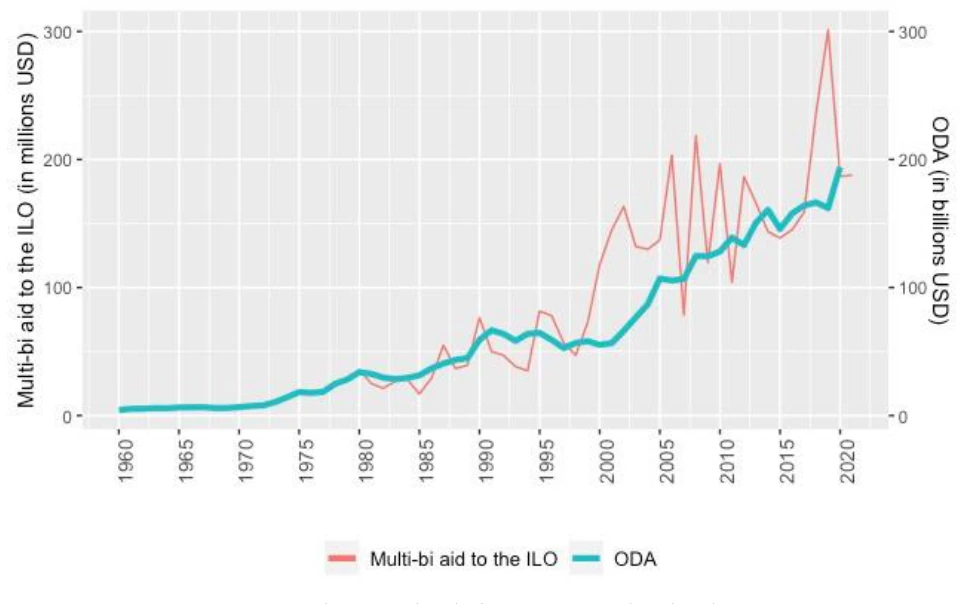
The ILO has not been immune from this trend, with voluntary contributions constantly increasing their share in the Organization’s overall resources over the past 30 years. In the 2018/19 budgetary biennium, 49 per cent of it total financial resources came from such voluntary funding. This consisted of US$ 27 million in voluntary core, and US$ 772 million in multi-bi ODA, earmarked to a different degree (ILO 2020). As demonstrated in Figure 1, multi-bi aid received by the ILO is closely related to total ODA, but it has a higher volatility.
The impact of such funding on the multilateral system is only one of the highly discussed topics in aid-related academic literature (Reinsberg 2016; Michaelowa 2017; Ege 2017). Another reason why ODA is generally interesting to scholars is that is can be used a as a proxy for modelling influence in interstate relations. In particular, aid earmarked to specific countries raises questions around the motives that drive such country choices.4 This applies equally to country-earmarked multi-bi aid, since – contrary to core multilateral grants – such allocation decisions are made by donor countries and not by the multilateral institution.
3 Often referred to as “regular budget”, such contributions are provided by virtue of states’ membership in the organization.
In terms of explaining donor’s country-earmarking decisions, the underlying theoretical framework has not evolved dramatically since the early 1970s and is typically structured around three principal motives: self-interest, altruistic drive and the so-called “merit” (Alesina & Dollar 2000; Dietrich 2013; Bagchi et al. 2016).5 The first of these areas has been quite widely documented and there seems to exist a rather uniform agreement on the strong significance of donors’ self-interest on bilateral aid decisions (e.g. Jepma 1991; Canavire et al. 2006; Younas 2008), the overall ODA generosity (Neumayer 2003c; Berthélemy & Tichit 2004; Berthélemy 2005, 2006) and some of the multilateral funding (Canavire et al. 2006; Fleck & Kilby 2006; Berthélemy 2006).6 The opposed side of the theoretical spectrum is occupied by altruistic donor behaviours, typically captured under the concept of the “need for aid” (Dudley & Montmarquette 1976; McKinlay 1978; McKinlay & Little 1977; Alesina & Dollar 2000; Berthélemy & Tichit 2004; Berthélemy 2006; Bertoli et al. 2008; Paxton & Knack 2008; Fuchs, Dreher & Nunnenkamp 2014). The third conceptual pillar in the aid allocation literature concerns recipients’ “merit”, which typically considers the quality of governance, respect for human rights or levels of corruption in recipient countries (Cingranelli & Pasquarello 1985; McCormick & Mitchell 1988; Katarina 1993; Poe & Sirirangsi 1994; Alessina & Dollar 2000; Neumayer 2003a-d; Knack 2004; Berthélemy & Tichit 2004; McGillivray 2005; Bandyopadhyay & Wall 2006; Lebovic & Voeten 2009; Hoeffler & Outram 2011; Bandyopadhyay & Vermann 2013; Acht & Thiele 2015).
The discussion presented in this paper contributes directly to the thematic strand concerning “merit”, with a specific contribution in the largely unexamined area of multibi aid and human rights. In addition, the findings provide an input to the debate on wider
4 Country earmarked aid to a multilateral institution like the ILO can come either through the central channel or through country-level representations, but in each scenario the selection of countries is largely driven by priorities in the donors’ development policy. See Gmyrek (2021) for a detailed discussion.
5 See e.g., Reinsberg et al. (2015) and Bagchi et al. (2016) for comprehensive overviews of the aid allocation literature, conceptual frameworks and empirical methods.
6 The extant bilateral aid literature argue that many donors do not hesitate to use their funding to influence voting positions in the UN General Assembly (Bernstein & Alpert 1971; Rai 1980; Wang 1999, Alesina & Dolar 2000; Hawes 2004; Dreher, Nunnenkamp & Thiele 2008) and to exert pressure on developing countries that occupy strategic seats in the supranational decision-making bodies, such as the UN Security Council (Kuziemko & Werker 2006). The more recent bilateral aid literature also suggests the use of climate change mitigation and adaptation aid flows to obtain consensus-based decisions in environmental negotiations (Bagchi et al. 2017). In the multilateral aid literature, we find evidence that some donors go as far as influencing the supposedly independent allocation mechanisms of the IFIs, pushing them to provide preferential funding in favour of recipient countries that are their political allies (Fleck & Kilby 2006; Broz & Hawes 2006; Berthélemy 2006; Dreher et al. 2008; Dreher & Sturm 2012). Similarly, a rotating seat in the Security Council has been associated with a temporary favourable treatment in terms of the conditions included in the IMF and the World Bank programmes (Dreher et al. 2009a-b), and with higher multilateral allocations by the UN (Kuziemko & Werker 2006).
implications of voluntary funding for the core functions of normative multilateral institutions, such as the ILO
3. Aid, Human Rights and the ILO
If one conceives of aid as a financial incentive, conditioning its provision on the recipients’ respect for human rights, including the International Labour Standards (ILS) of the ILO, seems like a reasonable approach to targeting long-term improvements in democratic governance. However, the logic of states’ behaviour does not easily respond to simple “carrots and sticks”, as political leaderships are composed of complex networks of co-dependencies and interests that need to constantly balance between such large ticket items as geopolitical influences and state security, economic and social goals, and longterm control of power. For this reason, most human rights instruments are principally soft and have been designed to influence through persuasion rather than coercion (Hafner-Burton 2005). This is also the case with labour rights, with the “teeth of the ILO” known to be rather soft on their initial bite and intended to work through more subtle long-term pressure points (Tapiola 2018).
What options then do the donor governments have if they are keen on promoting human rights through their aid programmes, or if they at least want to make sure that the money of their taxpayers does not eventually fund governments with the most flagrant human rights’ violations? As many newcomer staff of the donor administrations quickly discover, the hard weapons in their arsenal are, in fact, few.
Aid’s particular role as an instrument of conditioned response to recipients’ human rights record has become increasingly limited in the recent decades. With the diminishing role of the Official Development Assistance (ODA) among international flows to developing countries, governments of many ODA-eligible countries have found it increasingly easier to turn to other sources of finance (OECD 2013; Jenks & Jones 2013). In many cases, withdrawal of aid due to rights’ violations could even augment the political space of the violators, especially if the reduction of aid budgets was to diminish the local capacity of rights-oriented watchdog institutions (Murdie & Davis 2012). When cutting their funds in rights-compromised contexts, donors also must deal with their domestic stakeholders of aid, who might perceive such decisions as mainly punitive for the most vulnerable groups, already mistreated by their abusive authorities (Dietrich & Murdie 2017).
In addition, the lack of compliance with international standards concerning many social and economic rights often results from much broader local dynamics than simple ill-will of the recipient government, with the overall level of development playing an important role. 7 Sanctioning of underperformance across the board could be highly counterproductive to campaigns that target a wider ratification of international legal norms, in particular those that carry associated reporting obligations. Knowing that a low reporting score could eventually trigger aid reductions or other types of bilateral sanctions, developing countries would have little incentive to consider ratification of such instruments in the first place (Tapiola 2018).8 It could therefore be argued that, in country settings where incompliance results mainly from broader development challenges, donors should in fact consider boosting their financial support.
7 For example, Article 22 of the Universal Declaration of Human Rights and in Article 9 of the International Covenant on Economic, Social and Cultural Rights recognize the right to social security as a basic human right (ILO/SPF 2016). In many developing countries such access is still largely limited due to
The empirical literature largely suggests that most donors do not consistently reward or sanction their aid recipients, regardless of the type of rights at stake (Neumayer 2003ac; Adhikari 2021). Things change, however, when we consider multilateral settings. For example, Lebovic & Voeten (2009) observe that a negative UN resolution on the recipient country’s human rights record can lead to a decrease in the multilateral allocations and in the World Bank loans. The authors suggest that donors generally prefer to rely on indirect sanctions through informal influence on the multilateral channel instead of exposing their criticism openly through bilateral aid reductions.
The more recent aid literature brings an important third option to this range of choices, by demonstrating donors can also change the method of delivery to programmes that do not directly benefit governmental institutions in countries with a poor record of human rights (Dietrich 2013; Acht et al. 2015; Kilama 2016; Dietrich & Murdie 2017; Adhikari 2021). In the context of voluntary contributions to a rights-based multilateral organization, such as the ILO, this raises a question of adequate donor strategy for recipient countries that violate core labour rights.
As a tripartite organization, the ILO prioritizes in its delivery methods the concept of social dialogue, which is an approach to policy-making that involves regular consultation and consensus-building among the Organization’s three constituents: employers’ and workers’ organizations and governments. For the method to work in a national context, at the minimum all three parties should be free, independent, representative of their members, and have the capacity to engage in social dialogue and technical policy matters. As well documented, for trade unions these basic conditions are not always easily met (ILO 2021; ITUC 2021).
Violations of TU rights can range from mild policy-level obstacles in the formation and functioning of free labour unions to cases of outright violence against trade union members, including imprisonment, persecution and killing (Kucera & Sari 2019; ITUC 2021). If social dialogue is key to ILO implementation, donors that fund its development cooperation programmes should worry about this aspect when choosing recipient countries: it is hard to imagine a meaningful consultation on working conditions, wages, or even youth employment in a setting where TU leaders are in prisons, or worse.
Thinking in traditional terms of “merit”, donors could be expected to reduce benefits of their funding for recipient countries with high levels of TU rights violations. However, the lack of infrastructure and the financing gaps that cannot be attributed, at least exclusively, to public mismanagement.
8 See discussion in Tapiola (2018) on the reservation of developing countries with ratification of core ILO Conventions in fear of the potential subsequent use of their non-compliance as a protectionist argument.
given the largely non-financial character of the ILO’s development assistance, a complete withdrawal of funding in such settings would probably have small chances of improving the situation. Therefore, following the logic of the “bypass” mechanism (Dietrich 2013; Dietrich & Murdie 2017), donors could choose to provide voluntary funds primarily in benefit of local workers’ organizations in such country contexts. In fact, the ILO’s administration could even play an active moderating role in such a process, pointing out to the donors which countries have the greatest need for technical assistance related to freedom of association and collective bargaining, thereby optimising the practical use of its own supervisory system. Following this approach, donors would essentially be betting on a longer-term investment in the very foundations for ILO’s work in each country, that is, the existence of free, independent workers’ organizations, as a precondition to funding broader development programmes.
However, such a strict funding approach is also very restrictive. It limits the possibilities of engaging in other policy topics if the TU’s rights violations persist, giving little space for soft influence and incremental improvements. Taking this into account, donors could also choose to fund more neutral thematic programmes, which can ultimately increase the chances of creating political openings for social dialogue and for a gradual expansion of TU rights. This would combine the advantages of a bilateral approach with multilateral normative value added, helping the donor administration justify the use of multi-bi aid over the traditional bilateral channel.
The common denominator of these theoretical scenarios is that, at the level the overall ILO country-earmarked portfolio of the ILO and of a given donor, one would expect to observe a systematic relationship between the countries selected for voluntary funding and the level of violations of the TU rights in those countries. More precisely, two such alternative scenarios could be specified in hypothetical forms: a. Country-earmarked funds are systematically used by ILO donors to address situations of TU’s rights violations, thereby creating a positive association between the level of such violations and the amount of funding directed to countries (the more violations, the more funding goes to remedy the problem, either to TU-oriented programmes or broader programmes with TU-related elements): b. Donors sanction countries with higher TU violations, creating a negative association between the amount of funding allocated and the reported violations in each country. Logically, those two possibilities of a systematic structure to donor decisions are complemented by the “no one cares” scenario, in which no regular association exists between multi-bi aid allocated through the ILO to recipient countries and the violations of TU’s rights in those countries. In the empirical tests that follow, the latter is treated as a null hypothesis with tests aimed at its possible rejection at standard levels of statistical significance.
4. Labour Rights and Aid Data
Given the thematic focus on the link between the normative role of the ILO and its development cooperation functions, specific interest falls on the observations made by the ILO supervisory mechanism regarding TU rights at the country level. Traditionally, these observations do not easily lend themselves to cross-country comparisons, in particular in quantitative models. While rich in content, observations of the ILO’s supervisory bodies have a highly technical character and come in the form of text-based legal comments. In that context, the Labour Rights Indicators (LRI) initially developed by Kucera & Sari (2019), represent an impressive effort toward the advancement of comparative international studies that consider one of the core areas of the ILO’s mandate.9
The LRI database essentially converts the observations made by the ILO’s supervisory system, complemented by several additional legal contextual sources, into quantitative and standardized indices of country-level performance. While its official taxonomy refers to “labour rights”, unpacking the sub-indicators and the sources used for their construction makes it clear that the scores effectively measure the respect for core TU rights, especially the right to freedom of association and collective bargaining. This makes the database particularly well suited for empirical testing of the main research question posed in this paper. The LRI dataset comes with three indicators: “in law”; “in practice” and “overall”. Within the sample available for this study, “in practice” scores are hardly distinguishable in statistical terms from the “overall” scores. Since, in conceptual terms, the “overall” scores should be of most interest to the donors as they combine the legal situation and the actual application of rights on the ground, this indicator receives most attention in the empirical section.
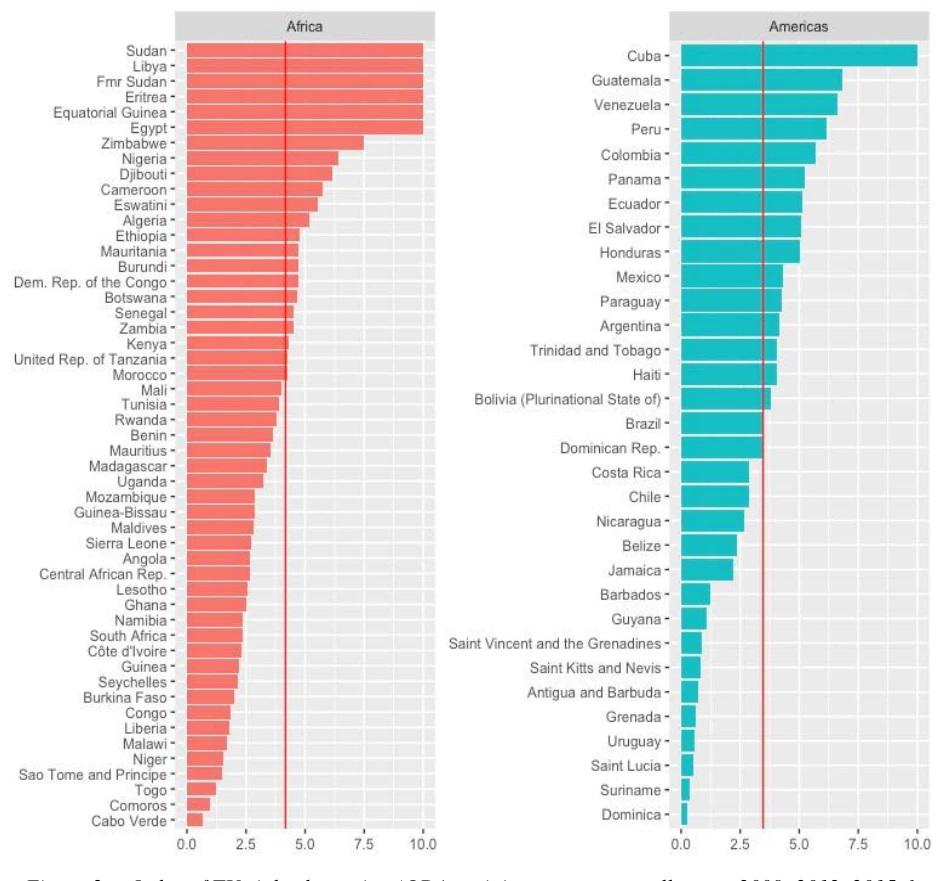
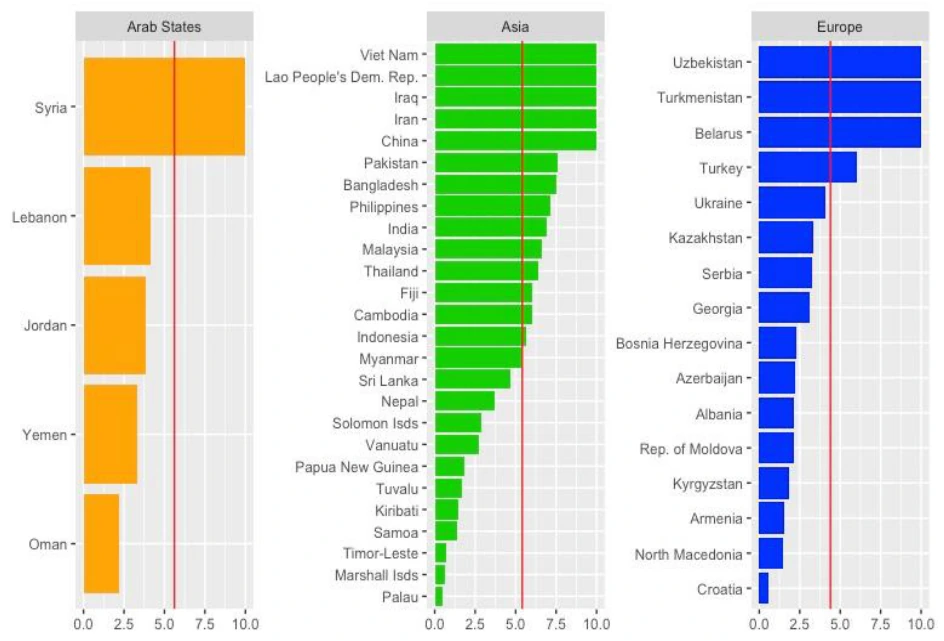
Figure 2 presents an overview of the LRI scores among the group of ODA-eligible countries. The scores range from 1 to 10, with 10 representing highest violations. Scores for 2000 and 2005 are not used, as there is no matching ILO aid data for those early periods. Regional means across the years used have been marked with red vertical lines, with a clear country-level variance present in each region.
9 It is hard to find a reliable alternative source to the LRI, when it comes to ensuring a direct link to the ILO’s supervisory system, which is key to this study. For example, the frequently used Labour Regulation Index of the Centre for Business Research only provides de jure coverage and does not reflect de facto observations reflected in ILO CFA.
In terms of the aid data, the source used in most published studies is the Creditor Reporting System (CRS) of the OECD/DAC, which stores individual records of aid contributions reported by the donor countries. There are, however, some serious issues with the overall completeness of multi-bi data in the CRS (Reinsberg et al. 2015) and the coherence of aid reported in the CRS compared to the funding reported as income by the UN agencies (Gmyrek 2021). Fortunately, the ILO provides an exceptionally transparent access to detailed data concerning its voluntary contributions through its publicly available Development Cooperation Dashboard. The aid data used in this study was downloaded from the ILO’s portal in the form of annual project-level allocations to individual recipient countries over the period 2010 to 2019. The dataset was manually reviewed to exclude all allocations that do not have any specific country-level earmarking.
The dataset of the labour rights- and aid-related variables is constructed based on the assumption of a one-year delay in the effect of labour rights situation on donors’ aid allocation decisions. This covers the LRI for years 2009, 2012, 2015, 2016 and 2017 and aid allocations for 2010, 2013, 2016, 2017 and 2018. Despite its irregular time intervals, the dataset allows for observation of effects between and within the panel structure.
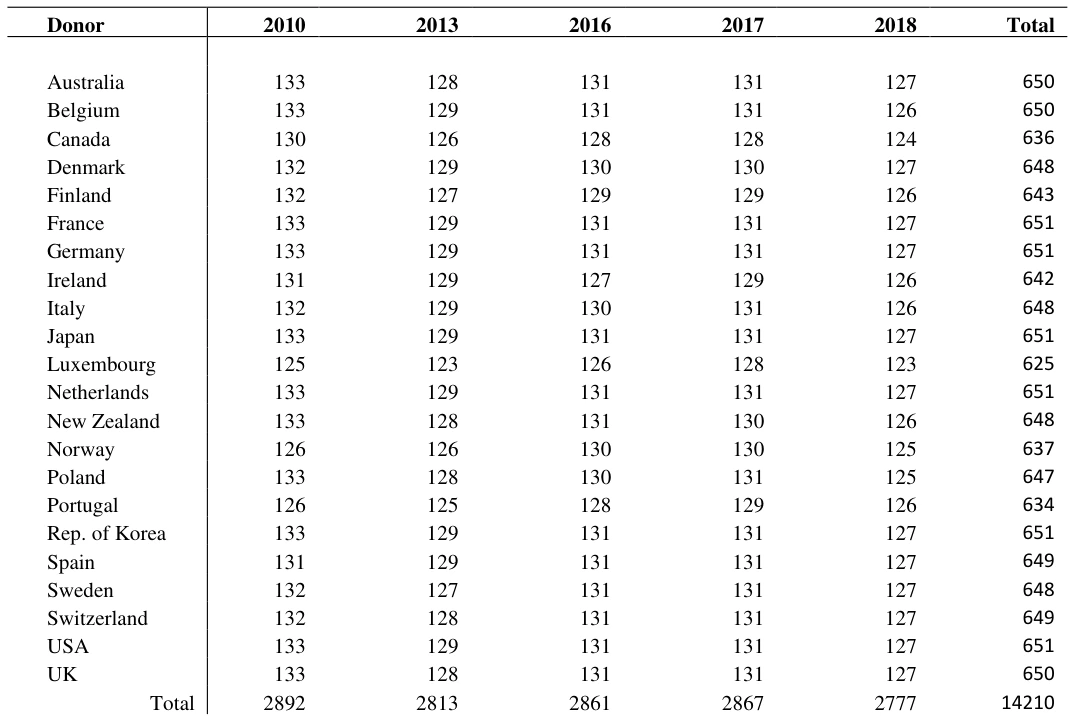
On the recipient side, the focus of the study is on developing countries that are eligible to receive aid, as per the classifications of OECD/DAC, and for which it is possible to compile data concerning the most important explanatory factors. Through the combination of 137 recipient countries, 22 donors and five annual observation points, the main dataset has 14,210 observations (Table 1, Appendix).10
5. The Empirical Model
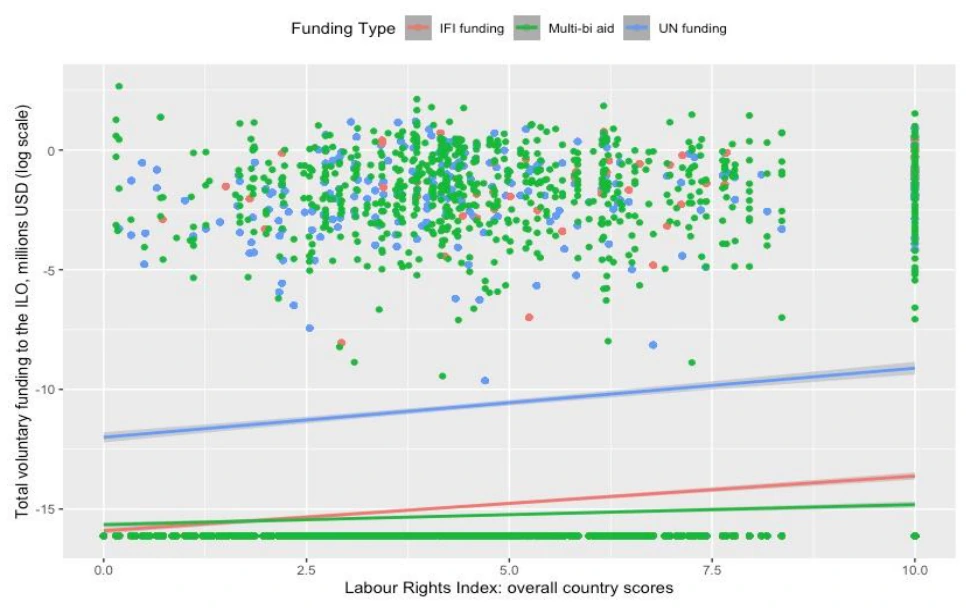
The first exploratory verification of the relationship between the LRI and multi-bi aid can be done by plotting the three categories of ILS scores against the aid allocations (Figure 3). Natural logs are used on the aid scale to correct for large variance in the sizes of ILO contributions.
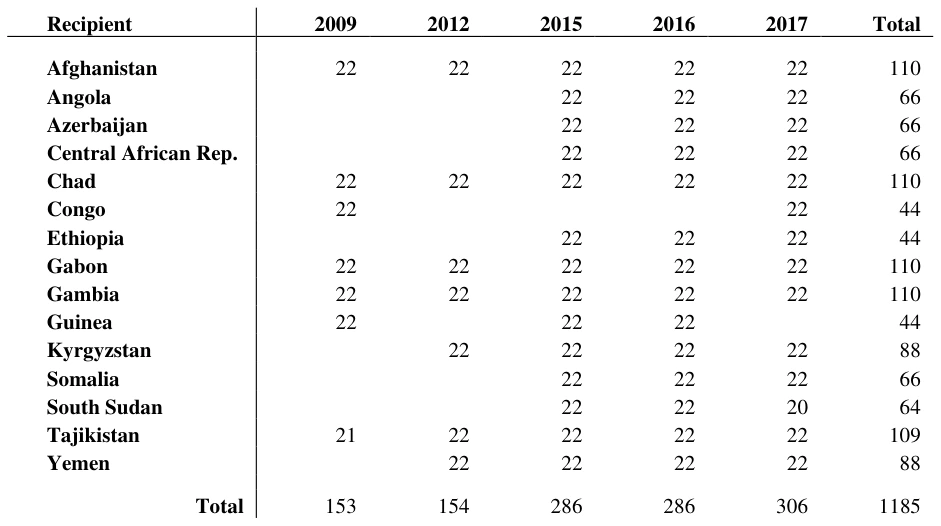
10 There are several countries that Kucera and Sari mark as “not recommended for econometric studies”, mainly due to known higher actual violations than what is reported in the sources used for the construction of the LR index. Among the developing countries in the sample, this applies to fifteen countries and leads to a loss of 1,185 observations: a non-negligible 8.3 per cent of the sample (Table 2, Appendix). To control for the possible bias that could result from the exclusion, I run the initial regressions both on the full and the reduced sample of recipients and determine the setup for subsequent tests based on the results of those initial assessments.
The particularity of data distribution suggests some additional consideration in the selection of the estimation method, since there is a disproportionate amount of real zero values among aid data points, representing the instances where no aid was allocated to a given ODA-eligible country. The second particularity concerns the uneven distribution of the LRI scores, with a clear gap between the main scores reaching up to around 8, and the accumulation of scores with the maximum value of 10. While this might represent an issue in terms of LRI methodology, it does not pose a particular problem to a linear estimation.
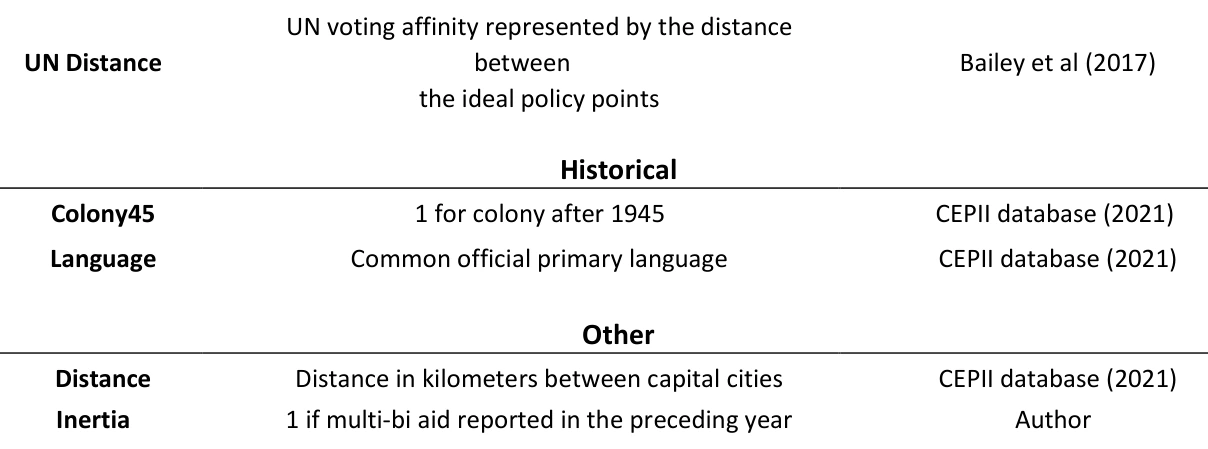
To account for further theoretical elements that are known to influence country allocation of aid, several additional controls are established. Self-oriented donor motives are mainly captured through commercial and geopolitical interests.11 Historical ties are captured through a shared official language and former colonial relationship after 1945, based on CEPII (Mayer & Zignago 2011). The need for aid relies on recipients’ GDP per capita, based on the simple (and largely simplified) notion that developing countries located at the low end of this scale have a higher need for aid.12 In addition, to account the fact that donors could be taking needs-related cues from other multilaterals’ funding patters, the model accounts for ILO’s country-level funding from the IFIs and other UN.
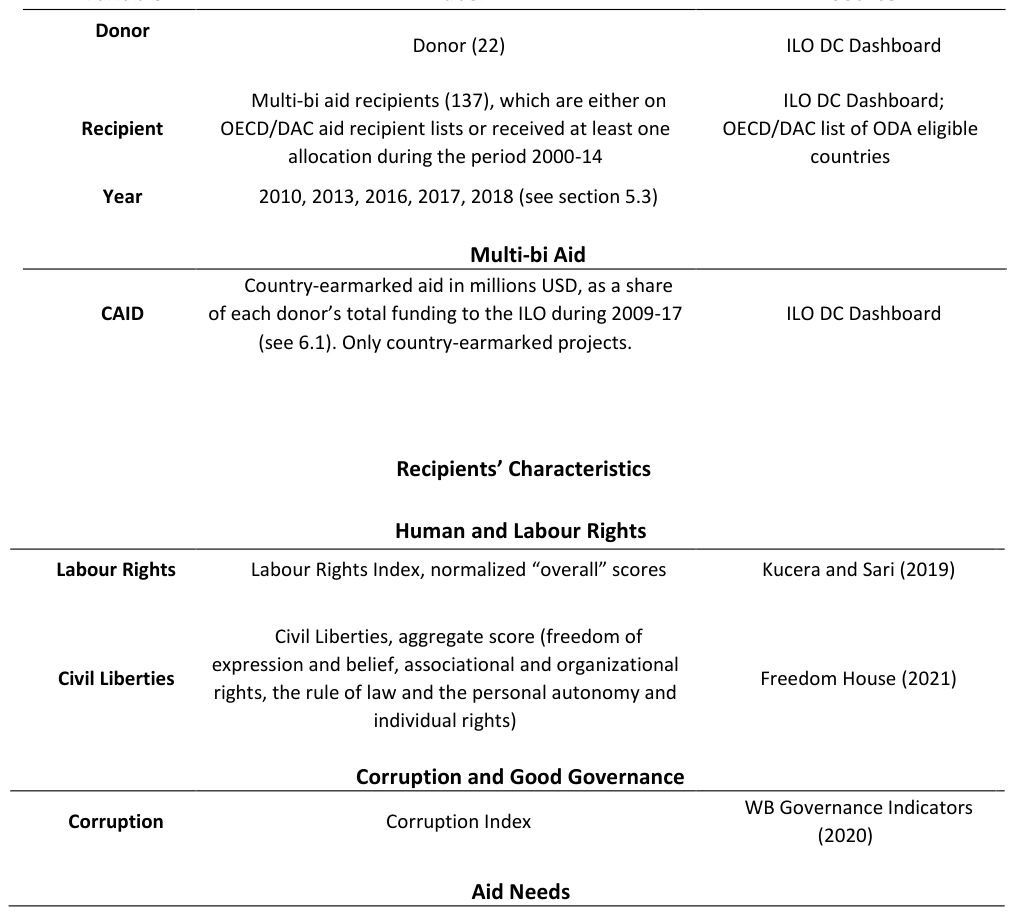
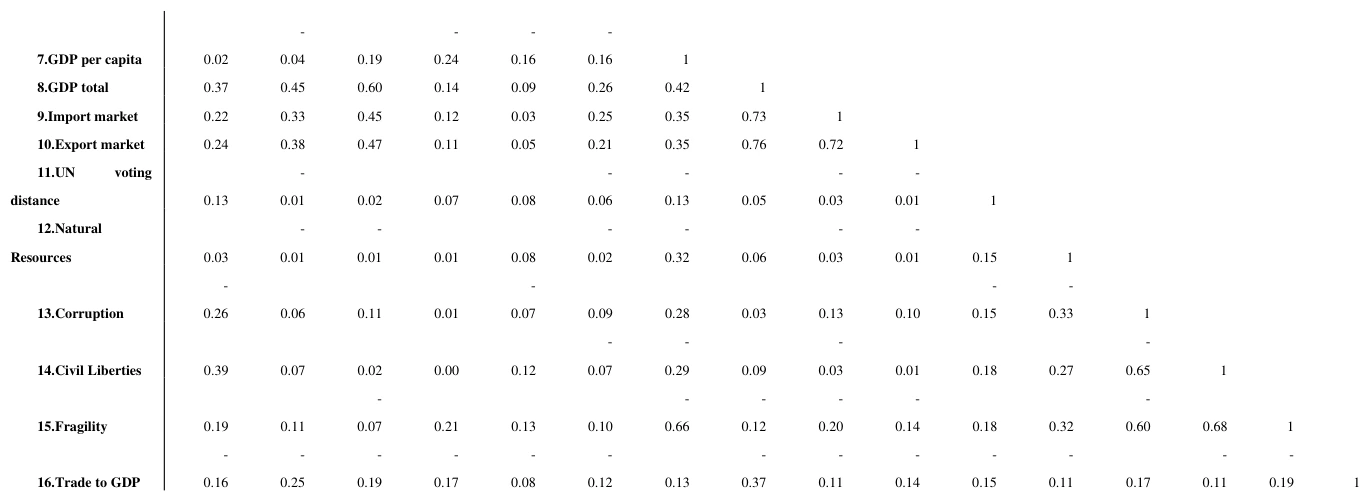
The conceptual category of “merit” is mainly captured through the corruption index of the World Bank (Kaufman et al. 2009; WB/WGI 2019) and the Civil Liberties Index (Freedom House 2019). Due to the obvious conceptual overlaps, violations of TU rights are highly correlated with violations of civil liberties in the sample. Therefore, the inclusion of the Civil Liberties Index in the estimations largely depends on the extent to which we are interested in isolating the LRI effects beyond the more generic donor behaviour motivated by the overall human rights context. Consequently, I compare the results of equations in which the LR indicator is used as the only explanatory factor with those that use the civil liberties index as an alternative and as a simultaneous regressor, attempting to understand the isolated effects of labour rights status on multi-bi aid decisions.
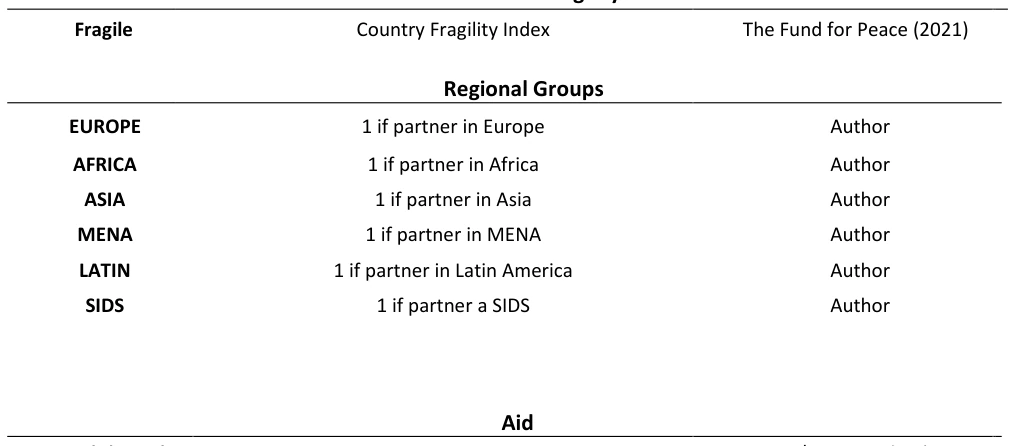
A dedicated set of variables accounts for the differentials in general international interest in individual aid recipients, based on the total bilateral aid allocated each year by the OECD/DAC group (OECD 2019), total annual net inflows of FDI as share of GDP (WB/WGI 2019), total rents from natural resources as share of each recipient’s GDP (WB/WGI 2019) and the total size of recipients’ GDP (WB 2019). To account for the humanitarian aspects of development aid decisions, I include a measure of recipients’ fragility (Fund for Peace 2020). Since most donors have clear priorities when it comes to regional distributions of their ODA, I also code the ILO’s official five regions through a set of separate dummies. In addition, I control for the distance between capital cities of the donor and the recipient, based on the notion that countries located farther might be more difficult for the donors to access and therefore receive multi-bi aid because of outsourcing delivery services to the multilateral system.
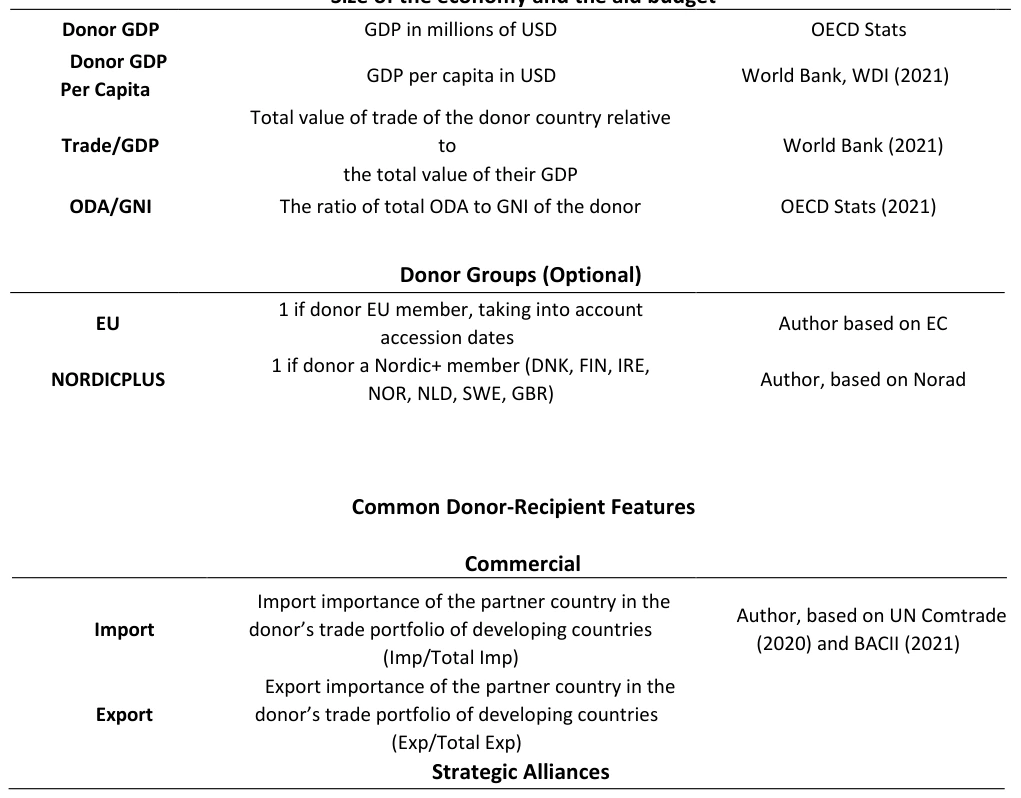
11 Commercial ties are calculated as a relative importance of a given ODA-eligible country in the overall trade portfolio that a given donor maintained each year. Geopolitical ties are represented through the standard indicator of political distances between country pairs, calculated based on the UN General Assembly voting patterns (Bailey et al. 2017). See Appendix Table 4, for a full list of variables and their sources.
12 I also rely on an alternative aid needs’ indicator, based on dynamic classifications of the recipients’ status into the four main categories used by OECD/DAC (OECD 2020).
On the donor side, I account for several features that are likely to explain some of the differentials in the use of multi-bi aid and the size of allocated contributions. This consists of donors’ total and per capita GDP, based on the expectation that larger and wealthier countries are more equipped to provide this type of funding. This is further nuanced through accounting for the development budgets available to each donor administration each year, represented as a share of total ODA to GNI (OECD/DAC 2019). In addition, considering the commercially attractive side of multi-bi funding, the openness of donors’ economies is captured as a share of total trade to GDP (WB 2020).
One important and typically neglected element of multi-bi aid allocation models concerns the implementing capacity of the multilateral institution involved. In other words, donors should be less attracted to multi-bi programmes in countries where the ILO has limited field presence. To proxy this factor, I account for the total multi-bi received by the ILO for a given recipient country during the period 2009-17, based on annual aid aggregates in the ILO’s donor dashboard (ILO 2020). This assumes that countries with larger multi-bi portfolios represent higher presence of ILO staff and operations on the ground. The model uses time dummies that can absorb the general effects of heterogeneity across the years.
The logic of the empirical approach relies on similar assumptions as the traditional gravity equation (Baier & Bergstrand 2003, 2007; Kareem 2013; Dür et al. 2014). However, instead of identifying factors that would make two countries exchange goods, the model is adapted to focus on donor and recipient characteristics that should create incentives and disincentives for the allocation of multi-bi aid. The explanatory factors enter a multiplicative gravity function that can be annotated in the following form:

CAID – country-earmarked contribution to a UN agency (commitments) X – vector of the explanatory donor features Y – vector of the explanatory recipient features Z – vector of common features between the donor and the aid recipient Β0-3 – vectors of coefficients, to be estimated u – standard errors i – donor country j – recipient country t – time expressed in years
Using the basic properties of the logarithms, the model is subsequently converted into a log-linear function:

To remove the bias resulting from many real zero values in the outcome variable (Figure 3), it is necessary to resort to estimation methods that can account for the twostep character of the aid allocation decision. The first step is whether donors allocate aid to a particular country; the second models the size of the allocated amounts. Based on discussion in the existing aid literature that deals with similar datasets (Cingranelli & Pasquarello 1985; Bérthelemy & Tichit 2003; Neumayer 2003; Canavire et al. 2006; Hoeffler & Outram 2011), I opt for the use of the Tobit model.14
Both the within- and between-effects are of interest, that is, the influence of relative differences in the labour rights’ indicator across the recipient countries on the allocation of multi-bi aid, and the donors’ reactions to changes in the levels of the LRI within individual recipients over time. This is especially important since the LRI for some individual countries are rather static across the years, and a reaction to annual year-onyear changes would imply an expectation of a really fine-tuned financing policy from the donors. This dual interest implies the use of a random effects model, which is also a better option considering the previously discussed censoring solution.15 The choice also fits well with the reasoning presented by Bell and Jones (2015) in general terms and Bagchi et al. (2016) in the context of aid allocation models.16
It is also necessary to consider donor heterogeneity at the level of the outcome variable. To make the multi-bi contributions comparable across the donors, the standard practice of to express them as a share of a donor-specific denominator: usually the size of annual total ODA. However, Reinsberg and Eichenauer (2017) caution against this practice and argue for the use of nominal values, as with the variations of ODA budgets across the years, it is hard to separate the effects of changes in the sizes of allocated aid (the numerator) from the changes in the size of ODA (the denominator). To overcome this problem, I express all multi-bi allocations as relative to the total of all multi-bi aid allocated by each donor to the ILO during the period 2009-17. This prevents the variations of the denominator and accounts for donors’ idiosyncratic use of the ILO’s multi-bi channel as a financing tool.

14 This implies the assumption of an equal influence of the explanatory factors on the first and second step of aid allocation since the Tobit estimation averages effects across its two steps of estimation. It also requires a particular treatment of the instances with zero allocations, which are automatically converted into missing values in the logarithmic conversion. I resort to one of the standard methods, which is to replace these missing values with a large negative constant that subsequently marks the censoring level.
15 Introducing fixed effects into the Tobit’s parametric maximum-likelihood estimation is complicated and results in biases of the estimates (Stata 2016).
16 Dreher et al. (2011) provide an extensive discussion on the limitations of the fixed-effects and noncensored methods for the modelling of aid allocations with scarce positive values of the outcome variable.
6. Results
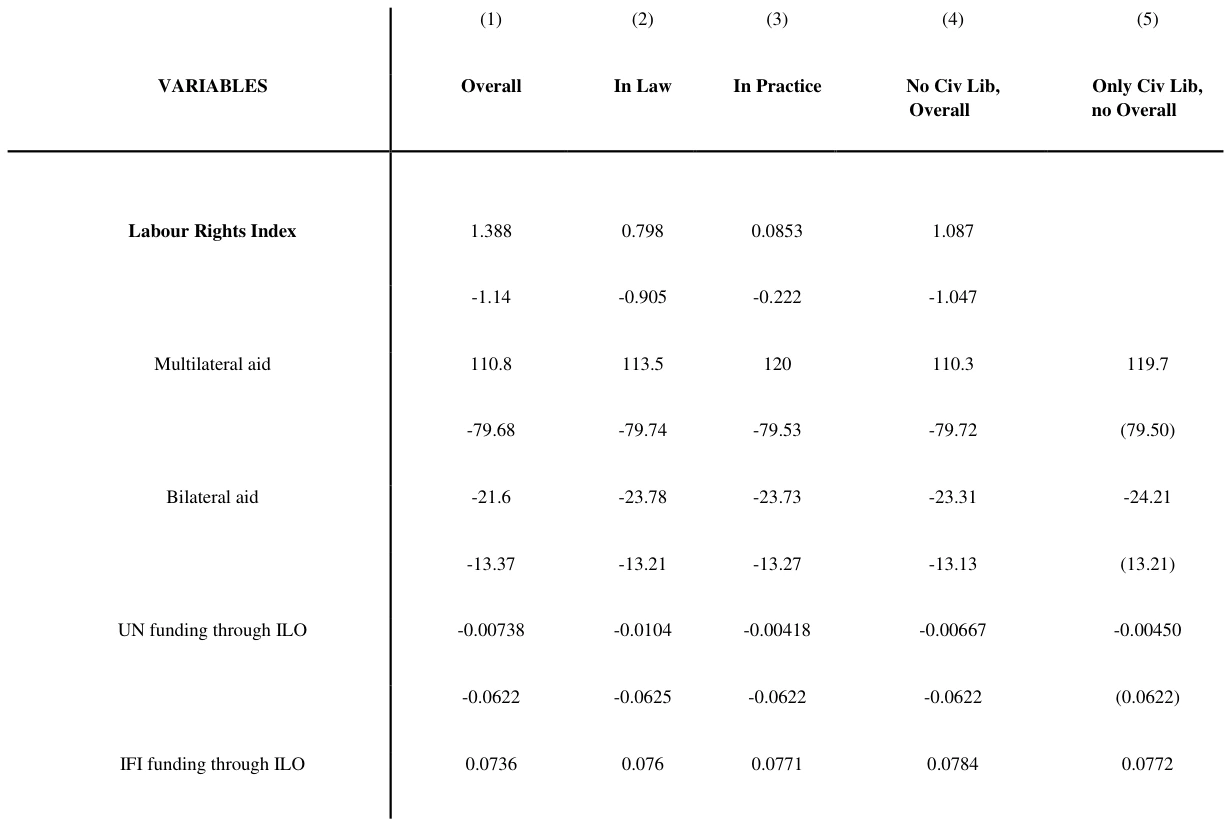
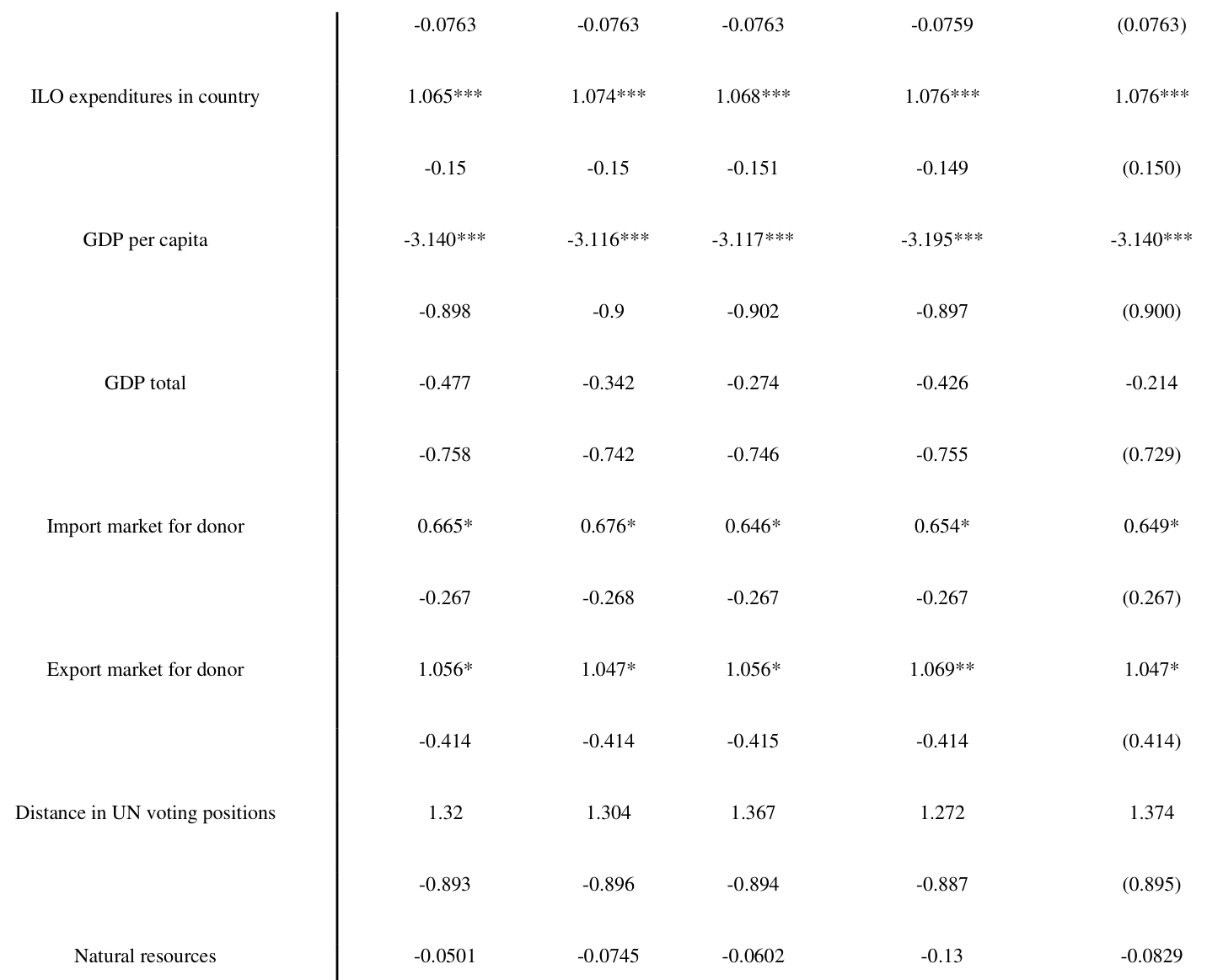
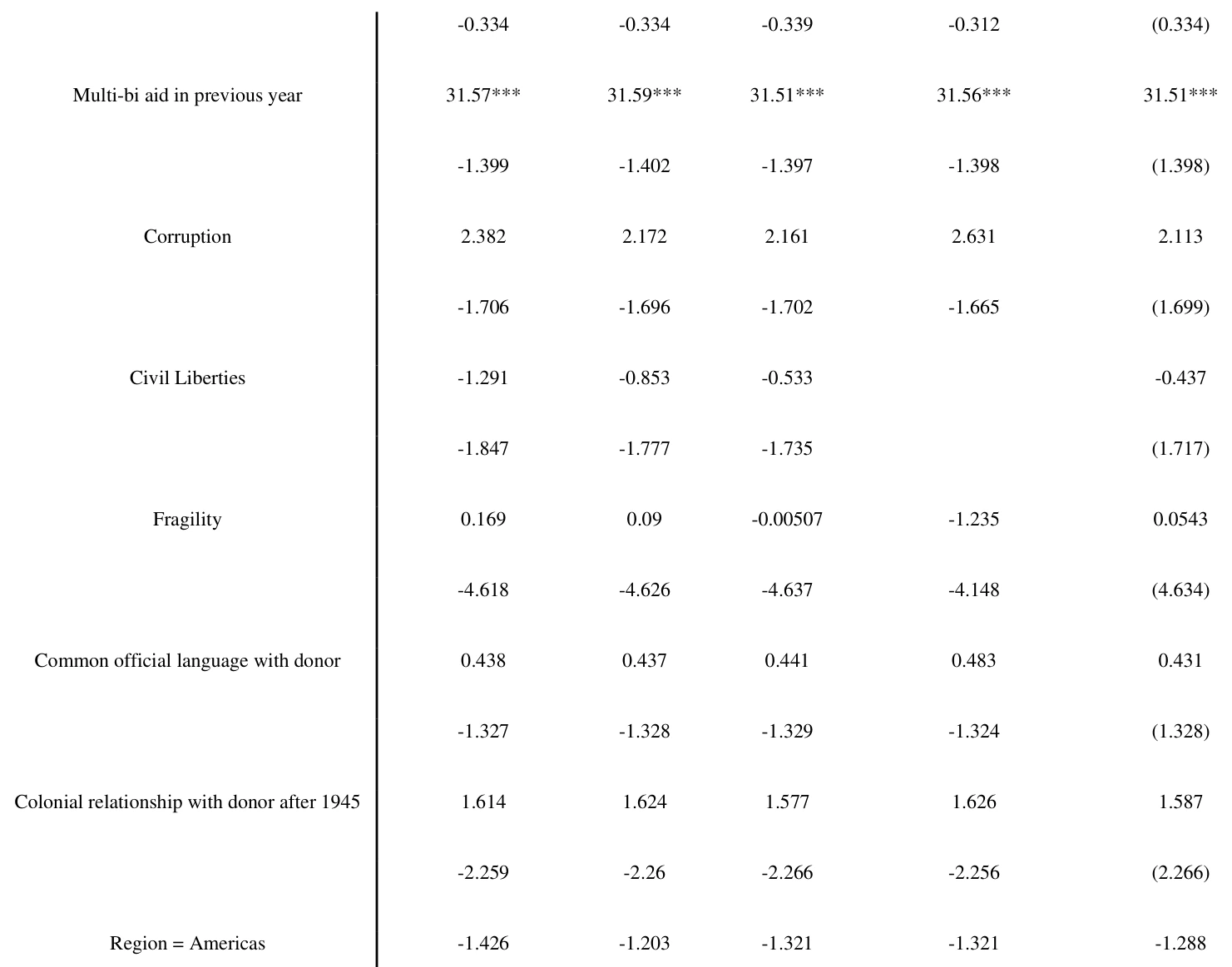
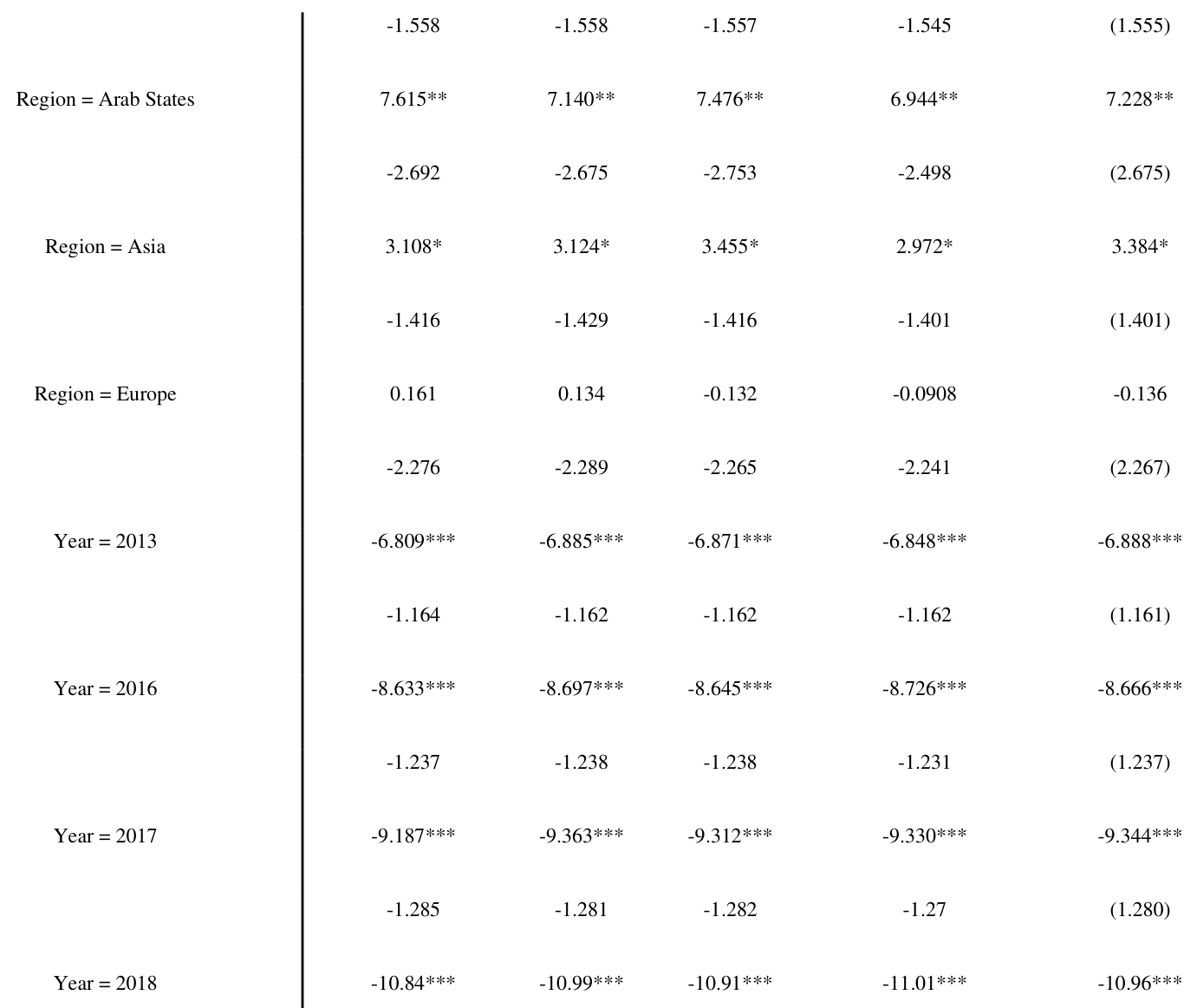
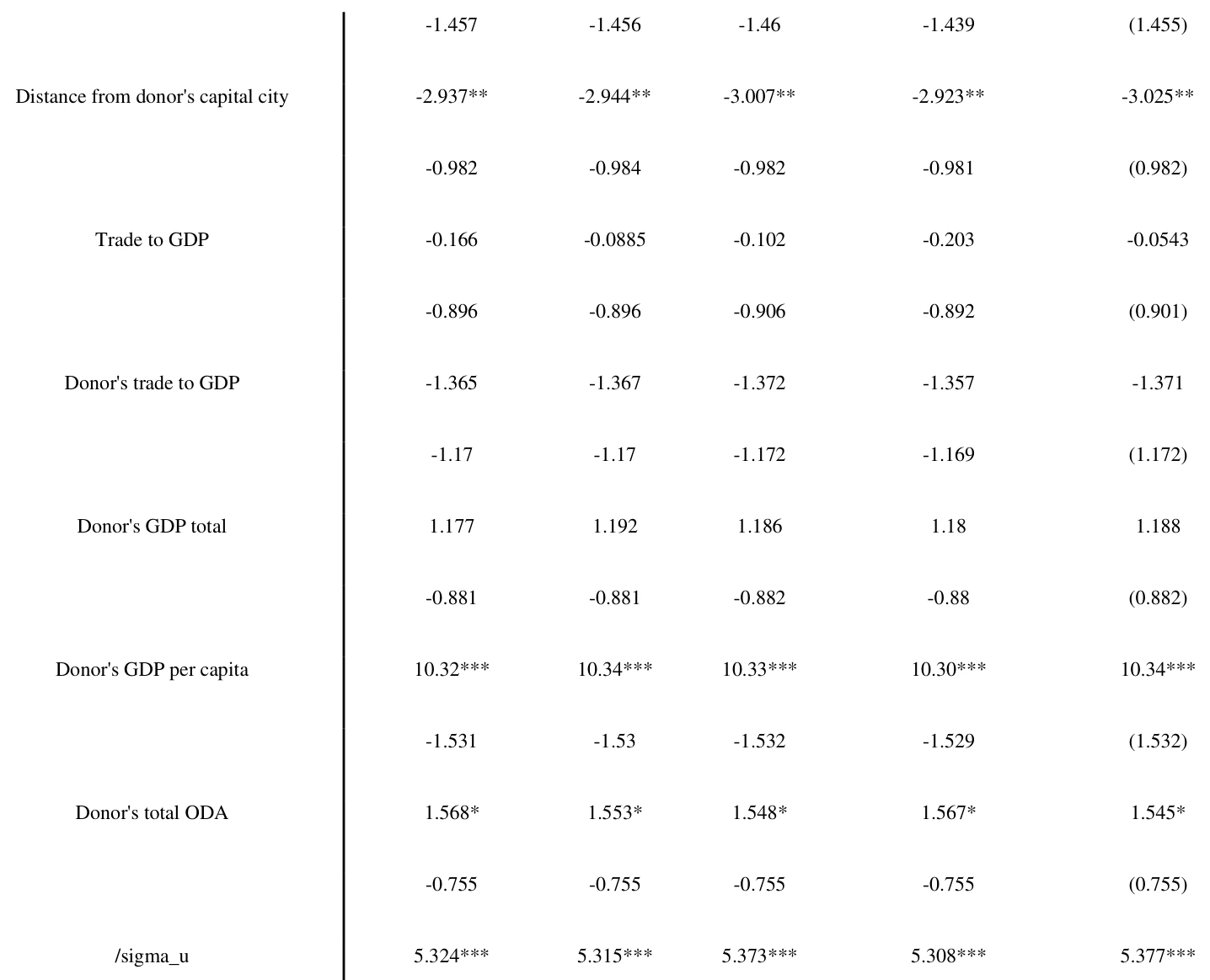
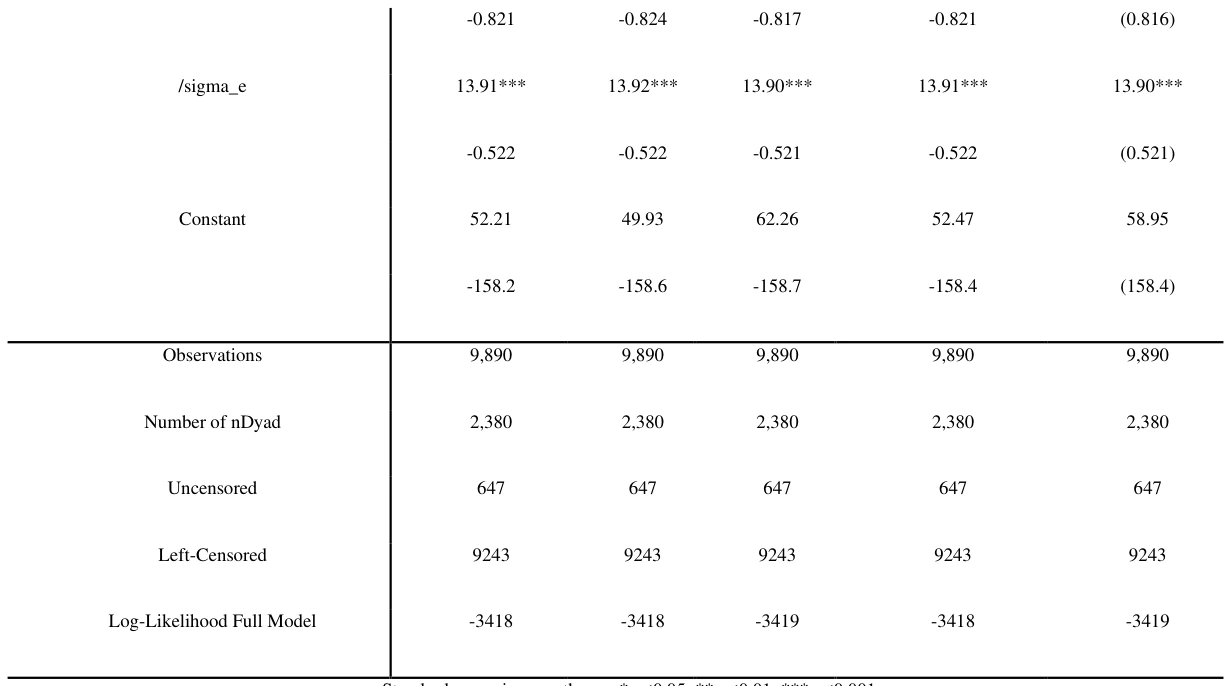
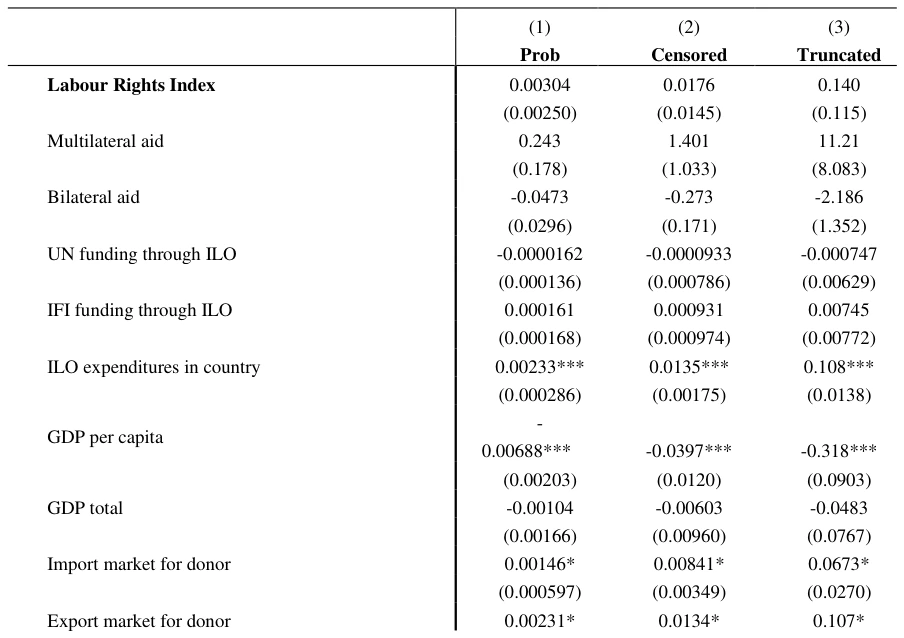
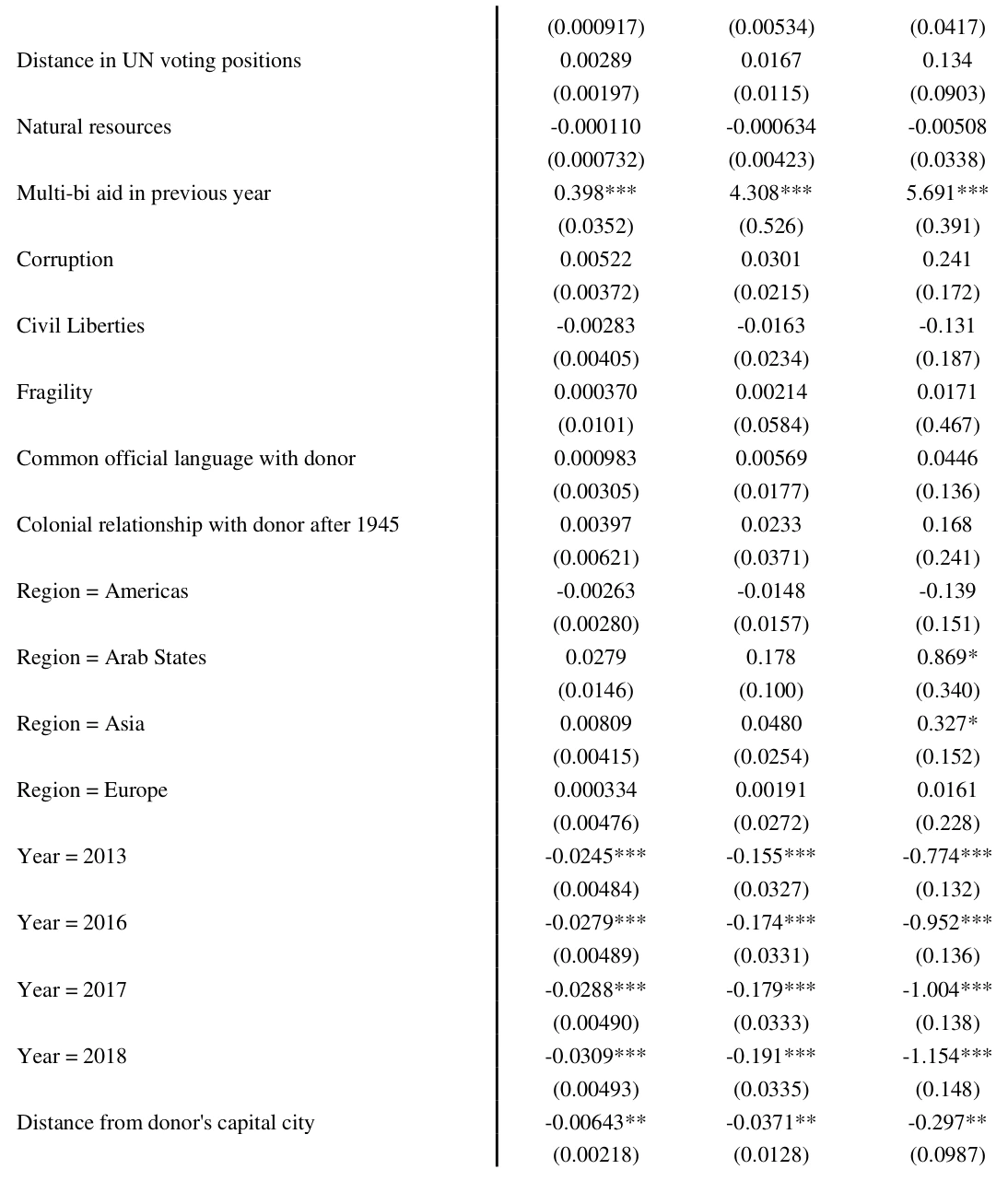
Table 1 presents the marginal effects of the main model specification, with more detailed results and technical discussion available in the Appendix (Table 4). The censored variable received most attention, as it represents the average effects among all countries, that is, those that received multi-bi aid and those that were eligible but remained unfunded. I start with a short overview of observations that go beyond the effects of the LRI.
(1) (2) (3)
Prob Censored Truncated
Labour Rights Index 0.00304 0.0176 0.140
(0.00250) (0.0145) (0.115)
Multilateral aid 0.243 1.401 11.21
(0.178) (1.033) (8.083)
Bilateral aid -0.0473 -0.273 -2.186
(0.0296) (0.171) (1.352)
UN funding through ILO -0.0000162 -0.0000933 -0.000747
(0.000136) (0.000786) (0.00629)
IFI funding through ILO 0.000161 0.000931 0.00745
(0.000168) (0.000974) (0.00772)
ILO expenditures in country 0.00233*** 0.0135*** 0.108***
(0.000286) (0.00175) (0.0138)
GDP per capita -0.00688*** -0.0397*** -0.318***
(0.00203) (0.0120) (0.0903)
GDP total -0.00104 -0.00603 -0.0483
(0.00166) (0.00960) (0.0767)
Import market for donor 0.00146* 0.00841* 0.0673*
(0.000597) (0.00349) (0.0270)
Export market for donor 0.00231* 0.0134* 0.107*
(0.000917) (0.00534) (0.0417)
Distance in UN voting positions 0.00289 0.0167 0.134
(0.00197) (0.0115) (0.0903)
Natural resources -0.000110 -0.000634 -0.00508
(0.000732) (0.00423) (0.0338)
Multi-bi aid in previous year 0.398*** 4.308*** 5.691***
(0.0352) (0.526) (0.391)
Corruption 0.00522 0.0301 0.241
(0.00372) (0.0215) (0.172)
Civil Liberties -0.00283 -0.0163 -0.131
(0.00405) (0.0234) (0.187)
Fragility 0.000370 0.00214 0.0171
(0.0101) (0.0584) (0.467)
Common official language with donor 0.000983 0.00569 0.0446
(0.00305) (0.0177) (0.136)
Colonial relationship with donor after 1945 0.00397 0.0233 0.168

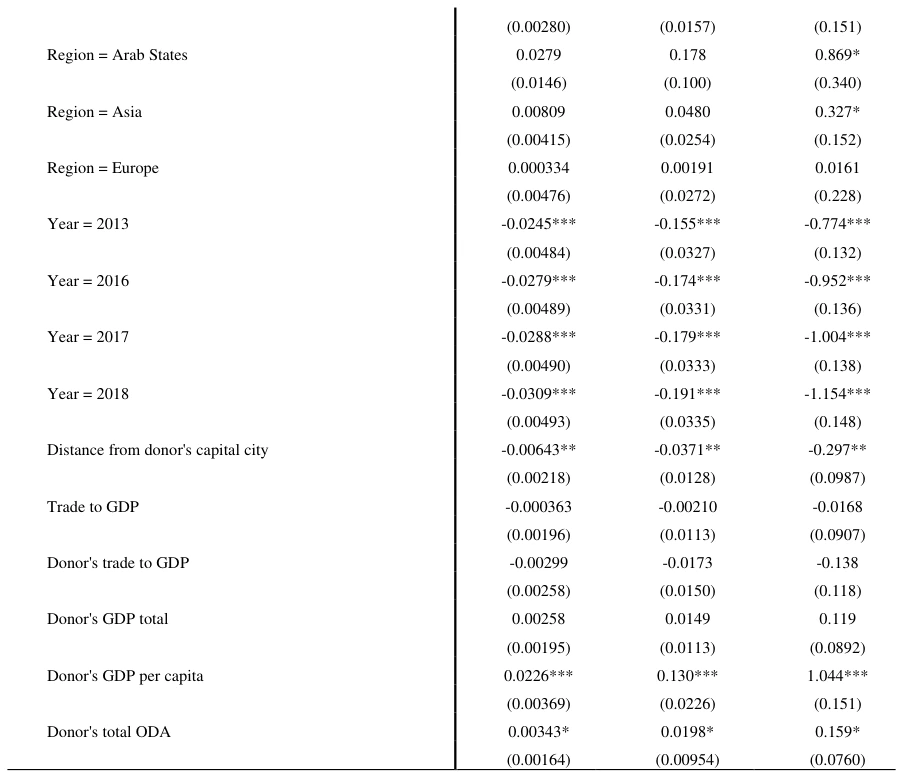
First, multi-bi is allocated to countries where the ILO has larger field presence, suggesting that the perceived local capacity is an important criterion from the donor perspective. This effect also likely captures the greater capacity of mobilising multi-bi funding by already large country teams, since local donor relations require significant investments of human resources in regular contacts and local networking. Multi-bi aid also “sticks” to the same recipient countries. An average size of multi-bi contributions is more than four times higher in counties that received multi-bi funding from the same donor in the preceding year, when compared with countries that did not receive anything in the year before. This speaks to the concept of bureaucratic inertia, that is, the fact that governmental structures tend to repeat the same annual patterns in their administrative decisions.
Second, multi-bi aid is driven by an interesting mix of altruistic and commercial motives. On the one hand, countries that are relatively poorer receive higher contributions through ILO’s voluntary funding programme. On the other hand, commercial relevance of developing countries for the donors is also an important factor, further confirming observations made in previous studies concerning the ILO and broader multi-bi datasets.
It is worth noting that, while both the importance as the donors’ import and export market results in larger multi-bi allocations, the effects are nearly twice as strong for exports.
Third, the physical distance of recipients from donor’s capitals has a consistently negative effect, suggesting that ILO’s field structure is not used by multi-bi donors as a means of outsourcing the delivery of their aid to harder to reach destinations. The distance effect also does not seem to relate to the commercial aspects, as interactions with import and export variables do not show any statistical significance.
Fourth, there are some important “absences” in the presented estimations. It seems that the allocations of multi-bi aid to the ILO does not reflect the overall patterns of multilateral and bilateral aid distribution, nor does it follow aid allocated to ILO’s country programmes through other UN organizations and the IFIs. This, combined with the earlier observation of significant importance of ILO’s field capacity, suggests that this type of funding is really provided to places where the ILO is seen as able to deliver and that this choice is agency specific. Combining this observation with the importance of import and export markets as multi-bi aid recipients could suggest the use of multi-bi programmes as a means of promoting agency specific standards in countries that are commercially important to the donors, and in which the ILO is seen as a multilateral partner capable to deliver results due to the size of its ongoing operations. Finally, on the donor side, both the size of ODA as well as relative affluence have a positive effect. In other words, ILO’s system of voluntary contributions is more attractive to wealthier countries and to those who generally spend more on aid.
Whereas these findings are interesting in the broader context of aid allocation discussions, the main variables of interest – the labour rights scores – never gain statistical significance in any meaningful specification of the overall estimation model. This is both the case when they enter equations as the main rights-related factor and when they are used as a complementary measure to the civil rights indicators. A significant effort is dedicated to econometric testing of the robustness of these “non-effects”.17
The absence of a systematic relationship between the amounts that get allocated to countries and the LRI fits well with the well-known complex picture of rights-related issues in donors’ funding decisions (Neumayer 2003a-c; Adhikari 2021), including the lack of a methodical approach to project selection based on rights-related criteria. While in the bilateral context this could be considered a question of idiosyncratic donor preferences, in multilateral normative settings it could have more serious consequences.
In historical terms, multi-bi aid constitutes a recent phenomenon that has been partially motivated by the opportunities of introducing bilateral donor preferences into the development programmes of multilateral organizations (Graham 2015; Reinsberg et al. 2015). Among over 240 multilaterals currently eligible to receive ODA (OECD/DAC, 2020), the ILO is among the very few institutions with a normative role tied to the broader human rights agenda, and an associated supervisory mechanism. This means that an explicit programming of aid in relation to ILO’s supervisory system would require additional donor effort, which can easily become administratively burdensome and inefficient. However, the long-term consequence of the dual funding stream created by multi-bi funds that do not connect with the core supervisory functions of the ILO could be a slow “hollowing-out” of the normative focus, with a gradual shift toward a more generally oriented development cooperation programme and a design of interventions that cater primarily to donor preferences.
17 See Appendix for more details.
On the other hand, one needs to critically consider whether an ideal relationship between labour rights and funding provided to ILO’s country-level assistance can be meaningfully established in monetary terms. In section 2, we discussed several arguments for which limiting funds in countries with human rights violations could be counterproductive to the rights agenda. However, in settings where such violations are persistent and severe, the benefits of the “bypass” option can also be limited by the absorptive capacity of the recipients. For trade union members that have been imprisoned following a Kafkaesque legal process or subjected to long term political persecution, additional funding and capacity building programmes can be of only partial importance, as the most important solutions are primarily of political nature. For example, one can imagine that for the leaders of the Solidarity movement in the early 1980s Poland, or the activists of the African National Congress during Nelson Mandela’s 27-year-long imprisonment, there was a limit to what could be achieved through additional donor funding for ILO’s TU activities. Therefore, it is possible that the political complexity and volatility of settings in countries with highest violations of TU rights does not allow for a systematic programming of aid allocations in a way that it can observed in the case of other parameters discussed in this paper, such as commercial importance, income levels of the recipient, or the overall presence of the ILO on the ground.
While donors might not use such fine-grained indicators as the LRI in their operational decisions, at the very minimum, it should become complicated for donor administrations to completely shy away from considering TU rights when funding ILO programmes in countries with flagrant, persistent, and publicly known violations. To verify this possibility, as the final step I explore the thematic focus of ILO’s multi-bi programmes implemented in countries that repeatedly received the maximum LRI score of 10 (Table 2).
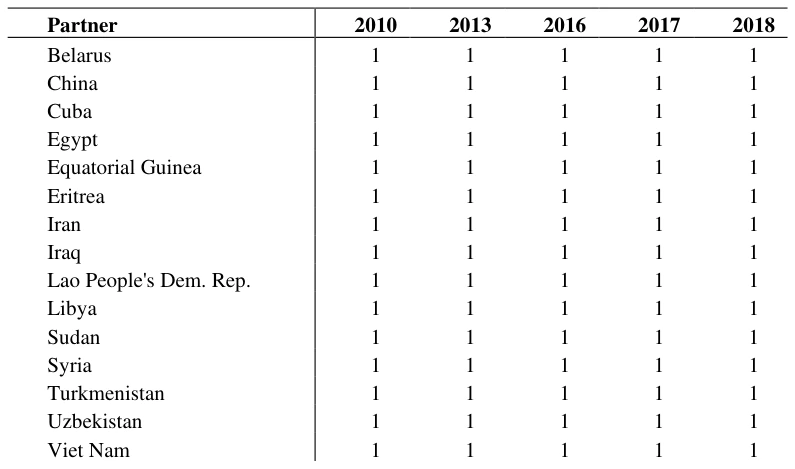
A simple thematic classification is introduced for all multi-bi projects, based on the ILO’s own linking to policy themes defined in its biennial Programme and Budgets. In a manual review of individual projects’ titles, a binary coding is used to reflect whether a given multi-bi programme directly dealt with the core rights of trade unions. While somewhat rudimentary, the method is quite efficient, as there are only a few thematic classifications that can receive a clearly positive score (Table 3).
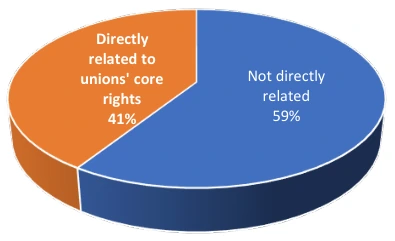
As shown in Figure 10, some 40 per cent of the total US$ 179 million received by those 15 countries were directly linked to the topic of TU rights. While the adequacy of this share can be debated, clearly the TU rights situation among those recipients was not completely ignored in donor decisions.
It is hard to judge to what extent the remainder of projects in this portfolio included some TU-related activities but given consistent “10” scores in those countries, it is possible that the question of TU rights was simply interwoven into the broader technical programmes, in line with the soft influence concept discussed in section 3. This is essentially the normative approach taken in the case of some recent development cooperation programmes, such as ILO’s technical cooperation programme in Qatar (ILO 2020), or the Trade for Decent Work project (ILO 2021). In both cases, the programmes take a broader thematic focus and introduce legal and technical assistance elements concerning workers’ voice and representation as one of the sub-components of the broader cooperation umbrella. To understand to what extent this is a standard practice in ILO’s intervention model would require a detailed qualitative examination of project documents and technical reports, which are not publicly available. A follow up to this exploratory study could consider a systematic review of such documents, alongside corresponding procedures that govern design of development cooperation programmes and their mandatory elements.
7. Final Discussion and Policy Recommendations
The focus of this paper was to theoretically consider and formally test the relationship between TU rights and donors’ aid decisions in the context of the ILO’s multi-bi programme. To the author’s best knowledge, it is the first study that links a quantitative representation of a normative multilateral function with voluntary and independent funding decisions of OECD/DAC members regarding the same institution. By doing so, the paper provides a contribution to the aid literature concerned with donors’ attention to human rights in recipient countries and to the broader literature on the effects multi-bi aid on normative institutions.
Several formal tests demonstrate that labour rights violations do not seem to have any systematic effect on multi-bi funding levels, neither across the ODA-eligible countries nor within the same countries over time. Nevertheless, it has also been demonstrated that a substantial share of the voluntary funded programmes implemented in countries with highest labour rights violations received a thematic focus related directly to strengthening of workers’ organizations. The paper also considered the theoretical advantages and disadvantages of a rigorous conditioning of aid allocation on recipients’ human rights status.
While a rigid system of rewards and sanctions might not be desirable, several recommendations can be put forward to further strengthen the link between the ILO’s supervisory system and donor funding channelled voluntarily through this organization.
Firstly, as shown in recent studies, bureaucrats of international administrations can play an important role in influencing development policies (Eckhard & Ege 2016), resisting donor interests and shaping funding decisions (Kennard & Stanescu 2019). Consequently, more could likely be done by ILO’s internal mechanisms to influence donor decisions in the ILO’s own portfolio and in other multilateral contexts. As the first step, this would require a better translation of the ILO supervisory system’s work into donor’s operational language and ODA realities. As of today, despite the transparency and public access of this information, the largely technical form of this content remains out of reach for operational staff of development cooperation programmes and donor representatives. If social dialogue is key to ILO’s delivery, and if the ILO’s own supervisory system regularly lists countries in which the levels of violations of TU rights does not permit for any viable forms of social dialogue to occur, such lists could be made more accessible to users in donor administrations without specialised legal training. As of today, the most accessible source of such information exists outside the ILO, in the form of a data visualising tool linked to the initial LR Index of Kucera & Sari (2019).18 The recent progress on the development of the SDG 8.8.2 indicator offers a significant promise in this regard, however, more could be done to visualise its contents and bring it to the centre of negotiations with ODA funding partners.
Secondly, information on TU rights could be more explicitly tied to the design on DC programmes, including the possibility of mandatory TU rights-related components in countries with highest violation scores. Working through the increasingly harmonised UN and multilateral assistance at the country level, the ILO could try to also use this information to influence the design of multi-bi programmes implemented by other UN agencies. Given the international consensus on the importance of social dialogue to a successful implementation of development programmes related to labour markets, other multilateral players should be equally concerned about the potentially negative impact of TU rights’ restrictions on the success and efficiency of their own development efforts. This would also highlight the value added to the multilateral system of the ILO’s normative role, clearly recognized by the recent donor-driven MOPAN assessment of the ILO (MOPAN 2021).
Thirdly, and perhaps most importantly, more could be done by the donors. In particular, the responsibility to follow the normative work of the ILO and development cooperation funding is often assigned to different branches in donor administrations, with the former covered by the ministries of labour, and the latter through the ministries responsible for ODA.19 This means that, compared to a typical aid allocation process, incorporating observations of the ILO’s supervisory system into a decision chain would imply a more complicated procedure and a closer cooperation among the ministries involved.20 Such processes become particularly challenging when faced with regularly rotating staff of the foreign service and the increasingly decentralised character of donor decisions. In addition, the notion of filtering target countries based on ILO’s supervisory system stands in conceptual contrast to today’s typical practice of establishing priority countries in donors’ development strategies. Because of this practice, only countries that qualify for aid on a given donor list can be reviewed based on rights-related criteria, often limiting such considerations to only a few possible targets, and leaving many most urgent cases aside. One possible solution could consist of the establishment of specific rights-oriented aid instruments, designed in a way that allows for a specific funding of TU rights-related elements in broader multi-bi programmes.
18 See Center for Global Workers’ Rights: https://www.dept.psu.edu/liberalarts/WorkersRights/. 19 Ministries of foreign affairs, ministries of development, or an independent development agency, depending on a particular donor setup. Refer to Dietrich (2021) for a discussion on different way of organizing donor administrations and the impact of such structures on aid allocation patterns.
20 In particular in coalition governments, where such political posts might be distributed across different political parties, this type policy coherence might be harder to achieve.
The ILO’s supervisory system constitutes a rare element in today’s complex multilateral architecture. A more systematic integration of its observations made regarding TU’s rights situation in a given country context could offer many potential benefits. At the very minimum, it can be used as a free and credible context analysis tool, which can enhance the fit of development programmes into the local development and socio-political contexts. In the long run, its more consistent use by all parties concerned with multi-bi aid would lead to reinforcement of an important element of the international system of human rights. While this might come with some additional complexity and costs, it certainly seems worth the investment, given the recent trends of challenging the legitimacy and usefulness of the international normative mechanisms, even by some traditionally rights-oriented member states of the UN.
Acknowledgements I would like to thank Janine Berg for her support in the preparation of this paper and for her patience with numerous detailed reviews of its much weaker drafts. I am also grateful to several colleagues at the ILO for their useful comments and suggestions, in particular to David Kucera and Dora Sari, for their inputs concerning Labour Rights Indicators, to Karen Curtis for her detailed legal comments on the functioning of ILO’s supervisory system, and to several anonymous reviewers in ACTRAV team, who provided consolidated technical comments under the leadership of Maria-Helena André.
Disclaimer The views expressed herein are those of the author and do not necessarily reflect the views of the International Labour Organization.