 Journal of Global Trade, Ethics and Law
1. Introduction
1.1. The Duality of South Africa’s Economy and Governance Conundrum
The structure of South Africa’s economy is characterised by a deep and enduring dualism, where a sophisticated, capital-intensive formal sector integrated into global value chains coexists with a vast and diverse shadow economy, used here descriptively, comprising both survivalist enterprises (the informal sector) and illicit forms of trade (Irish-Qhobosheane 2024a). This divide is a direct legacy of apartheid’s exclusionary economic architecture, a legacy compounded by the failure of post-apartheid growth strategies to achieve inclusive development (Hausmann et al. 2023). With official unemployment at 33.2% and youth unemployment at 62.2% in the second quarter of 2025 (StatsSA 2025a), millions of people rely on informal activities, including street vending, home-based services, cross-border trading and artisanal mining (Etim and Daramola 2020). Statistics South Africa estimates that the informal economy provides primary employment for about 3.3 million people, or 19.8% of the workforce (StatsSA 2025c). When factoring in dependents and broader informal activities, this sector supports approximately 13.4 million people (FinMark Trust 2024). These survivalist forms of labour provide income in the absence of formal alternatives, but are persistently “marginalised and overlooked” (Etim and Daramola 2020, 212).
In contrast, illicit markets, such as counterfeit alcohol, smuggled tobacco and uncontrolled mining, are extensive and highly capitalised, exploiting state incapacity and regulation gaps (Irish–Qhobosheane 2024a; National Treasury 2024; Thomas 2021). While both spheres operate in the shadows of the formal economy, their moral, operational and economic characters are fundamentally distinct. The informal sector represents a realm of survival and resilience, while illicit trade represents one of predation and profit. A study by Ngarava et al. (2022) found that COVID-19 lockdown shocks negatively impacted listed firms in this space, revealing potential vulnerabilities that predatory actors can exploit. This presents a significant dilemma for post-apartheid governance. While the informal-illegal link may provide the poor with life-saving assistance, it is simultaneously undermining the legitimacy and authority of the state. Nonetheless, it is also common for public discourse and state policy to treat these distinct moral and operational economies as the same. This stance persists despite clarification by the 17th International Conference of Labour Statistics that illicit businesses, such as drug dealing, fall outside the definition of the informal sector (Etim and Daramola 2020).
This paper argues that the blending of informal and illicit economies is not an analytical mistake or capacity failure but rather a deliberate form of governance. This structural design allows the state to manage populations by selectively applying the law, creating a zone of disorder where its power is reconfigured through opacity (Agamben 2005; Roy 2005). While politically convenient, the blending of the informal economy with illicit trade is analytically flawed and ethically unsustainable. The problem is clearly visible in Cape Town, where a “menacing shadow economy” extorts money from businesses (Irish-Qhobosheane 2024a, 2), demonstrating predatory illicit trade that must be distinguished from, not conflated with, survivalist informal economy activity. Yet, the very size and significance of the informal sector are sites of intense political struggle, with competing data sources revealing a fundamental conflict over which economic activities are counted as legitimate (Ohnsorge and Yu 2022; Rogerson 2000). As explored in Section 5, this statistical contest is not only a technical struggle but also a biopolitical struggle over economic visibility and value.

Non-official sources estimate that informality accounts for approximately 30% of the business landscape, with Micro, Small and Medium Enterprises (MSMEs) comprising the majority of informal businesses. These estimates encompass all informal economic activity and related livelihoods, indicating that the sector sustains up to 42% of the workforce (FinMark Trust 2024). Official data show that the sector’s contribution to GDP exceeds 5% (StatsSA 2021). It also accounted for 19.8% of total employment in the second quarter of 2025 under a narrow definition (StatsSA 2025c). Depending on the definition of unemployment used, there have been, on average, between 2 and 3.3 times as many unemployed people as persons employed in the informal sector since 2008. This ratio demonstrates that the informal economy is not an automatic absorber of the jobless (Burger and Fourie 2019). Macroeconomic evidence indicates that significant entry barriers prevent this transition (Burger and Fourie 2019), rendering it a precarious haven for those already inside but a fortress for many outside. This divergence in measurement reflects a political contest over how economic informality is defined and valued (Ohnsorge and Yu 2022; Rogerson 2000), a theme explored in depth later in this paper.
1.2. Operational Realities and Theoretical Framework In relation to the mainstream economy, survivalist sectors function as “rebellious economies” (Roy 2005, 148) and fill the regulatory void left by an exclusionary state. While sharing some of these features, illicit trade exploits regulatory vacuums and funds criminal syndicates. It also deepens institutional decay, a crisis reflected in South Africa’s ranking of 60th out of 158 countries on the industry-linked TRACIT Illicit Trade Index (TRACIT 2025a, 2025b). Irish-Qhobosheane (2024a, 2) argues that the Western Cape has “a long history of gang violence and extortion.” This reality has given rise to competing systems of power, leaving street vendors vulnerable to frequent harassment or arrest. By contrast, smuggling operations are allowed to thrive under the protection of institutions (Beetham 2013; Chipkin and Swilling 2022). The pandemic clearly exposed this contradiction: even well-meaning state measures, such as the ban on tobacco and alcohol (March–August 2020), unintentionally expanded illicit markets overnight, increased health risks and cost the state billions in lost tax revenue (National Treasury 2024; Vellios et al. 2024).
Moreover, municipalities and state restrictions ironically criminalised law-abiding persons and empowered illegal networks (Kotzé 2023). The fiscal impact is substantial: official tax-gap estimates confirm a significant loss of state revenue, while industry-funded assessments are used illustratively to describe sectoral disruption rather than to establish baseline figures (DFSA 2025). Given that many illicit consumers of alcohol also reported affordability as the main reason for their offence (Mashamaite 2024), both scenarios show how rigid, poorly calibrated enforcement fuels exclusion, erodes state authority and blurs the line between survival and organised crime. As a result, blanket enforcement during the 2020 crisis eroded public trust, criminalised survivalists, created opportunities for illicit actors and worsened public health risks for the poor (Seekings 2022; Witt and Nagy 2021). This inconsistency fractures the state’s authority. When citizens witness the state harshly evicting a street vendor while turning a blind eye to a protected smuggling ring, it reveals a sovereignty that is not just weak but complicit. While the traditional legitimacy of the state is closely linked to legal and bureaucratic authority (Beetham 2013; Guzman 2007), post-colonial critiques argue that this may not be enough to upgrade the informal sector (Grindle 2004).
Indeed, in post-colonial states, such as South Africa, where the state has historically been an instrument of exclusion, legitimacy is partially dependent on perceptions of fair, responsive and representative governance (Ferguson 2006; Mamdani 1996). When the state fails to provide this, informal traders establish parallel governance structures, such as street committees and informal credit systems, to fill the void left by the state. This act of societal organisation forces the state into an unstable dialectic of tolerance, co-optation and repression. As this paper will argue, untangling this nexus requires a fundamental ethical shift: the state must learn to distinguish acts of sheer necessity from systems of organised exploitation. Failure to do so carries substantial social, economic and human costs, as demonstrated in the sections that follow.
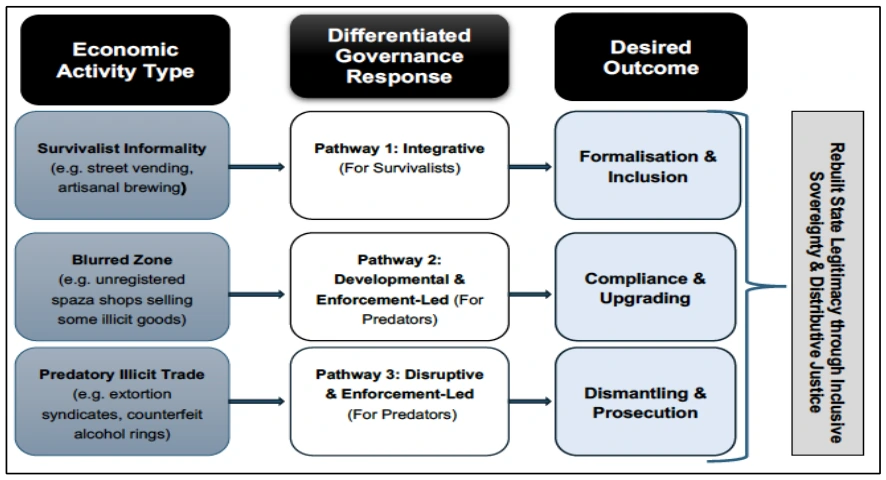
1.3. Research Outline Building on Roy’s (2005) view that informality is an assertion of state power rather than a “state of exception,” this paper advances a differentiated governance framework (see Figure 3) to disentangle the informal-illicit nexus. After establishing an ethical and theoretical position (Sections 2-3) and examining the colonial continuities and terrains constructed by the state that shape this context (Sections 4-5), it analyses systemic drivers and implications of predatory trade (Sections 6-8) and offers nuanced ethical pathways in Section 9. Finally, the discussion concludes that this differentiated approach is crucial to shifting the exercise of state authority from repression to post-colonial and inclusive sovereignty, which is essential for producing a decolonised post-apartheid social contract.
2. Data and Methodology
This paper uses a critical political economy framework to analyse the governance of the nexus between South Africa’s informal and illicit economies. The research design triangulates qualitative analysis of policy documents, academic literature and case studies with quantitative data from both national and international sources. The research employs a comparative case study approach to examine the informal-illicit nexus through two distinct cases: (a) the COVID-19 Alcohol and Tobacco Bans (2020) and (b) Cape Town’s Extortion Economies (2023-2024). The 2020 bans served as a critical juncture that revealed the state’s failure to differentiate between survivalist, informal and predatory illicit markets, as evidenced by impacts on revenue and public health (Vellios et al. 2024). Conversely, the Cape Town extortion case demonstrates the entrenched reality of a mature illicit economy, where violence and corruption thrive amidst persistent governance gaps (Irish-Qhobosheane 2024a). Triangulation assesses both policyinduced and structurally embedded market failures.
The study’s primary contribution is conceptual and qualitative, advancing a critical political economy analysis of governance in the informal-illicit nexus. This conceptual framework is substantiated and given empirical weight through the rigorous integration of quantitative evidence. To achieve this, a variety of data on the size of markets, employment, losses of taxes and health impacts (2019–2025) were gathered and triangulated from various sources, including primary quantitative data and reports published by national official institutions such as Statistics South Africa (StatsSA), South African Revenue Service (SARS) and the National Treasury, international organisation reports such as the World Health Organisation (WHO), independent research such as the Global Initiative Against Transnational Organised Crime (GI-TOC) and academic literature. To maintain data integrity, all quantitative figures and monetary values, such as market values, tax losses and contributions to GDP, are presented as outlined by the source (with the collection year clearly identified) with no inflation adjustments applied. This provides the reader with a sense of the context, justifications and methodology behind the data.
It is important to note that the data exhibited methodological divergence in measuring illicit and informal activities. To address this divergence, a clear hierarchy for adjudicating between the sources was identified, as follows: (i) Official primary data; (ii) Peer-reviewed academic studies; (iii) International organisation reports; (iv) Independent non-governmental organisation (NGO) reports; (v) Industry-funded reports (to be used with caution and qualified in the main text, primarily to contextualise sectoral impacts and upper-bound estimates rather than to define baseline or global scale); and (vi) Quality journalism (for illustrative quotes, but admittedly not core statistics). Where inconsistencies were found in the quantitative data for a variable, such as the illicit share of the tobacco market, the metric was presented as a range to indicate the uncertainty. Notably, data on illegal trade and the shadow economy more generally were affected by “a lack of reliable data” (Vellios and van Walbeek 2024, 17). Tables 1 and 2 have been constructed with precise, cell-by-cell citations. A detailed codebook of variables, a case selection rationale and a data harmonisation protocol are provided in Appendix A to ensure transparency and replicability.
The analysis is grounded in Rawlsian theories of justice (Rawls 1971) and post-colonial critiques of state sovereignty (Mamdani 1996; Roy 2005), utilising distributive justice and the decolonisation of governance as central analytical frameworks.
3. Ethical Frameworks: Survivalism vs. Predation
From an ethical perspective, survivalist informality is generated through structural exclusion and the need to secure livelihoods amid South Africa’s conditions of high unemployment, poverty and inequality. Street vendors, artisanal brewers and informal miners do so in search of legitimacy in territories of exception (Roy 2009; Sotomayor 2015), where informal economies substitute for missing governance. For example, traditional homebrewing of beer often poses low health risks when regulated by community norms (Rogerson 2019). This informal survivalism embodies the moral ethics of Ubuntu, ‘umuntu ngumuntu ngabantu’ (I am because we are), in which informal credit is applied to sustain communities abandoned by the state (Boswell 2016). This standpoint enters into a critical and complementary dialectic with Rawlsian notions of distributive justice.
While Rawls (1971) emphasises institutional fairness and distributional equality, the communitarian philosophy of Ubuntu offers a pre-institutional moral foundation for governance. This relational ethics shifts the focus from mere procedural justice to a mandate that the state recognise the intrinsic dignity of the informal actor as a precondition for legitimate governance (Hofmeyr 2025). Thus, this fundamental respect for personhood must extend into the economic realm, challenging the punitive, exclusionary justifications of colonial-era fiscal governance that historically and in its modern form, criminalise poverty (Boswell 2016). The state systematically denies this dignity by rigidly categorising legal status to demarcate legitimacy from criminality. Safit (2013, 78) emphasises the “ethics of survival” as a defining element of humanity during systemic breakdown, stressing relational responsibility. The pandemic’s real shock was not just the virus, but also the state’s response. When 648,000 formal jobs vanished overnight (StatsSA 2020), the state’s prohibitions effectively criminalised the only remaining survival strategies for millions, transforming economic necessity into a moral choice between starvation and illegality. Therefore, ethical governance must be rooted in this fundamental recognition before any push for formalisation can be considered just.
In sharp contrast, predatory illicit trade has a singular goal: maximising profit by exploiting a relationship with the state through violence (Irish-Qhobosheane 2024a). For extortion syndicates and smuggling networks, violence is not a matter of primordial criminality but a weapon they use to sever community bonds. Furthermore, it not only breaks the community apart but also reactivates the ancestral trauma of colonial subjugation (Fanon 1963). Survivalists foster collective resistance, while predators weaponise social fragmentation through violence to exert control, creating a predatorprey asymmetry. For example, the alcohol ban mistakenly equated survivalist homebrewers with predatory suppliers of toxic methanol-laced alcohol. This action sparked a fear-driven polarisation that ultimately atomised social trust and worsened the public health crisis (Kotzé 2023). Predatory violence becomes an anti-Ubuntu paradigm, systematising a de-socialisation process that severs community bonds and social trust, characterising survivalist informality (Hofmeyr 2025).
4. The Coloniality of Informality: Beyond Rational-Legal Authority
While Max Weber envisioned the modern state as holding a monopoly on legitimate violence within a rational-legal framework (Guzman 2007), the current South African government must manage an informal economy that the apartheid regime intentionally created to marginalise and disempower (Bhandar 2018; Rogerson 2000). Rather than simply indicating state failure, informal economies operate under a selective and inconsistent legal framework. Thus, the state gets to regulate some actors while leaving others, particularly elites or criminal networks, largely unchecked (Rogerson 2000; Roy 2005). Through statutes such as the 1913 Natives’ Land Act that facilitated the dispossession of Black communities, the central project of the apartheid system was to validate its purpose by establishing a permanent, legally codified informal periphery (Mamdani 1996). Contemporary governance operates through a modality that perpetuates the selective non-enforcement of law, where some are punished and others are empowered to act outside legal boundaries. This continuity explains the enduring colonial power structures and contributes to a credibility crisis that lies beneath the post-apartheid state’s purported rational-legal authority.
South Africa’s incoherent institutional architecture means that the state does not effectively wield the Weberian monopoly on legitimate power (Guzman 2007). This failure is quantifiable in an illicit economy that drains at least an estimated ZAR 100 billion annually, according to official SARS tax-gap estimates. Industry-linked assessments, such as TRACIT, are used illustratively to corroborate scale rather than to establish baseline magnitude, highlighting the resulting fiscal strain and public service delivery pressures (SARS 2020; TRACIT 2023). This scenario arises not only from an institutionally weak state but is also part of a causal chain which originates from apartheid, which systematically excluded Black people from formal engagement with the economy. While the legitimacy of post-colonial states depends on inclusivity (Ferguson 2006; Mamdani 1996), South Africa remains constrained by colonial laws governing survivalist informality, leaving it vulnerable to control by corrupt and illicit economies. The outcome is the intensification of historic precarity for Black and marginalised workers, who are positioned within the global precariat, a class characterised by unstable earnings and limited protections (Standing 2011). This pervasive and long-term precarity, a persistent condition in the Global South (Meagher 2019), highlights critical gaps in contemporary labour laws and underscores the need for a renewed focus on building state capacity and promoting labour rights protections.
4.1. Historical and Structural Foundations of Informality in the Global South
Informality is an enduring legacy of colonial labour frameworks (Meagher 2019). Colonial regimes systematically dismantled indigenous economies and established racialised labour systems. This framework ensured that formal protections and benefits were secured exclusively for settler communities, relegating subjugated populations to precarious, survivalist work (Mamdani 1996). Contemporary neoliberal policies, including privatisation, austerity and deregulation, function as post-colonial reconfigurations of this exclusion, expanding the “reserve army of labour” essential to capital accumulation (Falavina and Ulbricht 2025). Far from being marginal, these informal spaces constitute strategic resilience: marginalised communities utilise social networks and adaptive knowledge to navigate economic apartheid, subverting regulatory frameworks designed to suppress autonomous local economies.
Informality is, thus, a structural inevitability within systems built on inherited hierarchies of economic personhood. In reproducing the “coloniality of power” (Ndlovu-Gatsheni 2013), state practices perpetuate inequalities that persist beyond formal decolonisation, embedding racialised hierarchies and dependency into governance and policy. Through this mode, the state enacts what Sabelo Ndlovu-Gatsheni (2013) calls the “myths of decolonisation,” as post-apartheid institutions replicate colonial rationales by relegating Black communities to zones of non-being, while enabling elite extraction. Key actors in the informal economy, such as ‘pirates’ (taxis) and ‘disturbers’ (spaza shops), continue to face serious barriers due to punitive laws and invisibility in statistics (Desrosières 1998; Mongwe 2024). As a result, the state’s sidelining of Black economic activity increases patterns of colonial exclusion, which in turn weakens state credibility and deepens the governance crisis.
Conventional policy narratives position informality as a purposeful circumvention of state regulation and claim that its formalisation is essential to creating egalitarian, regulated markets (Chen 2012; Perry et al. 2007). However, these efforts tend to fail because state authority relies on the very ambiguity that formalisation would erase (Skinner 2018). This state indeterminacy is not a legal lacuna but a mechanism for social control, created to keep populations in perpetual negotiation with power (Rogerson 2000; Roy 2005). This is quite evident, for instance, through the state’s intentional selection and sanctioning of legitimacy, where it mediates the illegal elite land grabs while simultaneously ordering squatter camps to be demolished for access to the same land. As a result, informality persists because the state relies on the shadow economy to sustain clientelist networks and avoid redistributive duties (Sarkar and Sinha 2022). Within this state of exception, relational practices of informal labourers and their self-organisation can be understood as subaltern agency and alternative forms of infrastructures (Roy 2005). Nevertheless, this precarious autonomy is constantly undermined by state harassment and evictions, which resuscitate the motivations of dispossession that the post-colonial state claims to interrupt.
4.2. Informality as a Selective Suspension of Law
Empirical evidence shows that attempts to formalise informal property systems are not simply a technical matter but sites of intense political contestation (Sotomayor 2015). The persistent criminalisation and marginalisation of informality by post-colonial states, despite its role in sustaining millions, demonstrate the enduring operation of colonial governance paradigms (Rogerson 2000). This means that formalisation policies promoting registration, standardisation and taxation impose a Eurocentric fiction of order that disregards the lived realities of informal actors (Ferguson 2006). Viewing informality through an Agambenian lens reveals why these formalisation efforts, such as the International Labour Organisation’s Recommendation no.204 on Transition from the Informal to the Formal Economy, consistently fail (ILO 2015). They mistakenly attempt to integrate activities that the state’s sovereign power has deliberately placed in a zone of legal indifference. This is not benign neglect but active exclusion: it involves enforcing bureaucratic models alien to local practices while maintaining the racialised property rights, land dispossession and financial exclusion that create informality (Bhandar 2018).
Ultimately, formalisation policies that impose a Eurocentric model of property and order inevitably fail because they attempt to regulate activities that the state’s sovereign power has deliberately placed in a zone of legal indifference. The resulting marginalisation stems not from innocuous neglect but from active structural exclusion. The criminalisation of informality exposes the coloniality of state sovereignty, where actions like demolishing informal settlements re-enact the antiquated practices of dispossession from the past. Within this state of exception, informal actors nonetheless build alternative social infrastructures, such as kin-based credit systems, which constitute a form of subaltern political agency (Chatterjee 2011; Roy 2005). Recognising this agency is the first step towards a governance model that does not merely seek to formalise, but to integrate justly.
5. The Indeterminate State of South Africa’s Informal Economy: Measurement, Legitimacy and Ethical Governance
The conceptual and statistical indeterminacy of South Africa’s informal economy is a critical indicator of deeper, unresolved biopolitical struggles for economic legitimacy (Agamben 2005; Foucault 2009). A public dispute over unemployment figures in mid-2025 demonstrated that they are not neutral. In this instance, a Capitec Bank executive claimed a “real” 10% unemployment rate based on transaction data, which directly contested StatsSA’s official unemployment rate exceeding 30% (Khumalo 2025; Magubane 2025), revealing how measurement methodologies become sites of political contestation. The labour minister urged the collection of more nuanced data to capture informal livelihoods, while the trade minister stressed the sector’s long-understated role (Magubane 2025). However, StatsSA (2025b) defended its adherence to ILO standards, which formally include informal work, such as street vending, home-based services and unregistered micro-enterprises, within employment tallies. This methodological stalemate signals a far more serious crisis. The epistemic visibility of informal work remains disputed, even when technically “counted,” because survivalist activities frequently evade rigid survey instruments that require structured hours, tax IDs or formal business registration (Khumalo 2025).
As argued, this measurement conflict represents a biopolitical struggle over whose labour is counted and valued. From a post-colonial perspective, the ‘othering’ of the informal sector through statistical erasure or marginalisation can be seen as a form of epistemic violence (Spivak 1988). State-sanctioned metrics have historically dismissed the survival strategies of subaltern groups as illegitimate, thus reinforcing a neocolonial economic order that sustains racialised hierarchies of economic personhood (Bhandar 2018; Quijano 2000). Informality is, therefore, not merely a zone of transgression but, as Agamben (2005) indicates, a space where the law is intentionally suspended or misapplied, leading to the deliberate precarisation and depoliticisation of work (Pons-Vignon and Freund 2025). Consequently, the act of statistical contestation becomes a struggle over economic legitimacy and visibility within the post-apartheid state context.
Methodology Notes & Context

Accessible table text
| Metric | Value | Source & Year | Methodology Notes & Context |
|---|---|---|---|
| Official Unemployment Rate (Q2 2025) | 33.2% (8.4 million) | StatsSA (2025c) | ILO standard definition: persons aged 15-64 without work, took active steps to find work in last four weeks, and available to work. (Note: excludes discouraged work- seekers) |
| Expanded Unemployment Rate (Q2 2025) | 42.9% (12.6 million) | StatsSA (2025c) | Includes discouraged work-seekers who have given up looking for work. |
| Working-Age Population Not Employed | 25.0 million (59.8% of working-age pop. of 41.8 million) | StatsSA (2025c) | Computed as 8.4 m (officially unemployed) + 3.4 m (discouraged work-seekers) + 13.2 m (other not economically active). Represents total joblessness among the working- age population. |
| Youth Unemployment (15- 24 years, Q2 2025) | 62.2% (4.9 million) | StatsSA (2025c) | Official rate for this age cohort, highlighting the acute crisis. |
| Employment in the Informal Sector (Strict definition: Informal sector (non-agricultural) as a share of total employment, Q2 2025) | 19.8% of total employment (3.3 million) | StatsSA (2025b) | Those employed in businesses that are unregistered or have fewer than five employees. Excludes private households and agriculture. |
| Informal Sector Contribution to GDP (2021) | 5.1% | StatsSA (2021) | Measured via production and income approaches. This is a conservative, supply-side estimate. |
| People Sustained by Informal Livelihoods (Broad Definition and unofficial 2024) | ~13.4 million | FinMark Trust (2024) | Includes informal business owners, their dependents, and those engaged in informal work outside the strict ‘sector’ definition. |
Unemployment statistics direct governance to recognise some labour as valuable while rendering other work invisible (Desrosières 1998). As expected, alternative data challenges the official narrative. Primaresearch identifies a gap of 12.1 million between the officially employed population (16.8 million) and credit-active consumers (28.9 million) (Ismail 2025), indicating that a substantial number of people have dependable income streams not captured by the Quarterly Labour Force Survey (QLFS). Other studies estimate that employment could be 4-6 million higher, placing the unemployment rate at around 10–17% (Alcock 2025; Ismail 2025). This finding is consistent with research indicating that the unemployment rate would drop to around 7% if informality were reflected in income data (Asmal et al. 2024). Alongside Capitec’s claims, this highlights the limitations of the QLFS’s small-scale survey data (30,000 households) compared to the broader, risk-verified records of credit providers (Ismail 2025; StatsSA 2025b, 2025c). This statistical erasure makes it easier to label millions of livelihoods as ‘illegitimate,’ blurring the essential moral distinction between survival and predation that this paper argues is crucial.
As Figure 1 below illustrates, the country’s unemployment rate remains alarmingly high, well above that of Kenya (5.4%), Mexico (2.7%) and Brazil (7.6%), and even higher than in conflict-affected states such as Somalia (18.9%) and Yemen (17.1%) (World Bank 2025). This disturbing pattern demonstrates how regulatory hostility suppresses and criminalises informal economic activity (Joffe 2025). Joffe (2025) argues that South African cities should go beyond tolerating informality and integrate it into broader efforts to address the employment crisis, given its central role in job creation and poverty alleviation. This policy incoherence materialises in the daily realities of street vendors, who find the city a patchwork of ‘spaces of exception’ (Roy 2003). Their right to occupy a sidewalk hinges not on a clear permit, but on the fluctuating discretion of local officials and police. This unstable governance deepens racialised inequality: expanded unemployment stands at 47% for Black South Africans, compared with only 11.2% for Whites (StatsSA 2025c). The continued existence of such disparity demonstrates how statistical invisibility structurally reproduces apartheid-era exclusions. In this context, the informal economy remains both a fragile means of survival and a terrain of vulnerability induced by the state.
![Figure 2: Unemployment rates of selected countries (% of total labour force) Source: ILO Modelled Estimates database (ILOEST), via World Bank (2025). [Visualised by author]](/static/article-media/differentiated-governance-distributive-justice/repaired/figure-002-repaired.webp)
The structural underpinnings of this crisis are best elucidated by Asmal et al. (2024), whose research identifies South Africa’s central labour market dilemma. They demonstrate that the mean middle-income country ratio of wage employed to informally employed to unemployed is 45:45:10 for every 100 individuals in the labour force (45 are in formal wage employment, 45 are in informal jobs and 10 are unemployed). In contrast, South Africa’s ratio is 50:20:33. This critical insight reveals that South Africa’s unemployment problem is not primarily a failure to generate formal jobs, since it has an above-average rate of generating wage employment relative to its peers. However, the crisis is rooted in its unusually low levels of informal employment (see 1.1 above). The South African economy “does not close its labour market through high levels of lowbarrier-to-entry informal employment” (Asmal et al. 2024, 2) and leaves a substantial residual of workers unemployed. As Asmal et al. (2024) note, the informality conundrum requires reframing it not as a lack of formal jobs but as the deliberate suppression of the informal economy.
6. Illicit Trade as State-Crafted Terrain Within the Shadow Economy
Neoliberalism maintains colonial hierarchies through calculated doublespeak, promoting free trade, human rights and other cross-border benefits, while simultaneously enabling illicit financial flows, tax avoidance and resource extraction that subordinate the Global South (Thomas 2021). This condition imitates the colonial use of “free trade” to justify plunder and the slave trade that impoverished the African continent. Contemporary mechanisms, such as the dominant, stringent Intellectual Property (IP) regime that criminalises Global South producers, worsen this dependency. Similarly, the dispute over the return of looted artefacts valued in the billions has “frozen in time” (Gbadamosi 2022), limiting people’s ability to achieve cultural and economic sovereignty within a global system of rules unevenly distributed under the guise of market liberalisation. Thus, illicit trade is not a “fluke or empirical contingency but a feature of capitalism’s DNA” (Fraser 2014, 57) and produces “illicit peasantries” (Gutiérrez-Sanín 2021, 2577).
As a subset of the shadow economy, illicit trade involves “multiple crimes and commodities, including the theft, diversion, adulteration, counterfeiting and production of substandard goods, all acts which can occur at multiple points along a supply chain” (Shaw and Reitano 2020, 1). This activity does not operate in opposition to the state but functions as a strategic extension of state power. In urban areas, informality is not a residual condition but is actively produced through ambiguous land tenure and regulatory voids (Roy 2005). In the South African context, this is particularly evident in sprawling informal settlements and rapidly developing peri-urban areas on the outskirts of major urban centres. Nowhere is this policy-shaped environment more materially apparent than in South Africa’s peri-urban fringes, which are apartheid’s neglected spatial legacies where normative fluidity allows elite land grabs and worsens the conditions of precarity.
Declarations from the Western Cape provincial government confirm the systemic and economically devastating nature of this predatory illicit trade. At the June 2025 Multi-Sectoral Anti-Extortion Summit, Premier Alan Winde stated that extortion had stalled approximately ZAR 400 million worth of provincial infrastructure projects by late 2024, labelling it a “blight on society” that “strangles economic growth” (Western Cape Government 2025). This official acknowledgement, citing a specific and substantial fiscal impact, underscores that extortion is not a peripheral issue but a central threat to the formal economy and public service delivery, directly validating analyses of it as a mature, predatory illicit economy (Irish-Qhobosheane 2024a).
Townships and informal settlements function as critical epicentres where institutionalised exclusion and legal negligence directly enable illicit trade. Shaped by apartheid-era segregation and forced removals, these areas are characterised by insecure land tenure, weak governance and poor infrastructure that encourage illegal markets.
However, illicit trade is not confined to townships; it occurs across South Africa (Van der Zee et al. 2020). Across peri-urban areas and beyond, the informal economy is a significant contributor to economic activity. It also functions alongside equally pervasive illicit activities that drain valuable resources from the formal economy, stifle entrepreneurship and diminish government revenues. Criminal syndicates capitalise on lax border controls and regulatory gaps, dominating spaza shops and flooding communities with substandard or hazardous products while evading taxes (TRACIT 2025a).
In these zones of non-being, regulatory ambiguity paradoxically allows elite actors to seize land, whether through land grabbing or illicit, unplanned construction, while consciously ignoring planning rules and taxes (Fanon 1963). The state of exception sustains the victimisation of the poor, increases lawlessness and neglects marginalised communities. Thus, illicit economies operate through “shadow governance,” as stateproduced spaces in which informality functions as a technique of rule and legality is selectively suspended within a routinised state of exception and are facilitated by state institutions, corporate actors and their interlinked networks (Nili and Hwang 2020, 1099; Thomas 2021). For instance, Cape Town’s extortion economy thrives on institutional capture. Investigations into the “construction mafia” highlight that the efficacy of the state’s response is severely undermined by documented police complicity, creating a functional protection umbrella for criminal syndicates (Irish-Qhobosheane 2024a).
In Shadow trades: The dark side of global business, Thomas (2021) maintains that multinational companies purposefully take advantage of convoluted supply chains to increase neo-colonial exploitation through labour trafficking and hazardous waste disposal. This illicit trade is prevalent in the Global South, where loose regulation and weak enforcement make it easy to mask it within legitimate business practices. This situation reflects the concept of “deviant globalisation” by Gilman, Goldhammer & Weber (2011), which is linked to legitimate business. A more nuanced theoretical approach labels this phenomenon as “dependence”: neoliberal capital accumulation is entirely reliant on and cannot sustain itself without the exploitation of nonmarket social relations and socio-environmental gaps (Fraser 2014). This topology is materially evident in South Africa’s peri-urban fringes, where the state’s engineered neglect creates the perfect terrain for these illicit circuits to flourish, replicating colonial patterns of extraction in a neoliberal guise.
7. The Vicious Cycle: Systemic Drivers of Shadow Economies
A complex interplay of regulatory failures, weak enforcement and socio-economic hardship fuels South Africa’s shadow economy (Etim and Daramola 2020). These prohibitions functioned as a repackaged apartheid apparatus, effectively criminalising survival in marginalised Black communities while simultaneously opening vast profit avenues for criminal syndicates (Pitt and Van Dyk 2023). For example, sales of homebrewed beverages increased sharply, while counterfeit alcohol reached an estimated upper-bound market share of 31%. These figures, derived from industry-linked seizure and survey data, are corroborated by independent media and academic analyses highlighting significant market displacement during the prohibition period (Dare et al. 2023; TRACIT 2021). Similarly, the illicit cigarette market share is estimated to have expanded from approximately 22% to as high as 39%, with the range reflecting significant methodological divergence between academic and industry-funded sources.
A study by Ngarava et al. (2022) of listed firms in the tobacco and alcohol sectors demonstrated that these lockdown shocks induced significant structural breaks and increased volatility in their financial performance. This firm-level evidence provides quantitative confirmation of the market reconfiguration and disruption that predatory networks exploit. Complementing this signal, Parry (2025) shows that alcohol sales, a proxy for consumption, fell sharply during the 2020–2021 bans and returned to pre-ban levels by 2022, indicating a temporary policy shock rather than sustained demand suppression. As detailed in Table 2, the alcohol and tobacco prohibitions had immediate and severe consequences. More than a simple departure from the law, these bans led to a largely unregulated market, driven by a collapse in public trust and a resultant surge in informality. The COVID-19 prohibitions laid bare the mechanics of this strategy. The state’s sudden withdrawal from regulating legal markets was not a lapse in judgment; it was a dramatic enactment of its power to create vacuums, which predatory actors were perfectly positioned to fill (Gastrow 2021).
Systemic weaknesses and corruption bolster criminal economies. Although sanctions for illicit trade exist, they are insufficient compared to potential profits, creating a lowrisk, high-reward scenario. In Cape Town, extortion rackets penetrate workplaces such as nightlife, construction and transport sectors, employing violence and intimidation to exert undue influence (Irish-Qhobosheane 2024a). Gangs also use porous borders to transport drugs, weapons and other illicit commodities. Affordability is a key driver of illegal alcohol consumption, reflecting a market shaped by economic hardship. The failure of local enforcement to combat these activities weakens state authority and services, allowing criminal groups to flourish. Predatory economic enterprises capitalise on poverty, marginalisation and oversight failures, further undermining public institutions meant to serve public interest and intensifying the social crisis (Bonello, Reitano and Shaw 2021; Gastrow 2021).
Extortion, a serious crime carrying a minimum 15-year sentence, involves obtaining an advantage through unlawful pressure (Irish-Qhobosheane 2024a). This compelled form of consent lies at the heart of the invisibility and normalisation of extortion. Out of fear, shame or intimidation, many victims remain silent, enabling extortion to become normalised as a routine “cost of doing business” (Bonello et al. 2021; Irish-Qhobosheane 2024a). This self-reinforcing normalisation then drives more frequent and larger extortion requests. Extortion has its origins in gangster culture in Cape Town, evolving from a secondary income stream from organised crime to a mainstream crime in its own right, rivalling drug trafficking in profitability. Gangs target businesses through the “protection racket,” especially in townships like Khayelitsha and Nyanga, where criminals act as alternative protectors and exploit weak policing (Bonello et al. 2021; Gastrow 2021).
Tackling extortion requires enforcement and rebuilding a community of trust and state legitimacy, as socio-economic factors continue to drive many people into the shadow economy (Bonello et al. 2021; Gastrow 2021; Irish-Qhobosheane 2024a). In this regard, the city government launched its ‘Enough is Enough’ anti-extortion campaign in 2023, establishing a 24-hour tip-off line, a rewards system and a dedicated law enforcement unit to combat these crimes (City of Cape Town 2023). While this represents a targeted enforcement effort, its focus remains almost exclusively on the predatory end of the spectrum. The campaign’s framing, while necessary, does little to address the governance ambiguities that simultaneously criminalise survivalist informality in the same urban spaces, revealing the continued challenge of implementing a truly differentiated approach.
8. The Impact of the Illicit Market on Health, Fiscal Stability and Regulatory Integrity
The illicit alcohol problem demonstrates state failure across three dimensions: public health crises, massive fiscal losses and institutional corruption where police collude with criminals (OECD 2022; Witt and Nagy 2021). Nearly a quarter of global alcohol consumption remains unrecorded. WHO projections indicate that the global share of unrecorded consumption would rise modestly from 25.5% in 2016 to 27.7% by 2025. The WHO, however, cautions that this shift does not account for the projected increase in total per-capita consumption (Parry 2025; WHO 2018a). In regions such as Latin America, Africa and Eastern Europe, annual alcohol sales generate USD 19.4 billion in black market revenue (Euromonitor International 2018). Criminal networks exploit these conditions by utilising e-commerce and supply-chain disruptions to expand their operations. Although the precise scale of illicit markets is difficult to quantify, the United Nations Office on Drugs and Crime estimates suggest that money laundering alone may amount to roughly 2–5% of global GDP, underscoring the scale of concealed cross-border criminal value flows (UNODC, n.d.). Counterfeit alcohol products containing hazardous substances cause poisoning and preventable deaths, mainly in low-income communities. More broadly, hazardous alcohol consumption results in over 3.3 million deaths annually and is linked to more than two hundred diseases and injuries (OECD 2022; WHO 2018a, 2018b). This public health crisis reflects the state’s failure to protect its most vulnerable populations (Rawls 1971).
The illicit alcohol trade in South Africa, dominated by high-risk spirits (81%) due to their high profit margins and ease of counterfeiting, presents a serious health and governance threat (Allen 2020; Witt and Nagy 2021). Although beer constitutes only 5.5% of the global illicit alcohol volume, blanket regulatory tools like tax stamps disproportionately target it, failing to curb the most dangerous segments of the market (Allen 2020). Methanol poisoning represents a serious global health threat. A multicountry review estimated over 750 deaths and 4,300 hospitalisations between 2015 and 2020 (Manning and Kowalska 2021). In South Africa, the actual scale of the crisis is likely understated due to weak surveillance, which imposes long-term costs on healthcare systems and household livelihoods. In addition, the overall impact of alcohol consumption remains high in the country and is responsible for fatal road accidents (Vellios et al. 2024).
Many countries implement targeted regulatory measures to address the challenge of illicit trade. The Republic of Ireland’s Public Health (Alcohol) Act (2018), for example, bans the advertising of alcohol, including online advertising and marketing, in line with the WHO to reduce alcohol harm (Doyle 2022; WHO 2024). Despite such measures, significant enforcement gaps remain and countries lose considerable tax revenue to criminal organisations that exploit weaknesses in tax systems and law enforcement (EUIPO 2016). However, these measures can blur the line between legal and illegal ethanol supply chains and undermine the role and authority of government (OECD 2016, 2022).
Methodology Notes

Accessible table text
| Indicator | Illicit Alcohol | Illicit Tobacco | Extortion Economies |
|---|---|---|---|
| Market Value (ZAR) | ZAR 25.1 bn (31%-60% at 2022) industry-linked upper- bound estimate | ZAR 20.5 – 23.5 billion (23%-39% at 2022) range reflecting methodological dispute | No reliable national valuation. |
| Source & Year | DFSA (2025); TRACIT (2025a); Vellios et al. (2024); | TRACIT (2021, 2025a); Van der Zee et al. (2020) | Irish-Qhobosheane (2024a; 2024b) |
| Methodology Notes | Industry-funded study combining tax-gap analysis, consumption data and field research; treated as upper-bound | Lower bound from peer- reviewed academic survey data; upper bound from industry-funded seizure and empty-pack surveys | Estimate based on field interviews, reported cases and extrapolation from known extortion rates in Cape Town's construction and retail sectors; no national baseline available |
| Economy-wide Contextual Revenue-Loss Magnitude (Illicit Economy) | ~ZAR 100 bn (SARS 2020) - indicative economy-wide magnitude cited in a SARS presentation; not a formal tax-gap series | ~ZAR 100 bn (SARS 2020) - indicative economy-wide magnitude cited in a SARS presentation; not a formal tax-gap series | n/a |
| Sector-specific Revenue Loss (Annual, Illustrative Upper-Bound) | ~ZAR 11.3 bn (TRACIT 2025a) | ~ZAR 18 bn (TRACIT 2025a) | Not quantified |
| Sector-specific Revenue Loss (Cumulative, Peer-Reviewed) | n/a | ~ZAR 119 bn cumulative (2002–2022) excise + VAT revenue lost due to illicit cigarettes (Vellios and van Walbeek 2024) | n/a |
| Primary Driver | Affordability (high tax rates & price differentials); COVID- 19 sales bans. | Historical market share growth, exacerbated by the 2020 sales ban | Territorial control and exploitation of governance voids |
| Source & Year | Parry (2025); Witt & Nagy (2022) | Pitt & van Dyk (2023); Van der Zee et al. (2020); | Irish-Qhobosheane (2024b) |
The COVID-19 pandemic escalated the consumption of illicit alcohol in countries like South Africa and India, where virus containment policies prohibited the sale of legal alcohol, leading to a surge in black-market activity (Witt and Nagy 2021). Beyond the health impacts, the fiscal haemorrhage caused by illicit trade is substantial. As shown in Table 2, sector-specific fiscal losses are substantial but uncertain, with peer-reviewed estimates confirming significant revenue erosion (Vellios and van Walbeek 2024). Industry-linked assessments place upper-bound values at approximately ZAR 11.3 billion for alcohol and ZAR 18 billion for tobacco, which are used illustratively rather than as baseline magnitudes (TRACIT 2025a). These sector-specific losses must be contextualised within a larger crisis.
As established in Section 4, SARS has cited an economy-wide revenue loss associated with the illicit economy of approximately ZAR 100 billion. This paper does not treat that figure as a formal ‘tax gap’ series. Separately, Vellios and van Walbeek (2024) estimate that cumulative excise and VAT revenue lost due to illicit cigarettes amounted to about ZAR 119 billion over 2002–2022, underscoring the material fiscal impact of illegal tobacco within the broader context of revenue loss. The illicit alcohol and tobacco trades are thus significant, measurable contributors to this broader fiscal crisis, which deprives the state of capacity and hampers its ability to provide services and uphold the social contract.
As Allen (2020) demonstrates, industry-supported proposals such as beer tax stamps risk misallocating enforcement capacity, increasing compliance costs in a low-risk segment while leaving high-risk ethanol diversion largely untouched. This assessment is reinforced and strategically framed in submissions by industry-funded bodies such as the DFSA, reflecting their positions within ongoing fiscal policy debates. This practice also fuels extortion activities in Cape Town. Sudden or excessively high tax hikes, such as during the pandemic, prompt consumers to seek unsafe alternatives (Witt and Nagy 2021). Taxation changes should promote a market aligned with public health and economic goals, with duties adjusted for inflation. There is potential for tax reform to narrow the price gap between illegal and legal products, eliminating incentives for blackmarket entry. Evidence from South Africa’s immediate post-prohibition period demonstrated that illicit sellers could suppress legal prices, underscoring the need for price parity to curb illicit demand effectively. A similar dynamic was observed in the tobacco sector during the 2020 lockdown, when illegal tobacco sales increased (Pitt and Van Dyk 2023). Consequently, developing effective alcohol tax policies requires vigorous law enforcement and awareness initiatives to balance public health, fiscal objectives and market regulation (Witt and Nagy 2021).
9. Ethical Governance Pathways: From Repression to Integration
Reforming governance requires a shift from punitive systems to inclusive frameworks centred on justice, equity and human dignity. Five interlinked pathways for ethical reform, ranging from fiscal justice and enforcement realignment to institutional accountability and social contract reconstruction, are recommended to reimagine the state as a facilitator of integration rather than an agent of repression. The overarching framework for this differentiated approach is presented in Figure 3. The model illustrates the necessary policy responses to different types of economic activity, moving from undifferentiated repression to targeted integration and enforcement.
9.1. Tax and Regulatory Justice: Decolonising Fiscal Governance
Post-colonial tax systems should introduce gradual excise reforms, adjusted for inflation and wage growth, to prevent price shocks that disproportionately burden lowincome communities (Boswell 2016; Gwaindepi 2022). As outlined in the integrative pathway of Figure 3, differentiated licensing should incorporate survivalist informality, such as street vending, through simplified permits that protect traders from restrictive corporate commercial bylaws. Furthermore, tax harmonisation in the Southern African Development Community needs to mitigate colonial border arbitrage issues common to many member states, particularly by imposing alcohol and tobacco duties to eliminate smuggling linked to economic asymmetries (Irish-Qhobosheane 2024a; WHO 2024). This proposal aligns with Allen’s (2020, 1) “sledgehammer to crack a nut” metaphor, warning against uniform fiscal markers. Consequently, regional tax harmonisation should exempt low-risk beer from stamp duty and impose digital tracing only on high-risk spirits, pursuing risk-proportionate controls recommended by the WHO. These measures confront the racialised inequities in fiscal policy, where apartheid-era spatial planning continues to ‘other’ informal players.
A differentiated governance framework must also critically assess the regulatory environment for survivalist informality. The City of Cape Town’s 2013 Informal Trading Policy and 2009 By-law provide an institutional framework for integrating informal economic actors into the city’s developmental vision (City of Cape Town 2013, 2009). These instruments offer pathways for securing trading permits and specific licenses, such as a “hawking in meals” licence for food vendors at a nominal cost (City of Cape Town, n.d.). However, this supposed integration is immediately undermined by a key policy inconsistency that requires a complex business licence to sell food on the street (City of Cape Town, n.d.).
However, the requirement for a complex business licence to sell food on the street exemplifies the bureaucratic formalisation that can be exclusionary. While promoting food safety, this process can inadvertently criminalise those who cannot navigate its complexity, sustaining the indeterminacy (Roy 2005) that keeps survivalist traders in a precarious position, even as the city fights predatory extortion elsewhere. This contrast between the fight against illicit predation and the persistence of bureaucratic barriers to informal licit activity perfectly encapsulates the need for a more coherent and genuinely facilitative regulatory approach.
9.2. Intelligence-Led Enforcement: Dismantling Predatory Networks
Resources must shift from policing survivalists to targeting the ethanol diversion networks that supply criminal syndicates. Community policing models, capable of distinguishing meth labs from homebrewers, can exploit local knowledge while rebuilding trust damaged by militarised enforcement (Irish-Qhobosheane 2024a). Crossborder coordination with neighbouring countries will disrupt trafficking routes stemming from colonial border fragmentation. This shifts the enforcement landscape away from the spaces marked as informal settlements to the more pressing target of dismantling Cape Town’s multi-billion rand extortion economies established by gangs replicating extractivist colonial practices through “protection” rackets (Irish-Qhobosheane 2024a, 3). Furthermore, an intelligence-led enforcement strategy should prioritise state-controlled, independent track-and-trace systems for high-risk sectors like tobacco and spirits, avoiding the pitfalls of easily manipulated, industry-controlled solutions (WHO 2023; Van der Zee et al. 2020).
Recent initiatives at the sub-national level demonstrate a growing recognition of the need for this intelligence-led, collaborative model. The 2025 Western Cape Anti-Extortion Summit culminated in a commitment to establish a multi-sectoral structure focused on combating extortion, improving data sharing and enforcing a pre-existing collaboration agreement between the Western Cape Government, the South African Police Service (SAPS) and the City of Cape Town (Western Cape Government 2025). This aligns directly with the recommended pathway of integrating law enforcement, government and business intelligence to dismantle networks. Premier Winde himself tied the success of such efforts to the need for better-resourced SAPS crime intelligence and a capacitated National Prosecuting Authority, underscoring the critical link between local action and national capacity that this framework envisions.
9.3. Livelihood-Centred Formalisation: Reparative Pathways
An amnesty for unregistered traders should, as a recognition of the state’s role in their marginalisation, include a waiver of retroactive penalties. Analogous to Thailand’s informal worker identity cards, such arrangements would grant immediate access to social protection and healthcare, decoupling fundamental rights from formal employment status. In the Thai model, individuals can access health, accident and pension benefits through the Social Security Fund (SSF) without demonstrating formal employment status (Komin et al. 2024). Bangkok street vendors and motorcycle taxi drivers reported that SSF benefits, such as sick leave compensation, support their livelihoods when they are unable to work due to injury. However, implementation of the programme encountered obstacles, including very low benefit levels and bureaucratic complexity in claims processing after injury (Komin et al. 2024). These interventions reject neoliberal conditionalities. Instead, applying Fanon’s (1963) critique, they centre the “wretched of the earth” in policy design, prioritising human survival and livelihood security over market-driven bureaucratic compliance.
9.4. Institutional Reforms: Confronting State Capture
Implementing the recommendations of the Zondo Commission (2022) to prosecute 1,438 implicated entities is critical to disrupting the corrupt syndicates that allow illicit trade to flourish. Extortion task forces cannot simply prosecute illegal traders, but they must also dismantle local criminal economies. This is likely to involve asset forfeiture and targeting the so-called “construction mafia,” which controls infrastructure projects (Irish-Qhobosheane 2024a; WHO 2024). In public health governance, the parallel reforms should include strict implementation of the WHO Global Alcohol Action Plan 2022–2030 and its call for countries to be free of conflicts of interest to protect health policy from “commercial and other vested interests that can interfere with and undermine public health objectives” (WHO 2024, 10). These steps directly confront what Mamdani (1996, 24) terms “decentralised despotism,” remoulding institutions as sites of redress rather than repression.
9.5. Ethical Integration: Toward a Post-Social Contract
Collectively, these reforms can reshape economic governance towards redistributive justice. In particular, by protecting artisanal producers and actively dismantling criminal syndicates, the state can begin to challenge the colonial paradigm that regards poverty as a criminal offence (Gwaindepi 2022). The WHO’s “health in all policies” approach must extend to informal economies, ensuring development frameworks embrace survivalist activities and promote inclusion over marginalisation (Green et al. 2021). Only through such differentiation can the state shift from an instrument of extraction to an architect of inclusive legitimacy. In this transition, it aligns with Samans’ (2024, 241) ‘Roosevelt
Consensus,’ which advocates for an economic governance framework prioritising living standards over the Washington Consensus. This includes support for tax justice, which recognises livelihoods as equal to household welfare and fiscal stability.
10. Conclusion: Reimagining State Legitimacy in the Shadows
The analysis confirms that the crisis of state legitimacy in South Africa is deeply connected to its uniform governance of the informal-illicit nexus. The journey from ethical frameworks to colonial continuities and empirical case studies demonstrates that state-engineered ambiguity is not a passive failure but an active mode of governance with severe consequences. The cases of COVID-19 prohibitions and Cape Town's extortion economies, though different in origin, are two sides of the same coin: a state that cannot distinguish between survival and predation ultimately enables the latter and criminalises the former. This conflation imposes a measurable cost. As the econometric evidence of Ngarava et al. (2022) demonstrated, undifferentiated policies such as the sales bans create structural breaks and volatility that predatory networks are uniquely able to exploit. The outcome is a vicious cycle: fiscal haemorrhage, public health crises and the further erosion of the very trust needed for effective governance.
The way out of this cycle is the ethically and operationally distinct framework proposed in Section 9. This is not merely a policy checklist but a pathway to redefining state sovereignty. The state gains the ability to integrate survivalists by decolonising fiscal governance with simplified permits and risk-based taxation. Simultaneously, it reclaims its monopoly on force by focusing enforcement on intelligence-led operations to dismantle predatory networks. Success in either area is contingent on the other. The ultimate goal is moving from a state that relies on repression and ambiguity to one that builds legitimacy through recognition and integration. This transformation requires recognising the statistical visibility of informal work not as a technical task, but as a political commitment to economic citizenship. A reimagined social contract must be founded on this sense of distributive justice, acknowledging the epistemic agency of informal workers while systematically breaking the links between criminal capital and state structures.
In summary, this analysis contends that the conflation of the informal and illicit economies is not a market failure to be corrected but a symptom of a systemic governance failure that demands fundamental change. The proposed differentiated governance framework is more than policy; it is a mechanism for political accountability. This governance would compel the state to clarify whether to protect or condemn, not only regulating informality in the economy but also forcing the state to confront the colonial and exclusionary roots of its authority. Consequently, the true measure of success will not be merely reducing the informal economy but developing a state whose power relies on radical inclusion rather than strategic ambiguity, and whose legitimacy affirms the inherent dignity of all economic pursuits.
Funding No funding was received for conducting this study.
Conflicts of interest/Competing interests The author states that there is no conflict of interest. The funders had no role in the design of the study; in the collection, analyses, or interpretation of data; in the writing of the manuscript, or in the decision to publish the results.
- 2018. https://iris.who.int/server/api/core/bitstreams/9530de1c-1fd2-4c20-a167ec6ba7cb00c3/content World Health Organization (WHO). 2018b. Alcohol. https://www.who.int/news-room/fact-sheets/detail/alcohol
State Capture, Corruption and Fraud in the Public Sector, including Organs of State. Government of South Africa.
Appendix A: Data, Sources and Methodological Note
This appendix provides a comprehensive overview of the data and methodology employed in this study to ensure complete transparency and replicability. It details the variables used, the rationale for case selection, the criteria for evaluating sources and the step-by-step protocol for harmonising data.
A1. Case Study Selection Rationale
The two primary case studies were selected through a purposive sampling strategy based on their paradigmatic value in illustrating the core thesis of differentiated governance. They represent two distinct nodes within the informal-illicit nexus and were chosen to provide depth and analytical leverage. These cases are detailed as follows:
COVID-19 Prohibitions (2020): This case was selected as a critical juncture that exposed the state’s failure to differentiate between survivalist and predatory actors. It serves as a clear example of policy-driven conflation, where well-intentioned public health measures inadvertently criminalised survivalist activities, including homebrewing, while creating massive profit opportunities for predatory syndicates. The case enables a before-and-after analysis of market shifts, tax revenue loss, and the erosion of state legitimacy, providing measurable evidence of the consequences of undifferentiated governance.
Cape Town Extortion Economies (2023-2024): This case was selected as an illustrative example of a mature predatory illicit economy. It demonstrates the end-state of institutional decay and the operationalisation of state-crafted terrain. Unlike the COVID- 19 case, which was triggered by a sudden policy shock, the extortion economies show how illicit trade becomes entrenched through violence, corruption and the exploitation of persistent governance voids. This case study illustrates the predator-prey dynamic and the direct challenge predatory networks pose to the state’s monopoly on violence and authority.
Together, these cases provide a complementary analysis where one demonstrates the process of conflation and the other shows its long-term structural consequences.
A2. Data Harmonisation Protocol
A core principle of this study is to prioritise the integrity of source data while ensuring comparability. The following multi-step protocol was applied to all quantitative data:
- Source Acquisition and Recording - All data points were recorded with their
original value, unit of measurement, primary source, and, critically, the year of data collection (for example, ZAR 25.1 bn illicit alcohol for 2024 (DFSA 2025)).
- Temporal Contextualisation - No monetary values were adjusted for inflation.
Presenting figures as reported preserves the integrity of the original methodologies and contextualises them within their specific economic moment.
This approach avoids imposing a single adjustment formula that may be unsuitable for all data types.
- Adjudication of Conflicting Data -
- When sources presented conflicting figures for the same metric (for
example, illicit tobacco market share), the Source Hierarchy (A3) was applied to determine precedence.
- If conflicting sources were of similar standing (for example, two peer-
reviewed studies), the data were presented as a range (for example, 20.1 - 23.5 billion ZAR) to reflect methodological uncertainty and scholarly debate transparently.
- Unit Standardisation - All monetary values were presented in South African
Rand (ZAR) for consistency, while those in other currencies (such as USD) are reported as per the source. The figures are generally used to strengthen findings, not generate a quantitative study.
A3. Source Hierarchy and Conflict Adjudication
To ensure the use of robust and reliable evidence, a clear hierarchy was established for adjudicating between data sources. The following criteria were used to evaluate each source: methodological transparency, independence from vested interests, peer-review status and alignment with established statistical standards.
The resulting hierarchy, from most to least preferred, is as follows:
- Primary data from official national institutions, including Statistics South Africa
(StatsSA) and South African Revenue Service (SARS).
- Peer-reviewed academic studies, such as research published in journals
like Tobacco Control and World Development.
- Reports from international organisations, such as the OECD, World Bank and
WHO.
- Research from reputable, independent NGOs, such as the Global Initiative
Against Transnational Organised Crime (GI-TOC).
- Industry-funded or commissioned reports, including the Drinks Federation SA
(DFSA) and Transnational Alliance to Combat Illicit Trade (TRACIT). These are used cautiously, always flagged as such, and typically to illustrate a perspective rather than to establish a definitive fact.
- Quality Journalism was used only for specific examples or quotes, not for core
statistical claims. All such claims were traced to primary sources where possible.
A4. Codebook of Key Variables
This codebook provides precise definitions for the key quantitative variables used in the analysis.

Accessible table text
| Variable Name | Definition | Unit of Measurement | Primary Source(s) |
|---|---|---|---|
| Official Unemployment Rate | The percentage of the labour force (persons aged 15-64) that is without work, has taken active steps to find work in the last four weeks, and is available to work. | % of labour force | Statistics South Africa, QLFS |
| Informal Sector Employment (Strict) | The number of persons employed in businesses that are unregistered or have fewer than five employees. | Number; % of total employment | Statistics South Africa, QLFS |
| Informal Livelihoods (Broad) | A broader estimate including informal business owners, their dependents, and those engaged in informal work outside the strict ‘sector’ definition. | Number of people sustained | FinMark Trust |
| Informal Sector Contribution to GDP | The value added by informal sector enterprises, measured via production and income approaches. | ZAR (billions); % of GDP | Statistics South Africa |
| Illicit Market Value | The estimated total annual revenue generated by the illegal trade of a specific good (e.g., alcohol, tobacco). | ZAR (billions) | DFSA; TRACIT; National Treasury |
| Annual Tax Loss | The estimated annual shortfall in government revenue directly attributable to the illicit market, calculated by applying prevailing tax rates to the estimated illicit market value. | ZAR (billions) | National Treasury; SARS |
| Shadow Economy (% of GDP) | All unreported economic activity. Not directly comparable to StatsSA’s production-side estimate. | % of GDP | National Treasury; SARS |