Durham & Thunmann
Diamond open access No APC ISSN 2977-0025
Journal menu
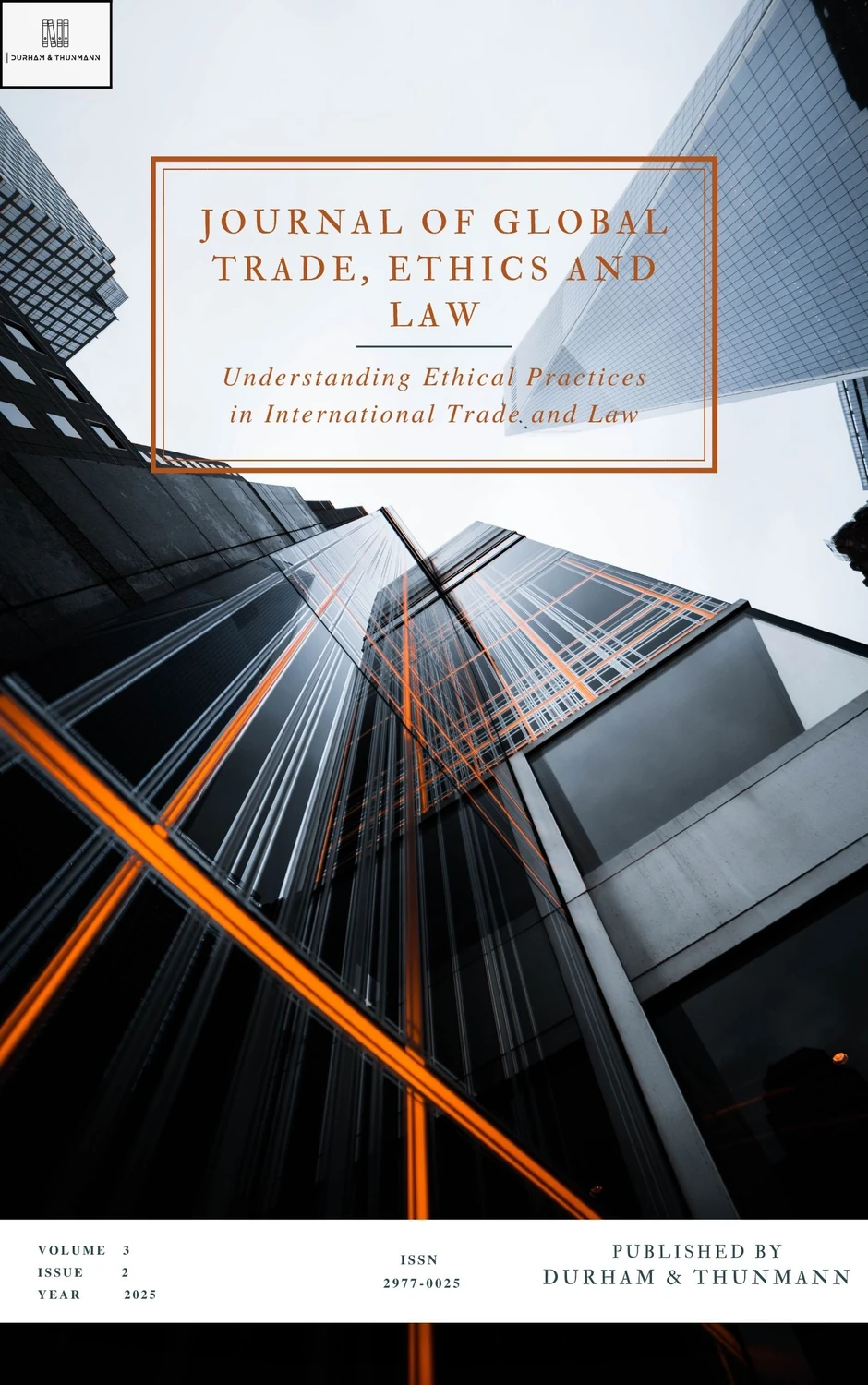
Cover of Journal of Global Trade, Ethics and Law, volume 3, issue 2

Volume 3 · Issue 2 · 2025

The current issue brings together research on mercantilism, distributive justice, prediction markets and the macroeconomic consequences of the COVID-19 shock.

Published
09 January 2026
Articles
4
Access
Open access

Research articles

Search all articles
  1. 01

    Research Article · Pages 1–20

    War, Trade, and Mercantilism: Reconciling Adam Smith's Three Theories of the British Empire

    Barry R. Weingast

    Adam Smith proposed two contradictory theories of the British Empire in the Wealth of Nations and suggested a third. The first view holds 1 that the empire was created for merchants eager to establish and maintain monopolies of the colonial trade. Smith concludes that “Great Britain derives nothing but loss” from the colonies. In the second view, Smith celebrates the European discovery of the new world, opening non-incremental increases the division of labour, specialization and exchange. The empire thus fostered the economic growth of both sides of the British Atlantic, net of the costs of monopoly. Smith’s third argument holds that many mercantile restrictions improved Britain’s security given its long-term military competition with France. How do we reconcile the incompatibility of Smith’s three views of the British Empire? Smith provides no guidance. I argue that, to understand the British Empire, we must view it from the perspective of a long-term military rivalry with France. Many navigation regulations were designed to advantage Britain vis-a-vis France. Smith argues, for example, that the harm to France from prohibiting trade in military stores more than compensates the loss in wealth due to the restrictions. I demonstrate the logic of these claims using tools from modern political economics and political science.

  2. 02

    Research Article · Pages 21–54

    Differentiated Governance, Distributive Justice: Ethical Pathways for South Africa’s Informal-Illicit Nexus

    Siyabonga P. Hadebe

    South Africa’s economy is marked by dualism, comprising a globally integrated formal sector and a substantial informal economy that provides livelihoods for millions excluded from formal employment. In contexts of persistent unemployment, informal work becomes a necessity for survival rather than a choice. However, state policy often incorrectly conflates this economic necessity with illicit markets. This conflation functions as state-engineered sovereignty, exercised through selective enforcement, regulatory ambiguity and epistemic practices that marginalise informal livelihoods while facilitating organised criminal economies. Using a critical political economy lens, this paper examines two cases: the COVID-19 alcohol and tobacco bans (2020) and Cape Town’s extortion economies (2023-2024). Drawing on policy analysis, case studies and quantitative data on market disruption, tax losses and price volatility, it demonstrates that sudden prohibitions and broad enforcement measures destabilise legitimate informal activities, expand illicit markets and undermine state legitimacy. The study concludes that it is crucial to differentiate, both analytically and normatively, between survivalist informality and illegal organised trade to rebuild a decolonised social contract grounded in distributive justice and risk-proportionate governance. Such a framework recognises subaltern livelihoods as elements of economic citizenship, treating dignity as a prerequisite for inclusion rather than a consequence of incorporation.

  3. 03

    Research Article · Pages 55–85

    Prediction Markets

    Emilio Barone, Federico Carli

    This paper provides an English version of a study originally circulated as a working paper in November 2005 on prediction markets and subsequently published in Italian in Mondo Bancario (January–February 2006). The paper reviews the structure, functioning, and empirical performance of prediction markets, with particular emphasis on the Iowa Electronic Markets and other platforms active in the early 2000s. The analysis covers electoral markets, current events, entertainment markets, and macroeconomic derivatives, and discusses issues related to information aggregation, forecasting accuracy, and regulation.

  4. 04

    Research Article · Pages 86–99

    Assessing the Impact of COVID-19 on the Chinese Economy: A Comprehensive Analysis

    Mario Arturo Ruiz Estrada, Evangelos Koutronas, Donghyun Park, Minsoo Lee

    This paper examines the macroeconomic impact of the COVID-19 shock on the Chinese economy through a multidimensional policy-modeling framework. The Massive Contagious Infectious Diseases Simulator (ECMCID-Simulator) employs macroeconomic indicators to examine how asymmetric infection dynamics propagate economic shocks across activity, labor, financial markets, investment flows, and aggregate output within strategic economic sectors during 2019–2021. The ECMCID-Simulator is constructed under the Omnia Mobilis assumption and interpreted through the Dynamic Imbalanced State framework. Key findings reveal pronounced heterogeneity in economic responses, with sharp contractions in contactintensive activities alongside relative resilience in essential production systems. The ECMCID-Simulator conceptualizes pandemic-induced economic disruptions as dynamic economic waves rather than static shocks. The ECMCID-Simulator offers policy-relevant insights into the management of systemic economic risk and the design of targeted stabilization strategies under conditions of extreme uncertainty.