 Journal of Global Trade, Ethics and Law
1. Introduction
In recent years the world economy and production have grown rapidly, if we look at the past few years technology and innovation have been growing very fast. Moreover, expansion has been marked by the low cost of production, and record work becomes effortless too. This extensive stretch of development matches with a critical interest in the improvement of information and technology (ICT) and its applications. A global network that can provide communication and give knowledge about all kinds of information around the world throws electronic libraries into your computer or cell phone to make your life much easy known as digital or internet. Internet or digital is one of the important variables, which has a large scale of contribution in the technology world. The Internet makes our life much easier than in the past. Nowadays we can buy almost everything online these days without any effort and this thing happens because of technology and the Internet. This study examines in the first step, to check whether the Internet has any effect on the production of the Chinese economy. Second, we test whether the internet does have any effect on the US economy or not. In the third part of our study, we compare the effect of the internet on the USA and the Chinese economy which countries have more effective and why. Internet and technology: A global computer network providing a variety of information and communication facilities, consisting of interconnected networks using standardized communication protocols. An electronic communications network that connects computer networks and organizational computer facilities around the world. Technology is the application of scientific knowledge to the practical aims of human life. It is sometimes phrased as the change and manipulation of the human environment.
Based on Young (Young, 2001), internet is the most innovative tech in information technology which changed world production as a combination of network etiquette infrastructure and access strategies. According to Sherman Young, the internet is one of the most important tools which open up connections between countries. It shares culture and communication across the border. The Internet is the main source that opens up a space that allows innovation in information communication technology (ICT). In this paper, his main focus is the effect of the internet and innovation on consumption and production to increase productivity. In this paper, he explains the internet is the basic and most important tool which connects countries. The fundamental procedures of advanced correspondence are the reason for various contending thoughts about what the internet is. In this comprehension, the web or the internet is a battleground for contending conceptual machines - not only specialized thoughts regarding TCP/IP and system associations. The internet makes life easier which is influenced by the way we live. Barreto & Burga (2014) checks the internet and cell-phone’s impact on production and employment. They examine the ruler areas of Peru in the last few years people start to increase their user of the internet and cell phone because of it the employment and employment wage, and production also increase. Its shows that there is a positive relationship between the internet and cell phone on production and employment.
A global network which can provide communication and give knowledge about all kind of information around the world throw electronic library into your computer or cell phone to make your life much easy is known as digital or internet. Internet or digital is one of the important and main variables which have a large scale of contribution in the technology world. The Internet makes our life much easier than before, we can buy almost each and everything online these days without any effort and this thing happens because of technology and internet, and increase in production effect positively on economic growth, production defined those things which can produce in a country in a specific time, so in this study first step we are going to check does the internet have any effect on production or not. Second, we can investigate does internet improves or increase trade volume. And third does the internet have any effect on trade between those countries which are far away from each other.
2. Literature Review
Since the birth of the internet and technology world changes a lot instant of countries’ connections and economic growth. Humans become used too to making themselves as self-comfortable and easy as they can. For the sake of it, nowadays the internet is the main tool to make our life easy and comfortable which affects the living standard and production of a country.
2.1. Information technology and Internet effects on economic growth
According to Young (2001), internet is the most innovative tech in information technology which changed world production as a combination of network infrastructure and access strategies. The key factor in characterizing the advancing web isn't the innovation essentially. The key factor is the superseding thought which educates it - and how it is permitted to be utilized. The best thing about the internet is that people can travel around the world without leaving their own home. Barreto & Burga (2014) checks the internet and cell-phone impact on production and employment. They explain the ruler areas of Peru for last few years people start to used and increased internet and cell phone because of it the employment and employment wage, and production also increase its shows that there is a positive relationship between internet and cell phone on production and employment. Further research where they can look at the minor effect of phone appropriation conversely with Internet support would give strategy producers more data about what projects should they organize.
Chou, Chuang & Shao (2014) investigates the impact of information technology (IT) on total productivity (TFP). Considering system externalities and endogenous development theory, their investigation intends to accommodate the appearing inconsistency between the ongoing observed proof and the expectation by neoclassical development hypothesis. They contend that computerization has reshaped the aggressive scene into a system economy with IT-incited externalities that advantage IT buyers as well as different partners. Also, IT is a stage innovation that can use advancements to upgrade the mechanical degree of the generation process. Subsequently, these two variables of IT-actuated externalities and IT-utilized developments apply positive effects on TFP. After the analysis of the data, they got the result that information technology (IT) not just have an impact on a firm’s productivity it affects total growth productivity (TFP). However estimated outcomes examine that there has a strong positive relationship between the information technology (IT) and total productivity (TFP). information technology (IT) does affect total productivity (TFP) but doesn’t have impact on the non-IT traditional capital like labour (L) and capital (K).
Melville, Gurbaxani, & Kraemer (2005) explained the impact of information technology (IT) on the industry’s productivity. In their study they explain two main things about the industry’s competitive environment first is industry concentration and second is industry dynamism. According to them in previous studies information technology (IT) has positive and significant effects on the manufacturing and services industries. The industry fixation is how much the yield of a whole industry is delivered by a couple of firms and is a backward intermediary for industry competitiveness. Industry dynamism indicates a change that is hard to foresee and is estimated as the deviation of industry deals from a pattern line. They break down the directing effect of fixation and dynamism on the yielding flexibility of data innovation and customary capital by evaluating a generation work utilizing 5211 firm-year perceptions spreading over the years 1987 to 1994.
The results showed that those industries which are large they have large resources and higher knowledge about information technology (IT) then those which are small in size. Because of that reason large industries have more effect and get benefits by technology. Their results also explained that competitiveness is associated with higher IT productivity, but lower productivity of regular capital. It means theirs is a negative relationship between competitiveness and productivity of regular capital. Griliches (1967) wrote a paper on USA manufacturing industries' production growth and technical changes after World War second. The main purpose of his study was to check the quality improvement in the labour force, improve investment in manufacturing industries and economies of scale does increase the productivity in manufacturing industries. He used the Cobb-Douglas production function to check the productivity of US manufacturing industries. He also explained in this paper that the Cobb-Douglas production function is not fully suited to calculate the economy of scale. The outcomes examine that there is a positive relationship between the quality improvement in the labour force and productivity of the USA.
Schreyer (2000) checks the impact of information communication technology (ICT) on economic growth by using production function. He examines that if improve the (ICT) in input then what will it affect production output. According to Paul Schreyer at the US firms for last nine years, they improve the growth in every field, the unemployment rate decreased, the employment rate increased and the inflation rate also lower than in past years because of this US government for past few years was investing in information communication technology (ICT) sector. Because of improvement in information communication technology (ICT) its effect on economic growth which continually increase the production and give this name “new economy”. He also mentions in this paper that they’re in the US past few years’ economic growths not as consistent as few other European countries as well as Japan too. After the analysis of the data, he got the result which shows that there is a positive effect between the information communication technology (ICT) and productivity, and second between the information communication technology (ICT) and multi-factor productivity (MFP) also have a positive effect.
Manyika & Roxburgh (2011) The internet is a very important part of economic growth in the recent world which affects a large scale of economic growth and daily life. The estimated results showed that the internet has a positive effect on economic growth. The Internet also changes the old working style. The Internet and technology also tell us the difference between rich and poor counties. Broughel & Thierer (2019) explained the impact of information technology innovation on economic growth and living standard of those countries which are using technology innovation products and how its effects on daily lifestyle. After the analysis the date he got the results that those countries which are using the innovative technology they have high living standard than those counties which discourage innovation technology because technology makes people life fast and easy. Innovation technology also has a positive effect on economic growth. Morrison (2019) discuss the Chinese economic growth from late 40 years till now. He said that the Chinese economy was too low and worst 40 years ago than after they change the foreign policies and opening up foreign trade and investment China become number one and largest economic growth county in 2018. China is one of the largest trade partners and thirdbiggest export partner and biggest source of import of the U.S. according to him these all happened because China make innovation in technology is the top goal.
2.1.1. Trade and economic growth
The business of buying and selling or bartering commodities is called trade. Trade involves the transfer of goods or services from one person or entity to another, often in exchange for money. A system or network that allows trade is called a market. According to this, Dollar & Kraay (2003) stated that International trade has a significant impact on the economic growth of a country.
An early form of trade, barter, saw the direct exchange of goods and services for other goods and services. Barter involves trading things without the use of money. Later, one bartering party started to involve precious metals, which gained symbolic as well as practical importance. For Arif et al. (2022), trade openness influence positively on the economic growth of South Asia from 1980 to 2018. Modern traders generally negotiate through a medium of exchange, such as money. As a result, buying can be separated from selling, or earning. The invention of money (and later credit, paper money, and nonphysical money) greatly simplified and promoted trade. Trade between two traders is called bilateral trade, while trade involving more than two traders is called multilateral trade.
Economic growth is the increase in the inflation-adjusted market value of the goods and services produced by an economy over time. It is conventionally measured as the percent rate of increase in real gross domestic product, or real GDP.
Growth is usually calculated in real terms - i.e., inflation-adjusted terms – to eliminate the distorting effect of inflation on the price of goods produced. The measurement of economic growth uses national income accounting. Since economic growth is measured as the annual percent change of gross domestic product (GDP), it has all the advantages and drawbacks of that measure. The economic growth rates of nations are commonly compared using the ratio of the GDP to population or per-capita income.
The "rate of economic growth" refers to the geometric annual rate of growth in GDP between the first and the last year over a while. This growth rate is the trend in the average level of GDP over the period, which ignores the fluctuations in the GDP around this trend. López (2005) “the increasing the exports volume affect production and economic growth.”
In recent years the world economy and production have grown rapidly, if we look at the past few years technology and innovation growing very fast. Moreover, expansion has been marked by the low cost of production, and record work becomes effortless too. This extensive stretch of development matches with a critical interest in and the improvement of information and technology (ICT) and their applications. Following this assumption, Eaton & Kortum (2001) examine that innovation in trade, describing how it has a positive impact on the economic growth for a nation.
2.1.2 Production growth
Douglas Source (1928) give a new concept about a production that how to increase the productivity. They give an idea that there are two factors which are contributing to increase the production, one is labour and second is capital. They explain that if between them one-factor increase we increase than production will also increase. They took data about the United States manufacturing enterprises from 1879 to 1922. In fixed assets they took the land, machinery’s, buildings, raw materials, and those good which are under the prosses of manufacturing. After they analysed the data, they got the results that in fixed capital machinery’s growth will increase around 30% from the year 1899 to 1922, and building growth will increase by 16.5%. Few other authors they combine both these two factors machinery and building which are increase 46.5%. According to Missouri State Bureau of Labor report which they published in 1923 they said that in the US, manufacturing building and machinery’s have total worth around 334.7 million which have 46.5% of total capital value, which was initially 58.7 million in 1904. The fund that the labour force was increased 61% from 1899 to 1922 but the ratio of capital to labour force was 2.67 % greater, and the total production was increased 140% and individually per labour production was around 50% higher than from 1899. In that paper, they give a new concept about production and give this concept name production function in which two factors directly impact production which is labour and capital cost.

where:
- P = total production (the monetary value of all goods produced in a year) • L = labour input (the total number of person-hours worked in a year) • K = capital input (the monetary worth of all machinery, equipment, and buildings) • b = total factor productivity • α and β are the output elasticities of labour and capital, respectively. These values are constants determined by available technology.
Griliches (1967) wrote a paper on USA manufacturing industries' production growth and technical changes after World War second. The main purpose of his study was to check the quality improvement in the labour force, improve investment in manufacturing industries and economies of scale does increase the productivity in manufacturing industries. He used the Cobb-Douglas production function to check the productivity of US manufacturing industries. After the analysis of the data and estimate the results that he was said that the Cobb-Douglas production function can find the production of manufacturing industries, but he was not fully sure that the Cobb-Douglas production function is the best because he took that he didn’t have enough evidence. He also explained in this paper that the Cobb-Douglas production function is not fully suited to calculate the economy of scale.
Eksioglu (2015) explained the labour productivity of Radio Frequency Identification (RFID) and technology. In this paper, they said that the Cobb-Douglas generation work is a notable financial hypothesis that clarifies the relationship of yields with two information sources, work, and capital. In any event, when this capacity is created with just two info factors, it is still generally utilized for estimating efficiency. This paper, utilizing the Cobb-Douglas creation work, researches the impacts of RFID innovation on the work efficiency of the U.S. retail inventory network. Coming up next is the examination theory to test whether RFID selection offers advantages to receiving retailers in profitability. After they analysed data by used the Cobb-Douglas production function on the U.S industry sector. They got the result that those companies which used RFID technology they have a higher elasticity of labour to gross income than those companies which are non-RFID, which shows that those companies which are RFID have higher labour productivity but the difference between RFID and non-RFID is very low that is 0.004 which not significant if we check the investment that RFID companies in their companies. The RFID organization's profitability increases ought to be clarified by the RFID venture just as joining exertion between the current data frameworks and RFID. As stated by Mitra, Sharma, & Véganzonès-Varoudakis (2014), technology and innovation in Indian manufacturing industries have positive impact on productivity. For Yoo & Yi (2022) the effect of economic innovation on social systems is also examined in this study. According to the findings, economic innovation is sparked by many factors at various times. their findings show that the production sector's productivity can be increased and costs can be decreased thanks to the impact of digital economic innovation on the industrial structure. Results indicate a relationship between economic innovation and its effects on the technical and social worlds.
Based on the literature in this study, we fill the gap in the literature to examine the impact of internet on the economic growth of China and the United State from 1990 to
- To analysis the data we used the Cobb-Douglas production function. In the first chapter we explain the introduction of the study, in the second chapter we examine the literature review, in the third and four chapters we investigate the methodology and results of the study, in the last we discuss the outcomes and conclude them.
2.1.1. Objectives:
Dose the internet innovation increase the Chinese economic growth? Does the internet innovation have any effect on the United State economic growth? Compare the innovation and the internet effects on the USA and the Chinese economic growth?
3. Methodology
In our research we are using the production function to investigate and check the effect of the internet on economic growth, the Cobb-Douglas production function explain below:
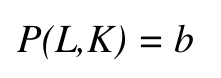
where: • P = total production (the monetary value of all goods produced in a year) • L = labour input (the total number of person-hours worked in a year) • K = capital input (the monetary worth of all machinery, equipment, and buildings) • b = total factor productivity • α and β are the output elasticities of labour and capital, respectively. These values are constants determined by available technology.
The output depends on the elasticity of and, for example, = 2 then the elasticity in labour is 2, mean change in labour from 1 to 2 then it has an effect on production 2×2=4.
Further if + = 1 than if both L and K increase or decrease 30% then it affects a production total of 30%.
We took the log of the production function to make it simplify Log(P(L/K) = b) Log(L/K) = Log(b) + log(L) + log(K) + e This is the model which we are using our research to check the internet effect on productivity because in previous research history give us knowledge that the production function is one of the best functions to explain the relationship between resources and growth so that is the resin, we are using this model in our research to check the relationship between internet and growth. We use Stata to analyse the data.
We took years from 1990 to 2018 and the number of internet users as labour, internet investment as capital cost, and GDP as total production. Internet users mean the total number of internet users in China from 1990 to 2018, internet investment means the Computer, communications, and other services (% of commercial service exports) in China from 1990 to 2018 and GDP means the total gross domestic product in China from 1990 to 2018.
4. Data
We took data for our research from 1990 to 2019 from the world bank. Three main variables L, K, and P, a total number of internet users mention as L, cost of the internet as examine K (Computer, communications and other services (% of commercial service exports)), and GDP represent the total production or economic growth P.
4.1. Dose the internet innovation increase the Chinese economic growth?
China is one of the largest economies in the world, which economic growth increasing rapidly from 1988 to till now. In economic growth there are many areas where China not just develop their country only, they become one of the strongest and iconic countries in the world where other countries learn from China that how to develop and increase the economic growth. There are many fields where China has become the number one country in the world one of them is the digital economy where China rapidly develops in a last few years. In our research we are going to check does there is any impact of the internet on the Chinese economy, for that purpose we took data from the world bank for the last 29 years and we use the Cobb-Douglas production function to check the relationship between the internet and economic growth.

In table 1, we take the descriptive statistic of our data related to China which explain the behaviour of the study variables. We have 29 observations for each variable in our study, the highest value in internet users is 10.8881, the lowest value is 5.2984, the mean is 9.0858 and the standard deviation is 2.0194. The second variable which is internet cost the highest value is 1.8776, the lowest value is 1.2727, the mean is 1.6750 and the standard deviation is 0.1639. the highest value of the third variable which is GDP which value is 13.1338, the lowest value is 11.5573, the mean is 12.3626 and the standard deviation is 0.5192.
This shows us that the highest values we get in GDP than second are internet users and on the last internet cost.
We use Stata software to test the Cobb-Douglas production function. We took years from 1990 to 2019 and the number of internet users as labour, internet investment as capital cost, and GDP as total production. Internet users mean the total number of internet users in China from 1990 to 2019, the internet investment means the Computer, communications, and other services (% of commercial service exports) in China from 1990 to 2018 and GDP means the total gross domestic product in China from 1990 to 2018.
Accessible table text
| — | Variables | — | — | GDP | — |
|---|---|---|---|---|---|
| Internet cost | Internet cost | — | 0.259*** (0.0248) | — | — |
| internet users | — | — | — | -0.545* | — |
| — | — | — | — | (0.306) | — |
| Constant | — | — | 25.16*** 0.977 | — | — |
| — | R-squared | — | — | 0.840 | — |
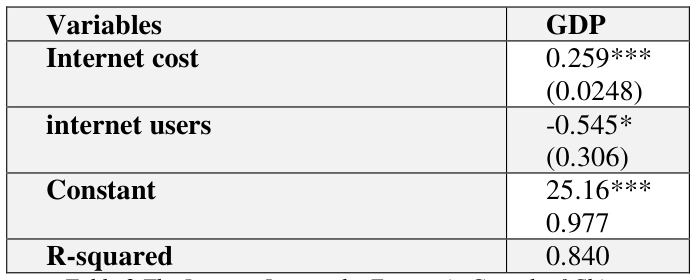
After we analyse the data to used Stata, we got the results which we mention in table 2, we have three variables GDP as a dependent variable and the other two internet users and internet cost are independent variables.
In the table the first row is internet cost which is significant at a 1% confidence interval which shows us that there is a very strong relationship between GDP and internet cost and the value of internet cost here is 0.259, Standard error value is 0.0248 and *** show the signification at 1% confidence interval. In the second row, we have internet users which are also significant at a 5% confidence interval and the internet users’ value is -0.545, Standard error value is 0.306 which shows us that there is a negative relationship between internet users and GDP. The third row shows us the constant (α) and the value of the constant is 25.16 which is also significant at a 1% confidence interval. The value of r-square is 0.840 which shows us the influence between dependent variable GDP and independent variable internet cost and internet users is very high.
Our finding shows us that there is a positive relationship between Internet cost, Internet users, and GDP and strongly significant.
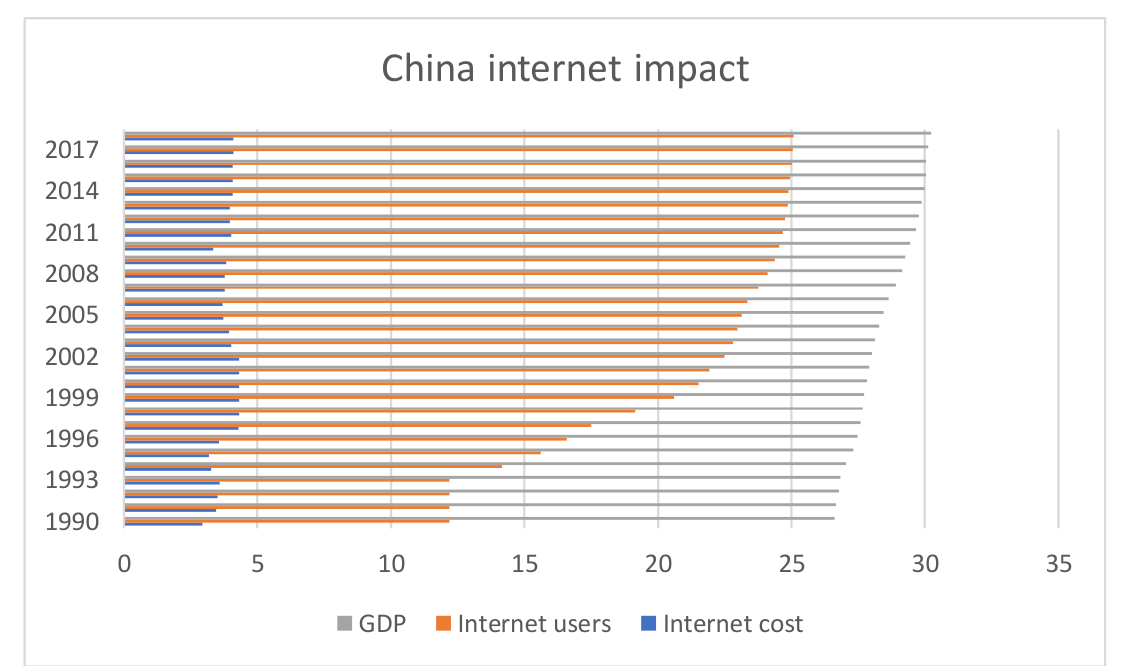
In figure 1, we show the year was increased in internet cost and internet users have increased or decrease the GDP. Three colour lines are mentioned three different variables values, the blue colour indicates the internet cost, the orange colour indicates the internet users, and the brown colour explains the GDP. The graph clearly shows us that there is a positive relationship between dependent variable GDP and independent variable internet cost and internet users from the year 1990 to 2018. When we saw the value of GDP, internet cost and internet users from 1990 to 1999 in those years the value of internet cost and internet users are between 3 to 13 which are not high that’s why the value of GDP also around 26 but from years 2000 to 2011. The value of internet cost and internet users are higher than 15 which increase the GDP around 28 and from years 2012 to till 2018. The value of internet cost and internet users are around 25 which give boost the GDP from 28 to higher than 31 which show us there is a positive relationship between the independent variable’s internet cost and internet users and the dependent variable GDP.
4.2. Does the internet innovation have any effect on the United State economic growth?
The second-largest economy in the USA which also increasing rapidly for last more than 30 years but if talk about technology and innovation than United State (USA) is one of the strongest and innovative country in the world that is the reason we took the USA as our data sat and test that how does internet change and increase the USA economy. We took 39 years to test the effect of the internet on the economic growth of the USA.

In table 3 same as table 1, we examine the descriptive statistic of our data related to the USA which explain the behaviour of our study variables. We took 29 observations for each variable, the highest value in internet users is 24.0555, the lowest value is 19.1138, the mean is 22.8824 and the standard deviation is 1.5069. The second variable which is internet cost the highest value is 3.8490, the lowest value is 3.4355, the mean is 3.7161 and the standard deviation is 0.1236. the highest value of the third variable which is GDP which value is 30.6268, the lowest value is 29.4228, the mean is 30.0818 and the standard deviation is 0.3753.
We took data from the year 1990 to 2018 and the number of internet users as labour, internet investment as capital cost, and GDP as total production. Internet users mean the total number of internet users in the USA from 1990 to 2018. The internet investment means the computer, communications and other services (% of commercial service exports) in the USA from 1990 to 2018, and GDP means the total gross domestic product in China from 1990 to 2018.
Variables GDP

1.721 R-squared 0.842
Table 4 The Internet Impact the Economic Growth of USA.
*** p<0.01, ** p<0.05, * p<0.1
After we analyse the data to used Stata, we got the results which we mention in table 4, we have three variables GDP as a dependent variable and the other two internet users and internet cost are independent variables. In table 4 first row explains to us the behaviour of internet cost and how internet cost effect on USA GDP (total output), where 2.378 is the value of internet which mean if we do change 1% internet cost it has a 2.378% effect on the total output which is the high effect and the result are significant at 5% of the confidence interval. The second internet users have just low effect because the value of internet users is 0.0346 and it is insignificant. The constant have strongly significant and the value is 20.45 and if we talk about the r-square which is 0.842 shows us the influence of internet cost and internet users on the USA (total output).
After we analyse the data, we found the results which show us that there is a positive relationship between internet cost, internet users, and GDP in the USA economy.
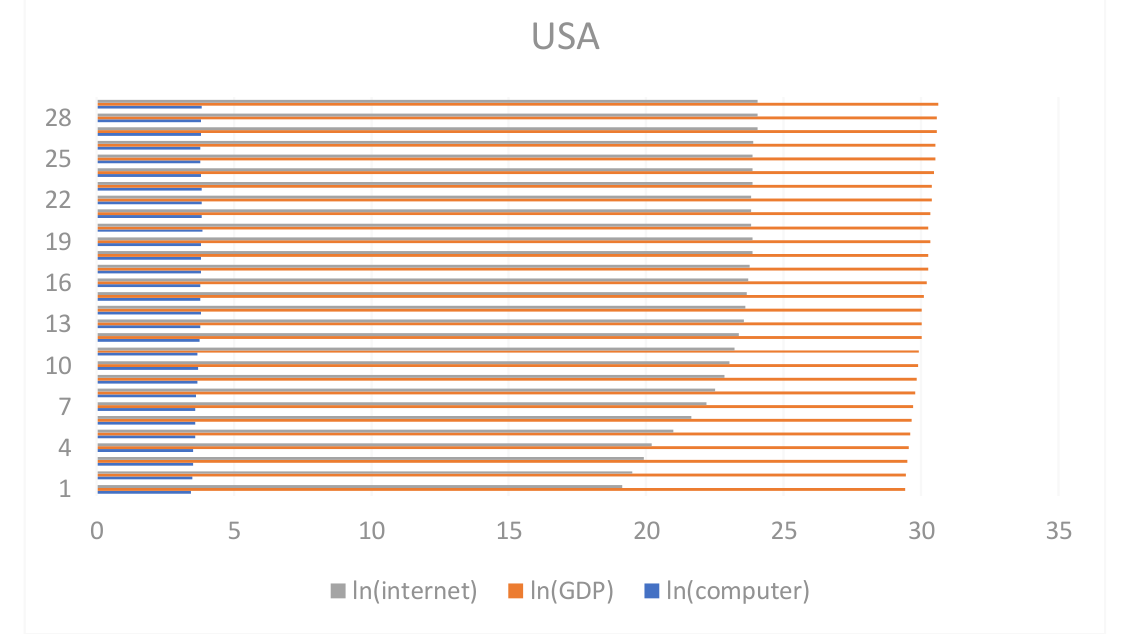
In figure 2, we show how internet cost and internet users effect on GDP. The estimated results show that developed countries same the USA they didn’t have internet cost same as developing countries which make cost low and low investment on the internet and will get high output. If we talk about internet users was increased rapidly from 1990 to 2018, form first few years 1990 to around 2000 the internet users was increased very highly but from 2000 to till 2018 the internet users not increased as much as increased from 1990 to 2000. The GDP (total output) was increased rapidly from the year 1990 to 2018 which shows us the difference between developing and developed country. The developing countries still need to improve in internet users that’s why they are investing on the internet which increases the internet cost, but the GDP (output) doesn’t increase as fast and as much as increased developing countries.
4.3. Compare the innovation and the internet effects on the USA and the Chinese economic growth?
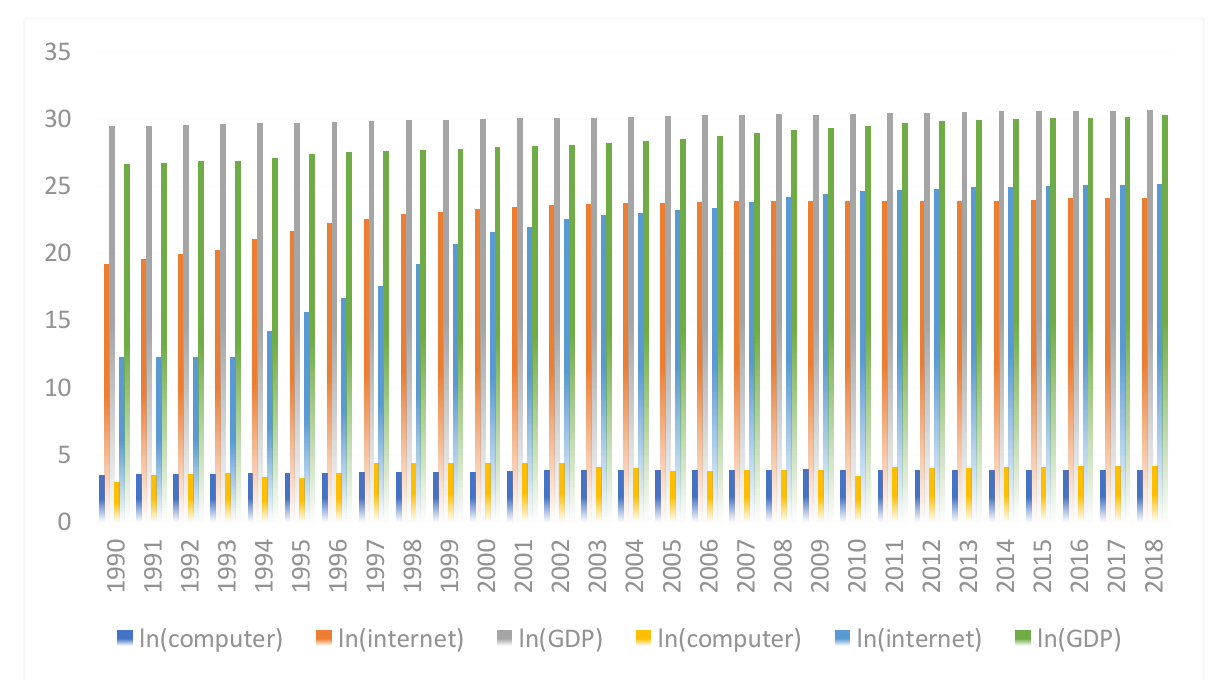
Figure 3 examine the effect of the internet on China and the USA economy and comparison between these two countries. After took the internet as a tool which shows us that how much the internet does affect the USA and Chinese economy. In the figure there are six different colours which explain the effect of internet users and internet cost on GDP of the USA and the Chinese economy. Blue colour shows the internet cost, orange colour the internet users and brown colour the GDP of USA economy. Other three colours which are yellow explain the internet cost, light blue the internet users and green the GDP of the Chinese economy.
The outcomes of the study examine that the internet cost, in figure internet cost of China is higher than the USA but internet cost of China become rapidly decreased from 2010 to onward which start to dich USA. If talk about internet users, from 1990 to 2000 number of internet users of the USA are higher than China but from 2001 to till now the number of internet users of China are increase rapidly more than USA which affects the USA digital economy. The last thing in the figure is total GDP, the USA GDP which is also higher than Chinese GDP from 1990 to 1999 but from 2000 to till now the Chinese GDP is growing fast and rapidly more than USA which also effects the USA economy.
Internet cost of the USA is lower than China which makes a high impact and difference in GDP (output) because there are two reasons which make internet cost high. One is internet cost increase that time when any country going to invest the area in internet which make internet cost higher and second reason is if any country just takes internet services charges not going to invest in internet filed but in case of China they started to invest on the internet from 1995 to 2010 which make their internet cost high. But on the other hand, the USA has internet costs almost the same as they had 1990 because they are producers, the USA is a developed country already that’s why they don’t have many gaps in the digital economy side.
Internet users also not fully functional in China than the USA which shows us there is a gap in internet users in China that give us information that in few areas at China still, people are not using the internet yet that’s why every year internet users increased deliberately which can decrease technology gap between urban and ruler areas which increase the number of internet users at China it also decrease the gap between these two countries which also shows us that how fast the China growing in digitalization. But if we check the last 5years from 2014 to 2018 the difference between internet cost and internet user’s percentage almost stable not increased much and the gap become very narrow between China and USA which clearly show us that China growing very fast and near to chough the world number one country in the technology which is the USA.
When we observe table 2 and table 4 which are our finding after used Stata shows us that the internet cost and internet users have a high impact on GDP (total output) at the USA. But if talk about the effect of internet cost and internet users on China is not as much high as have on the USA. China is a large economy country in the whole world that gets mostly total output from an industrial sector not much from the digital sector, but the USA highly relies on the digital economy which is a reason to make difference here.
5. Conclusion
Internet is the main source to connect the people and countries, in our study we checked how does the internet affect the economy of a country and how much the countries are like China and the USA economy depend on the internet. For that reason, we check the effect and relationship between the internet and Chinese economy. We took 30years of data from 1990 to 2019 and analysed the data by used the Stata on production function and got the results which we mansion in table 1 and 2, which shows us there is a positive relationship between the internet and the Chinses economy. In other words when we increase the internet users and internet cost than the total output will also increase as much as we increase the internet users and internet cost.
In the second part of our study, we check the relationship between the internet and the USA economy which we mention in table 3 and 4, that there is a positive relationship between the internet and the USA economy. Which shows us that if we increase the internet users and internet cost than USA economy means the total output will also increase.
In the third part of our study, we compare the effect of the internet on Chinses and USA economy, Internet cost is lower in the USA than China which makes a high impact and difference in GDP (output). Internet users also not fully functional in China than the USA which shows us there is a gap in internet users in China that give us information that in few areas at still people are not using the internet yet that’s why every year internet users increased deliberately.
But if we check the last few years from 2014 to 2018 the difference between internet cost and internet user’s percentage almost stable, not increased much and the gap become very narrow between China and USA which clearly show us that the China is growing very fast and near to chough the world number one in technology USA.
When we observe table 2 and table 4 which are our finding after used Stata shows us that the internet cost and internet users have a high impact on GDP (total output) at the USA but if talk about the effect of internet cost and internet users on China is not as much high as have on the USA. China is a large economic country that gets mostly total output from an industrial sector not much from the digital sector, but the USA highly relies on the digital economy. In other words, we can say that there are positive effects of the internet on the Chinese and the USA economy.
Research Limitations and Recommendations
Based on the results of the study, there are some limitations and suggestions. The purpose of the study is to examine the impact of internet on the economic growth of China and the United State from 1990 to 2019. To analysis the data we used the Cobb-Douglas production function. There are limitations in data and the models as well. For the future researchers will be choose data from different countries and regions other than China and the USA. To get the estimated results researchers will also can used other models than production function like the Gravity model, Fixed and Random effect model etc. which will help to improve the results. Additionally, the outcomes of our study give suggestion to the Chinses and the United State policy maker to motivate the investors to invest in the information communication technology field to improve the living standard and increase the economic growth of a country.
Authorship and Acknowledgements
The digitalization is a key component of the world economy from past resent years, based on that in our study we are taking part in how digitalization changes the economy of the USA and China.
In our study we checked how does the internet affect the economy of a country and how much are countries like China and the USA economy depend on the internet, for that resin we check the effect and relationship between the internet and Chinese economy. We took 30 years data from 1990 to 2019 and analysed the data by used the Stata on production function and got the results which we mansion in tables and figures, which shows us there is a positive relationship between the internet and the Chinses and USA economy, in other words when we increase the internet users and internet cost than the total output will also increase as much as we increase the internet users and internet cost.
Our contribution is there we are taking first time in our study the Cobb-Douglas production function to check the relationship between the internet and the economy growth, and check that how does internet change the economic growth and if there we skip the internet than how much total GDP decrease in a country. Finally, we also compare that the internet between both the USA and China which have more effect on economic growth.