 Journal of Global Trade, Ethics and Law
1. Introduction
The tenor of the present article differs from that of many articles one might read in a scholarly journal. There are no Greek letters. There is no econometric modeling. Mathematical analysis is almost nonexistent. What the reader will find is a discussion on trade practices and policies that incorporates thoughts from the economics, political science, philosophical, sociological, historical and ethics literature.
Rights theory and the structural deficiencies of utilitarian ethics are discussed, an approach that is almost never taken in the traditional trade literature. The views of Rawls, who is generally regarded as one of the top political philosophers of the twentieth century, are critically analyzed and found wanting. The views of Flew, whose views may be unfamiliar to trade specialists, are discussed and applied to trade theory. Increases in inequality are shown to be a good thing. The entitlement theory of Nozick is shown to be superior to the “iffy” theories of Pareto and Rawls. Cohen’s view that limits should be placed on justly-acquired wealth is shown to increase the amount of injustice in society. The Kantian view that it is intent that counts, not consequences, is shown to be philosophically untenable. The general view that trade deficits are bad and trade surpluses are good is shown to be deeply flawed.
The relationship between wealth and power is examined, and arguments that the accumulation of wealth is somehow bad for society in general are shown to be flawed. The concept of economic democracy is introduced and discussed and is shown to be a good regulator of economic activity as well as a mechanism that prevents the accumulation of wealth from being a threat to freedom. The accumulation of governmental power is seen to be more of a threat than the accumulation of corporate power, since corporate power is dependent on satisfying consumer wants, and can evaporate if and when a corporation ceases to meet those wants.
Flow charts are used to show the flow of logic for utilitarian ethics and rights theory in a way that is understandable to the general reader who may not have a background in ethical theory or philosophy. The logic from these flow charts can be applied to any trade question to determine whether a trade policy is “good” or “bad” from a philosophical perspective. The flow charts eliminate the need for econometric modeling, which must necessarily include assumptions that may be flawed and/or based on imperfect or incomplete information.
Trade restraints are shown to result in negative-sum games, since there are more losers than winners (from a utilitarian perspective) and since any such restrictions must necessarily violate someone’s property, contract or association rights. Antidumping laws are bad because they either raise prices or prevent consumers from purchasing what they want at a price that would be lower in the absence of the trade restraint. Antidumping laws are shown to be a form of rent-seeking, since a small group of producers uses the force of government to feather their own nest at the expense of the general public. Such laws also misallocate resources, which reduces the standard of living, the rate of economic growth and overall societal benefit. There is no way to adequately reform the antidumping laws. They must be abolished. Anything less than total abolition results in the violation of property, contract and association rights.
Economic sanctions are shown to be a negative-sum game where both sides lose and there are no winners. Just because country A loses $10 billion in wealth as a result of sanctions whereas country B loses only $6 billion does not mean that country B “wins.” They both lose. Studies have shown that the vast majority of sanctions do not produce the change in behavior that the sanctioning country wants, which means the sanction in question was a failure. One factor those who advocate sanctions fail to consider is the secondary effects that any sanction produces. In some cases, this failure to consider secondary effects is deliberate. In other cases it is a mere omission, perhaps because it is difficult, if not impossible, to determine what the secondary effects might be, a point that Bastiat (1964abc) pointed out in the 1840s.
The conclusion is that all restraints on trade are unethical, either because they result in negative-sum games or because they must necessarily violate someone’s property, contract or association rights. They are a form of theft, in a sense, since they deprive owners of the use of their property. The main difference between traditional theft and protectionism is that it is government that deprives property owners from the full use of their property rather than private actors.
2. General Comments
The vast majority of economists apply utilitarian ethics to policy issues, not only in the area of international trade but to economic issues and policies in general.
Adam Smith (1776), the father of economics, was a utilitarian, as were John Stuart Mill (1962), Jeremy Bentham (1988) and numerous other economists and political philosophers. Bentham even went so far as to say that there is no such thing as natural rights, that all rights come from government.1
Pareto optimality (Pareto 1906; Schumpeter 1951) is a variation of utilitarian ethics from an economist. According to this view, a situation is optimal if any other configuration would make at least one person worse off, the policy implication being that it is perfectly acceptable to violate the rights of one or more individuals if the result is to prevent one person from being worse off. Of course, what is not addressed is the fact that the person whose rights would be violated must necessarily be worse off as a result. If some utilitarian solution would prevent someone from exercising his first choice, that person must necessarily be worse off. Or if a utilitarian solution would result in the confiscation of someone’s property without just compensation, as is the case with eminent domain proceedings, then that person would necessarily be worse off. The Pareto optimality view differs from the normal utilitarian approach, which would allow one individual to become worse off if two or more individuals would become better off.
1 “…there are no such things as natural rights – no such things as rights anterior to the establishment of government…Natural rights is simple nonsense: natural and imprescriptible rights, rhetorical nonsense, -nonsense upon stilts.” Jeremy Bentham, Anarchical Fallacies, reprinted in Waldron (1987). The quotation is from pp. 52-53.
Philosophers have also been known to take a utilitarian approach to trade issues, although philosophers do not often write about trade issues. Ulshöfer (2000) discusses interests rather than rights for various groups that stand to be affected by a western hemisphere free trade agreement. Although she does not critique rights, she makes it clear that she would not hesitate to affect the rights of some so that the interests of others could be served. Like many writers on policy issues, she fails to distinguish between interests and rights. Interests often conflict whereas rights, properly understood, cannot. My right to property cannot conflict with your right to property. This property is either mine or it is not mine. That property is either yours or it is not yours.
Disputes regarding rights can develop in cases where the right is not clearly defined. For example, some tribe of American Indians may claim the right to certain land that precedes the right of the people currently living on the land. But one would not say that their rights conflict. It would be more proper to say that the rights are not defined sufficiently to determine who has a right to the land.
Rawls (1971) takes the approach that my property is generally mine and your property is generally yours, except in cases where the inequality of the property distribution results in injustice, in which case some of the property you have justly acquired can be redistributed to someone who has done nothing to earn the right to that property. His analysis is a bit more sophisticated than that, of course, but that is the thrust of his argument.
Flew (1981) did an excellent job of dismantling Rawls’ argument. I will not reinvent the wheel in this regard but will merely summarize what Flew has already said. Flew starts by challenging the identification of equality with justice and equity. In order to be just, rules and laws must apply equally to all. In other words, all people who are subject to a set of rules must be treated alike. People who break those rules should be treated differently than people who do not break those rules.
Flew focuses his attention on Rawls’ statement that “Inequalities are permissible when they maximize, or at least all contribute to, the long-term expectations of the least fortunate group in society.” (Rawls 1971, 151, quoted in Flew 1981, 74). Why Rawls focuses on the least fortunate group is unclear, as is the view that individuals who have justly acquired their assets must somehow part with some of those assets based on the expectations of some group. It is not clear why those who excel should have a moral or legal obligation to subsidize those who do not excel.
Problems develop when one tries to apply the rule. For example, if you or I make some improvement to our home, everyone whose home does not have that improvement must become relatively (to us) disadvantaged, although no member of the disfavoured group is any worse off in absolute terms. We could expand this concept to international proportions by making the point that rich countries and rich individuals in those countries make others worse off in relative but not absolute terms. Rawls would try to convince us that individuals who improve their lot in life can do so justly only if doing so also somehow contributes to the least fortunate group in society.
Otherwise, such improvements are somehow viewed as unjust, even though no one becomes worse off in absolute terms.
Flew sums up the problem with Rawls’ viewpoint as follows:
“The prescription actually given forbids anyone to become better off, even if this is achieved with no help from nor harm to anyone else; save on condition that they transfer a cut of the extra to the least advantaged group – and no one is to ask any Victorian and properly compassionate questions about individual or family need. By what right does the least advantaged class thus become as such entitled to unconditional and permanent flows of tribute?” (Flew 1981, 79)
Flew prefers to determine whether a condition is just on the basis of entitlement. “…to do justice is to see to it that people have what they severally deserve, and what they are entitled to.” (Flew, 1981: 81) If Rawls’ theory were applied, the result would be that the state would ultimately determine rewards without regard to contributions. The market would no longer determine who becomes rich. The state would. One of the main criticisms of Rawls’ theory is that it disregards property rights.
Nozick (1974) takes an entitlement approach, which he refers to as the principle of justice in transfer (Nozick 1974, 150). According to his view, in a world that is totally just, the definition of justice in holdings would comprise the following three elements:
- A person who acquires a holding in accordance with the principle of justice in acquisition is entitled to that holding. 2. A person who acquires a holding in accordance with the principle of justice in transfer, from someone else entitled to the holding, is entitled to the holding. 3. No one is entitled to a holding except by (repeated) applications of 1 and 2. (Nozick 1974, 151).
In other words, “a distribution is just if everyone is entitled to the holdings they possess under the distribution.” Nozick holds that “this is mine because I am more entitled to it than anyone else.” For example, if I am a basketball superstar and if my employer decides to give me a commission of 25 cents for each ticket sold to each game in which I play because my presence increases game attendance, I have earned those 25 cents. No one is more entitled to it than I am. The fact that there may be people outside the stadium who are hungry does not alter that fact.
Gerry Cohen (1995, 19-37) disputes Nozick’s basketball example as being the last word on the view that all voluntary exchanges are just. Cohen argues that limits must be placed on how much wealth individuals may have regardless of how they came to hold it, since those who have what Cohen considers an excess amount of wealth may have an unacceptable amount of power over others.
Several criticisms can be made of this view. For one, it is impossible to define how much wealth is excessive without being subjective and arbitrary. Furthermore, limiting the amount of wealth that may be accumulated violates property and contract rights, whereas permitting unlimited wealth accumulation does not violate anyone’s rights. If one defines a just society as one where you get to keep what you earn and I get to keep what I earn (Williams 1987), then what Cohen is suggesting amounts to increasing the amount of injustice in society.
The relationship between wealth and power also needs to be examined. Just because someone has accumulated a great deal of wealth does not mean that he or she will be able to exercise a great deal of power over anyone else. The fact that Donald Trump is worth several billion dollars has no adverse effect on me and actually benefits me indirectly, since he has invested his billions of dollars in projects that create jobs and make the world wealthier. The tens of thousands of rental units he owns increase the supply of housing, which puts downward pressure on housing, which is one of the items I consume. Were it not for the Donald Trumps of the world causing the supply curve to shift to the right, the amount of rent I have to pay would be higher than is now the case.
Allowing the government to confiscate what it considers to be his excess wealth would have several adverse consequences. For one, it would destroy Trump’s incentive to create more wealth (and thus more jobs and further reductions in housing costs), since there would be no reward for doing so. Secondly, if the government confiscates his wealth, assets would shift from the private sector to the government sector, which would result in a relative misallocation of resources, since governments are more likely to waste money than are private individuals.
The case of General Motors may serve as another example. General Motors Corporation was once the largest corporation in the world. It got that way through voluntary exchange, for the most part, although it also abused its position by going to the U.S. Congress, hat in hand, and asking it to restrict foreign competition. But it has since gone bankrupt because it made cars that no one wanted to buy. No matter how big or powerful a corporation like General Motors is, it cannot force me to buy its product. That being the case, how much power does it really have?
The point is that a corporation gains and retains economic power only as long as it produces goods or services that people want. As soon as it no longer attracts customers it starts to lose its power. People vote with their dollars or other monetary units by purchasing what the corporation has to sell. If some other auto company makes more attractive cars, consumers will shift their dollar votes to a competitor. It is economic democracy at work. Consumers ultimately determine how wealthy a corporation or individual can become by voting with their dollars or other monetary units to purchase what the corporation has to offer.
Rather than worry that those who become rich as a result of voluntary exchange should be curbed so that they do not accumulate too much power, Cohen should be concerned that governments will accumulate too much power if they are permitted to prevent voluntary exchange from taking place. We have more to fear from governments that accumulate power than we do from corporations or individuals who become super rich by offering consumers what they want.
If one were to summarize the utilitarian and rights approaches in flow chart form, they might look something like this:

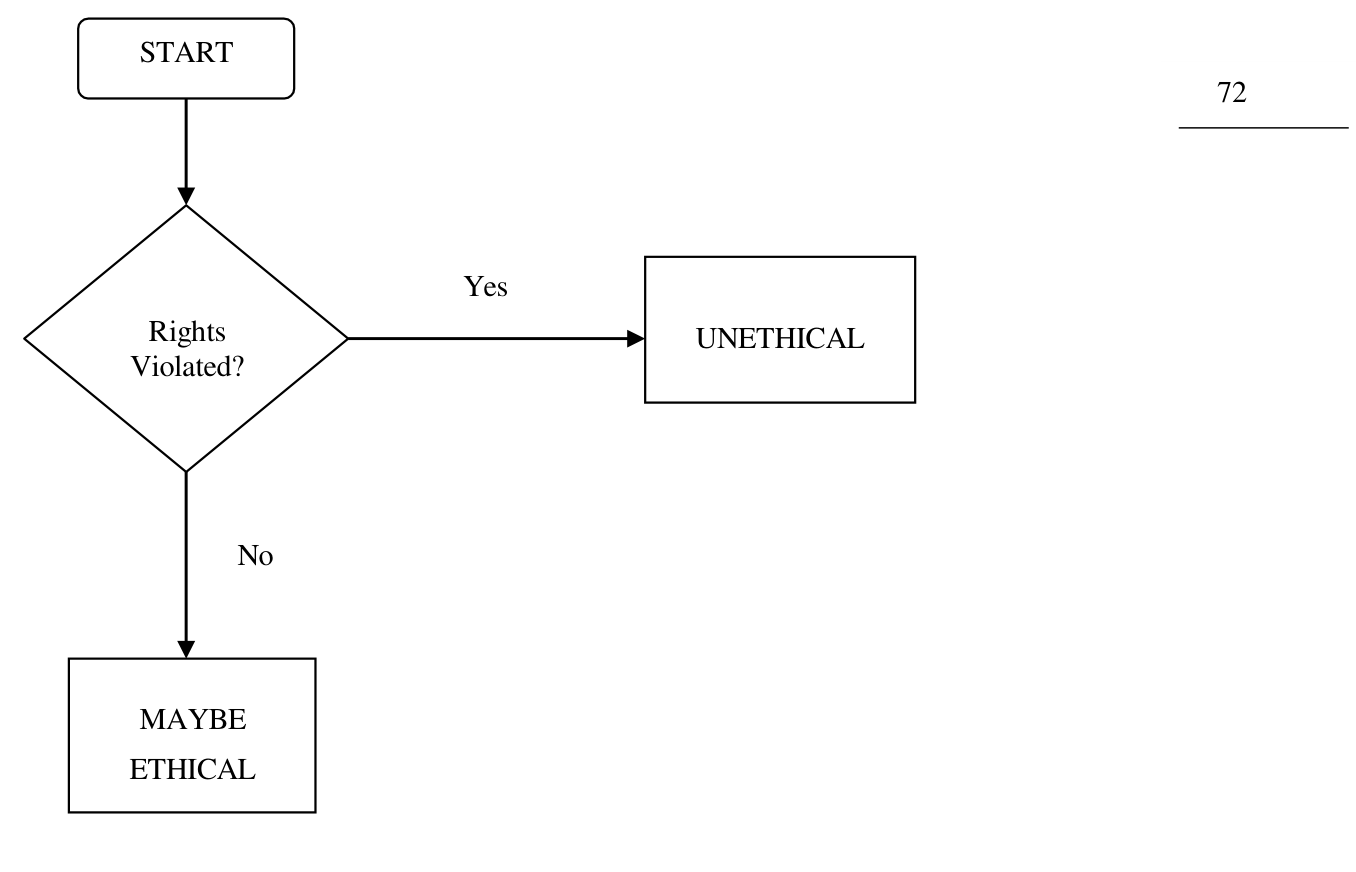
The rights-based approach is superior to the utilitarian approach because it allows one to identify unethical conduct without trying to apply some imperfect calculus. But rights theory cannot answer all ethical questions. It tells us that any act that violates rights is unethical but it does not tell us that any act that does not violate rights is ethical. Prostitution, suicide, the taking of illegal drugs and other victimless crimes may or may not be unethical. One can disagree on the morality of these acts but there is no disagreement that engaging in these activities does not violate anyone’s right (Feinberg 1990; McWilliams 1996; Rich 1978).
Most writers on trade topics take a purely utilitarian position and ignore the rights approach entirely. If rights are discussed at all, it is an incomplete subset of rights. Also, the general approach to discussions of economic sanctions is to provide an incomplete utilitarian and rights analysis.
Some examples are in order. In the case of free trade versus protectionism, the existing literature generally compares gains and losses and ends the discussion at that point. If free trade is good, it is good because there are more winners than losers. Rights issues are completely ignored. The fact that consumers are not able to exercise their right to trade the property they have (cash) for the property they want (a Japanese or Korean auto) because some trade restraint precludes them from exercising their property right is never discussed.
The same may be said for discussions of antidumping laws. Such laws prevent consenting adults from trading the property they have for the property they want. This issue has not been discussed in the antidumping literature. What is discussed is the deadweight loss that results from antidumping laws.
In the case of economic sanctions, the analysis needs to go beyond that of current scholars who have addressed this topic in at least two important ways. From the perspective of utilitarian ethics, their analysis is incomplete because they do not include all affected groups in their analysis. They only look at the losses suffered by the target groups or country and compare those losses to the sacrifices borne by the initiator of the sanctions. They declare the sanction to be effective if the losses to the targets exceed the losses to the initiators, or if the losses to the targets lead to a change in their behaviour.
No philosopher of a utilitarian bent would accept such an analysis. Frederic Bastiat (1801-1850) warned us against such analyses. If we are to determine whether an action or policy meets the utilitarian criterion (more winners than losers), we must first attempt to identify all affected groups, then determine the effect that the policy or action has on those groups. The literature on economic sanctions almost uniformly ignores secondary effects of sanctions. U.S. manufacturers of aircraft engines are adversely affected by certain sanctions, as are U.S. hotel chains that are prohibited from doing business in Cuba. The people who would otherwise be employed in these activities suffer, as do shareholders. A good utilitarian analysis would include an examination of the effects on these groups, but most scholars in the area of economic sanctions ignore most or all secondary effects of sanctions. Hufbauer et al (2007) even go so far as to announce that they have not included any analysis of secondary effects in their study of more than 100 economic sanctions.
The other area where the analysis needs to go beyond that of most other scholars is the inclusion and application of rights theory. Property and contract rights need to be discussed. If someone’s property or contract right must be violated in order to enforce some protectionist measure, an antidumping law or a sanction, that is merely part of the utilitarian calculus for them. In reality, it is the factor that makes the act or policy unethical because it fails the rights test.
Some scholars who write about economic sanctions do discuss rights issues. However, their analysis is generally limited to human rights issues, such as the oppressed people or Iraq or Cuba. They do not discuss other rights issues, such as property or contract rights. Any discussion of these issues sets one’s work apart from those of the other commentators.
Baron, Pettit and Slote (1997) have taken the position that three ethical systems have dominated the Western debate over the last few hundred years – consequentialism, Kantian ethics and virtue ethics. Graham (2004) has identified eight theories of ethics –egoism, hedonism, naturalism and virtue theory, existentialism, Kantianism, utilitarianism, contractualism and religion.
Consequentialism, which includes utilitarian ethics, holds that it is the consequence of an act (or a rule, in the case of rule utilitarianism) that determines whether an act is ethical. Kant rejected this view and held that it is intent, not the consequence, that determines whether an act is ethical. Kant emphasized duty and categorical imperatives and asked questions like “What if everybody did it?” as a means of determining whether an act is ethical.
I also reject utilitarianism, mostly because it totally ignores property, contract and association rights, because of some of utilitarianism’s other flaws as well. Those who engage in protectionism are acting unethically because they violate rights. The fact that their intentions may be pure (although misguided) is irrelevant. Likewise for those who employ economic sanctions to punish some individuals or groups because their behaviour does not conform to some norm. Slapping economic sanctions on individuals violates their rights and cannot be condoned except (perhaps) in the case of war.
The issue of intent in the case of antidumping laws also seems to be irrelevant. Using the antidumping laws to punish acts between consenting adults always violates the rights of those consenting adults. Antidumping laws can be used as a tool of protectionism. If the intent of using them is to harm competitors, it could be argued that the perpetrators are more evil than would be the case if they acted with the purest of motives. Dante would likely assign them to a lower rung of hell because of their evil intent. However, from the perspective of determining whether the use of antidumping laws is ethical, it does not matter what the intent is. Using antidumping laws always violates the rights of those who are targeted, and such use is always unethical on that account alone, without regard to intent.
We could take a Kantian perspective to other trade topics – protectionism in general, antidumping laws in particular and economic sanctions. If we asked, “What if everyone engaged in protectionism?” our conclusion would be that protectionism is unethical because it reduces overall welfare and always involves the violation of property, contract and association rights. We would arrive at the same conclusion if we asked the same question regarding antidumping laws and economic sanctions.
Going to the legislature or to some executive agency to target competitors, whether by the use of antidumping laws or some other protectionist tool, could be viewed as a form of theft, in the sense that such acts result in depriving rightful owners from the use of their property. The main difference between traditional theft and these forms of theft is that government agents are used to do the dirty work.
Most ethical systems consider theft to be unethical, although the reasons sometimes differ. Virtue ethics would hold that theft is unethical because virtuous people do not commit theft. Religious-based ethics would hold theft to be unethical because the Bible says “Thou shalt not steal.” Utilitarians and Kantians would conclude that theft is unethical because of its consequences.
It might also be mentioned that societies where property rights are respected tend to be societies where there is human flourishing, which would be in keeping with both virtue ethics and the various forms of consequentialist ethics, not to mention the Kantian categorical imperative.
The imposition of economic sanctions violates property, contract and association rights, which would be considered unethical under most ethical systems. It would be unethical under virtue ethics because sanctions do not result in human flourishing. If we asked the Kantian question – What if everyone did it? – we would reach the same conclusion. If one determines the ethics of an act by intent rather than consequences, the solution is more complicated because some sanctions are imposed with the best of intentions.
One criticism that could be made of using intent as the measure of whether an act is ethical is that identical acts by two individuals could be viewed completely differently. For example, if one individual imposes sanctions because he sincerely thinks that the imposition will be for the good of the people in Country X, his act could be considered to be ethical even though the actual result is to make their condition worse than before the sanction was imposed. Another individual who had evil intent would be considered to have acted unethically for imposing the same sanction.
For utilitarianism and rights theory – intent is irrelevant. All that matters is whether the result is a positive-sum game (in the case of utilitarian ethics) or whether someone’s rights are violated (in the case of rights theory).
3. Free Trade vs. Protectionism
Thousands of books and articles have been written about free trade and protectionism over the centuries. In The Politics Aristotle (1941) spoke about the evils of trading with other Greek city states more than 2,000 years ago. His view was that such trade tarnished the soul. Plato (1982), his teacher, said basically the same thing in The Laws. Some of the main arguments against free trade have been that:
- Trade is a zero-sum game; for every winner there is a loser. • Trade deficits are bad; trade surpluses are good. • Free trade destroys jobs; domestic jobs must be protected. • Globalization is bad.
More recent scholarship has attacked free trade – acts between consenting adults involving more than one country – on several counts. Some scholars begin with the premise that trade is a zero-sum game, that for every winner there must be a loser. Thus, they argue that domestic industries must be protected so that their country can be the winner, or at least not the loser.
I have argued against this view on several occasions (McGee 1994; 2002; 2003a; 2008a&b). Trade is a positive-sum game. If both sides did not benefit, in their own subjective judgment, there would be no trade. No one enters into a trade agreement with the intent of becoming worse off.
Statistics are compiled monthly to measure these so-called gains and losses. Trade deficits are supposed to be bad and trade surpluses are supposed to be good. There are several weaknesses in such a position. The main one is that both parties are always better off as a result of being able to trade what they have for what they want. It is therefore illogical to conclude that trade deficits are bad while trade surpluses are good. This point has been discussed in detail elsewhere (McGee 1992) and I will not repeat myself here, other than providing a brief summary.
Another problem with the “trade deficits are bad” philosophy is that there is a problem measuring the numbers. Since every transaction involves both a buyer and a seller, one would think that if one added up all the sales and subtracted all the purchases the sum would be zero on a worldwide basis. But such is not the case. The world is in a net trade deficit position, a situation that would be impossible if the numbers were compiled accurately. Thus, economic policy decisions are being made based on incomplete data.
Another problem with the “trade deficits are bad” philosophy is the fact that large nations will always have trade deficits with small nations, all other things being equal. For example, Japan has a population of about 127 million (CIA 2007). The United States has a population of about 301 million (CIA 2007). If everyone in Japan bought $10 worth of stuff from the United States and if everyone in the United States bought $10 worth of stuff from Japan, the United States would have a negative trade balance with Japan because people in the USA buy more total stuff from Japan than Japanese people buy from the USA.
Some people say such a situation is bad and argue that the Japanese should buy more US products. But in order to have an equal balance of trade with Japan, the average Japanese person would have to buy $2.37 worth of US goods for every dollar of Japanese goods the average American buys.2 Such a requirement seems unfair to the Japanese, first because each Japanese would be required to buy more per capita than the American counterpart and secondly because they would be pressured to do so. Certainly, they should not be forced to purchase US goods. They should not be pressured to do it either, since

people should be able to spend their money as they see fit, not as some government sees fit. They should be free to buy or not buy from anyone they want without being pressured or required to by some government.
Another problem with the “trade deficits are bad” philosophy is that the people who advocate this view are guilty of what Frédéric Bastiat called the mother of all economic fallacies – the failure to look at all sides of the issue, both long-term and short-term (Bastiat 1964abc; Hazlitt 1946). When Japanese goods flow into the United States, U.S. dollars flow into Japan. But Japan cannot use U.S. dollars in the domestic Japanese economy, so they flow back to the United States in one form or another, either to buy U.S. goods or to invest in the U.S. economy. Either way, the domestic money supply increases, thereby putting downward pressure on interest rates, making it easier for U.S. businesses to borrow money to finance their operations, to expand, to create jobs domestically, etc. Lower interest rates also make it easier for consumers to buy homes, which help the real estate market and increases home ownership and individual net worth. In other words, the country becomes stronger economically, not weaker, as the “trade deficits are bad” crowd would have us believe.
The point is that merely looking at trade balances and concluding that trade deficits are bad is not only bad philosophy; it is also bad economics. Various authors have agreed with my position, including Adam Smith (1776; 1937, book IV, chap. III, part 2), Bastiat (1964bc), Machlup (1976), Rueff (1967) and Wells (1988). However, this view that trade deficits are bad and trade surpluses are good refuses to go away in spite of the overwhelming evidence. Daniel Griswold (2011) made pretty much the same arguments to show that the trade deficits are bad theory is untenable. Recent discussions taking the position that trade deficits are bad were made by Lynch (2010) and Schneider (2010) and Cha (2010). Their view is based on an incomplete analysis because they fail to take into consideration the other side of the transaction, the cash flows that come into the importing country, which serve to reduce interest rates and the cost of capital. They make the same mistakes that Frédéric Bastiat warned against in the 1840s (Bastiat 1964b&c).
One of the main arguments in favour of protectionism is that domestic jobs must be protected. But, although it is true that free trade destroys jobs, it also creates jobs. In fact, studies have estimated that for every job lost as a result of free trade, two or three or more jobs are created, or that the cost of saving a job exceeds the salary of the worker whose job is saved (Boorstein 1987; Bryan & Humpage 1984; Collyns & Dunaway 1987; Crandall 1984, 1987; deMelo & Tarr 1990; Dinopoulos & Kreinin 1988; Feenstra 1992; Hickok 1985; Hopkins 1991; Hufbauer, Berliner & Elliott 1986; Lindsey 2004; Luttrell 1989; Smith & Venables 1991; Tarr & Morkre 1984). The Institute for International Economics sponsored major studies to measure the costs of protectionism in Europe (Messerlin 2001), the United States (Hufbauer & Elliott 1994), China (Shuguang, Yansheng & Zhongxin 1998) and Korea (Kim 1996). More recent studies have also concluded, mostly on utilitarian grounds, that free trade is the best policy (Bhagwati 2004; Griswold 2007; Ikenson 2009, 2010, 2011; James 2009; Sally 2008; Wolf 2004).
This creative destruction is inherent in any vibrant market economy (Cowen 2002; Schumpeter 1942). The alternative would be less destruction but even less creation, meaning economic growth. Those who look only at the job losses (Vargish 1992) without also considering job gains are guilt of incomplete analysis, since they fail to consider the effects on all groups, both long-term and short-term, which has been pointed out elsewhere (McGee 1994, 2002).
Another facet of the free trade vs. protectionism debate is the globalization debate. This debate sometimes involves the trade deficit argument, the positive versus negative-sum game argument and the creative destruction concept. All of these arguments have already been discussed, so there is no need to rehash those discussions.
Basically, globalization is no more than trade between a buyer who lives in one country and a seller who lives in another country (Bhagwati 2004; Cowen 2002; Marber 1998; Moran 2002; Norberg 2003). It is little more than an application of the theory of comparative advantage that Adam Smith spoke about in 1776 and David Ricardo discussed in 1817. It’s just that more of this kind of trade seems to be going on these days. Admittedly, trade has an effect on culture, but the effect is generally good, in the sense that individuals who participate in trade necessarily benefit from it. Otherwise, they would not engage in trade (Cowen 2002; Rivoli 2005).
My position is that consenting adults should be able to trade what they have for what they want without interference by any other party, including government. My position is based on both utilitarian ethics and rights theory. Free trade is a positive-sum game. Both sides benefit. There are no losers, except perhaps the companies who make products no one want to buy (General Motors, Ford, U.S. textile companies, etc.), but such companies are not part of these trades. A free trade regime is the only regime that does not involve force or the threat of force. Thus, a free trade regime is superior to other regimes on moral grounds.
A number of scholars agree with the position that free trade should not be restricted, although they do so on utilitarian grounds. Authors in this category include Bhagwati (1988, 2000, 2002), Cowen (2002), Curtiss (1953), Elliott & Freeman (2003), Gable (1986), George (1980), Irwin (1996, 2002), Larsson (2001), Lindsey (2002, 2004), Marber (1998), Rivoli (2005), Taylor (1986), Taylor (1992), Thornton & Ekelund (2004), and Wolf (2004).
At the opposite end of the spectrum are those who think globalization is evil. The main criticism of their position might be that they ignore the fact that trade is a positive-sum game. Opponents of globalization who fall into this category often hold this position because of the belief that globalization harms the poor, which is sometimes correct (remember creative destruction?) but is quite often not the case. Some of the authors who fall into this category include Mander & Goldsmith (1996) and Korten (2001). The International Forum on Globalization (2002) has also come out against globalization.
Graham (2000) takes the position that these antiglobalizationists are fighting the wrong enemy. Rather than fighting multinational corporations, they should support agreements that foster foreign direct investment. Saari (1999), one of the antiglobalizationists, disagrees with this view, holding that multinational corporations should not be able to invest carte blanche in developing countries. Saari’s view is that the people did not elect investment bankers and CEOs, and that the public interest is therefore not represented.
The counterargument to this view is that there is no need to get the consent of anyone who is not a party to the transaction. There is no reason to ask for permission of the United
Auto Workers in Detroit if some Japanese auto maker wants to sell a car to an American in Arizona or Oregon. Likewise, there is no need to get anyone’s permission if some multinational corporation wants to borrow money from some bank in order to build a plant facility in Guatemala that will employ a few hundred or a few thousand workers.
Sometimes the antiglobalizationists hold these beliefs because of the often incorrect view that workers are exploited under globalization. But in fact, if workers are exploited in some cases, it is often not because of the spread of free trade but rather because some government intervention prevents workers from working or because the WTO or some other trade agreement prevents their employers in developing countries from selling their products in developed countries.
If globalization is to be criticized, it is because some of these so-called free trade agreements, like the WTO agreement, actually manage trade. The WTO, NAFTA and various other trade agreements have rules that restrict trade in some cases (Barfield 2001; Chanthunya & Murinde 1998; Danaher 2001; Destler 2005; Wolf, Globerman & Walker 1994; Hufbauer & Schott 1992, 1993; Martin 1993; Mastel 1986; Noland & Pack 2003; Rogowsky, Linkins & Tsuji 2001; Sakalya 2004; Schott 1994; Wallach & Sforza 1999). In that sense, the anti- globalization advocates have a valid point.
Then there is a third group whose views fall somewhere in between the other two positions. Stiglitz (2003), a Nobel Prize winning economist, is perhaps the most visible of those who fall into this category. His view can be summarized as follows:
I believe that globalization – the removal of barriers to free trade and the closer integration of national economies – can be a force for good and that it has the potential to enrich everyone in the world, particularly the poor. But I also believe that if this is to be the case, the way globalization has been managed, including the international trade agreements that have played such a large role in removing those barriers and the policies that have been imposed on developing countries in the process of globalization, need to be radically rethought.
If one were to summarize my positions on the various free trade vs. protectionism arguments, it would be that:
- Trade is a positive-sum game; there are more winners than losers. • Trade deficits are not necessarily bad; trade surpluses are not necessarily good. • Free trade destroys jobs but it also creates more jobs than it destroys; domestic jobs must not be protected. • Globalization is good.
The debate on these issues has not changed much since Bastiat discussed them in the 1840s. That is often the case in the soft (social) sciences. Each generation forgets the refutations of the prior generations and feels compelled to reinvent the wheel.
Eggert and Greaker (2011) talk about trade policy in terms of increasing welfare, which is a consequentialist, utilitarian approach. Bird, Vance and Woolstencroft (2009) do make an attempt to discuss ethical aspects of protectionism but their discussion is limited to fairness and procedural justice. Property and contract rights issues are not discussed. Abboushi (2010) proves empirically that trade protectionism is harmful. He does not discuss rights issues at all. Kim (2010) discusses buy national policy from the perspective of politics and welfare economics. Ehrlich (2010) discussed the fair trade-free trade debate from the perspective of welfare economics. He did not discuss rights issues.
4. Antidumping
Those who advocate antidumping laws do so because of the belief that they are needed to prevent unfair trade practices. Those who oppose antidumping laws assert that the antidumping laws themselves constitute an unfair trade practice. There are three basic views of antidumping laws. They:
- Are fine just the way they are, or perhaps need to be strengthened; • Need to be reformed; or • Need to be abolished.
Antidumping laws are a subset of protectionism. Ostensibly aimed at fostering “fair trade,” whatever that is, in reality antidumping laws are used as weapons of protectionism. Domestic producers use them to prohibit foreign producers from offering their goods on domestic markets at competitive prices.
A number of utilitarian based studies have measured the gains and losses from various antidumping actions. Perhaps the most damning utilitarian study was done by the United States International Trade Commission (1995), one of the two agencies charged with enforcing the antidumping laws in the United States. The USITC found that antidumping laws produce a deadweight loss of billions of dollars a year in the United States. Their estimate was conservative, since they did not attempt to measure some of the adverse secondary effects that antidumping laws have on trade.
However, not all studies of antidumping laws conclude that they are counterproductive. Some scholars advocate the use of antidumping laws to promote fair trade. Mastel (1998) is perhaps the most famous scholarly proponent of this view. Those who support antidumping laws on intellectual grounds (which leaves out domestic producers and labour unions) argue that foreign companies should not be allowed to dump their products on the domestic market. By dump, they mean either selling below cost or selling on a domestic market for less than the price they charge for selling in the home market.
There are several weaknesses in this argument. For one, companies that sell below cost will eventually go out of business, so it is usually economically irrational to sell below cost. The counterargument is that they sell below cost only until they drive out all competitors, at which point they can raise prices to reap monopoly profits. The problem with this argument is that a predatory pricing strategy is irrational because the company engaging in it makes itself worse off instead of better off (Bovard 1991: 155-158).
Even in the rare case where a company is able to drive out all competitors, the only thing that can keep them out of the market is low prices. Once the predatory pricing monopolist starts raising prices, competitors will re-enter the market. Several studies over the years have examined the predatory pricing argument and have tried to find actual cases where predatory pricing has been successful, so far in vein (Armentano 1972, 1990; Bovard 1991, 157; Fisher 1987; Koller 1971; McGee 1958; McGee 1994, 137-141; Shughart 1990). Their conclusion is that predatory pricing exists in theory but not in practice. Thus, applying the predatory pricing argument to dumping is a nonstarter, as has been pointed out elsewhere (McGee 1994, 2000, 2003a, 2008a&b).
Another aspect of the selling below cost argument is that it can sometimes be rational to sell below cost if the alternative is to not sell at all. For example, a flower monger in New York, when faced with the prospect of either selling his wilting Dutch tulips below cost or not selling them at all would logically decide to sell them for whatever he can get, since the alternative would be not to make any sale at all. Yet the U.S. antidumping laws would treat wilted flowers the same as fresh flowers (Bovard 1991, 120; McGee 1994, 105). Such flower mongers would thus be found guilty of dumping even though they made the rational decision, with no intent of driving domestic flower growers out of business.
The problem with the concept of fair trade rather than free trade is that reasonable people can differ as to what fair trade means. What seems fair to some may seem unfair to others. The problem with any so-called fair trade regime is that someone rights must always be sacrificed in order to achieve what the author considers to be fair.
My definition of fair trade is trade where people are completely free to trade what they have for what they want without any interference. Any trade that involves restrictions on free choice is not fair, as Bovard (1991) and others (McGee 1994) have pointed out, because parties who are not involved in the trade must necessarily use force or the threat of force to prevent consenting adults from trading what they have for what they want (McGee 2000; 2002; 2003a & c; 2004; 2008a&b).
Another problem with punishing foreign producers for selling their products to consenting domestic adults for lower prices than what the foreign producers charge their own consumers at home is that the foreign producers are actually doing domestic consumers a favour by offering them low prices. Admittedly, domestic producers might lose sales if foreign producers offer lower prices, but no one’s rights are violated as a result of the practice. Thus, foreign producers are found guilty of dumping, and are therefore punished, when in fact the dumping is beneficial to a large segment of the domestic population – millions of consumers compared to a handful of domestic producers.
Thus, from a utilitarian perspective, the practice results in a positive-sum game, and from the position of rights theory the practice of selling at low prices should be permitted because no one’s rights are violated. Although a number of authors have addressed the topic from a utilitarian perspective, most publications overlook this rights issue, with a few exceptions (McGee 2000; 2002; 2003a & c; 2004; 2008a&b). Economists tend to be utilitarians and utilitarians do not discuss rights, or if they do, they disparage them (Bentham 1987; 1988; Waldron 1987).
The antidumping literature falls into three general categories. One group likes the antidumping laws just the way they are, or perhaps they would prefer to strengthen them so that they are even more protectionist. Mastel (1998) falls into this category, as do many domestic producers, most labour unions and a number of WTO member states.
The second group calls for reform but not abolition of the antidumping laws. These calls for reform are almost always based on utilitarian arguments. Scholars in this category include Cass and Narkin (1990), Dale (1980), Gunn (2005), Hindley & Messerlin (1996), Johnson (1992), Kaplan, Kamarck & Parker (1988), Knoll (1987), Lindsey & Ikenson (2002), and Palmeter (1986, 1988).
The third group calls for outright abolition. This group includes Bovard (1991), Bastiat (1964bc) and Caine (1981). Choubey & Singh (2004) take the position that the best course is abolition, but rather than advocating abolition they take the fallback position that the antidumping laws should be merged into the antitrust laws.
All of these advocates also use utilitarian arguments to support their position. None of them discuss property or contract rights aspects of the issue. Broude (2003) states that the best solution is total repeal, but then goes on to advocate hammering out a new antidumping law that allows dumping in most cases but not in all cases. Again, the arguments he uses to justify his various positions are all utilitarian based.
To summarise my own position on antidumping laws, they:
- Always constitute a negative-sum game because the losses exceed the gains, thus violating utilitarian ethics; • Always violate property and contract rights; and • Need to be repealed because they cannot be reformed in a way that does not violate property and contract rights.
Since I have published my views on antidumping, other authors have also addressed the issue. However, their arguments are more or less confined to utilitarian analyses. They do not address rights issues (Ikenson 2005, 2010, 2011). Lee & Baik (2010) published an article in the Journal of Business Ethics that addresses some ethical issues, but their focus was on the relationship between the effort that complaining companies exert and the returns they receive from filing antidumping petitions. They concluded that the firms who lobby for protection are the ones who receive the largest return.
Peng, Wang & Jiang (2008) view antidumping as a barrier to entry for emerging economies. Their analysis is limited mostly to utilitarian approaches. Bao & Qiu (2011) investigated whether China’s antidumping policies are more retaliatory than those of the United States. Again, their analysis is utilitarian based and does not address issues of property or contract rights. Zeng & Liang (2010) examined the effect of the US use of antidumping laws on China. These two Chinese authors employ a utilitarian or consequentialist approach.
Haberl (2007) examined the rise in the Chinese use of antidumping laws in recent years in her doctoral dissertation. I also examined this issue but included several additional Asian countries in my most recent analysis (McGee 2008b). Collie & Le (2010) used a
Bertrand duopoly model to arrive at the conclusion that antidumping laws can be used to reduce competition. Their study did not speak about property or contract rights.
Vandenbussche & Zanardi (2010) studied the chilling trade effects that the proliferation of antidumping laws have on trade. Again, their approach is consequentialist. Another study examined the evolution of Japan’s antidumping system. They do not examine rights issues (Song & Lee, 2010).
This lack of discussion on rights issues could be attributable to the fact that most of the authors are Asian, and that Asians generally do not discuss rights issues. Alternatively, the lack of a rights discussion could be attributable to the fact that they are economists, and economists do not usually discuss rights issues. Two of my recent articles on antidumping laws (McGee 2008 a&b) devote substantial space to the discussion of rights issues.
5. Economic Sanctions
The international relations literature is divided into two main camps when it comes to sanctions. One group holds that sanctions generally are effective. The other camp holds that they generally are not effective. However, there are at least two deficiencies in this literature – incomplete utilitarian analysis and lack of a discussion of contract and property rights violations.
I have addressed issues relating to the ethics of economic sanctions elsewhere (McGee 2002; 2003b) and will not repeat myself here., other than to say that many authors who write on this topic focus on the political success of sanctions. They attempt to answer the question: “Did the sanction result in the desired political outcome”? For example, did the U.S. sanctions against Cuba result in Fidel Castro’s overthrow? Did the arms embargo against Bosnia save lives and bring the war to a quicker conclusion? Did Roosevelt’s embargo of war materiel against the Japanese and the freezing of Japanese assets in the United States cause them to fail in their invasion of Manchuria?
In a sense, the embargo against the Japanese was successful, since it caused them to lose Manchuria. But the embargo and freezing of Japanese assets also led to the bombing of Pearl Harbor, the event that triggered United States entry into World War II, causing the loss of a quarter million American lives. So, although international relations theorists might conclude that the embargo was successful because it achieved the desired result, a complete utilitarian and rights analysis would reach the opposite conclusion, since the result was a negative-sum game that violated property and contract rights and led to the deaths of hundreds of thousands of Americans as well as many more Japanese, many of them civilians.
International relations specialists are particularly prone to view sanctions from this perspective – Did they do what they were supposed to do? (Cortright & Lopez 2000; Haass 1998; Haass & O’Sullivan 2000; O’Sullivan 2003; Shambaugh 1999) Any ethical analysis of sanctions is considered irrelevant. In fact, many international relations specialists of the realist school (Machiavelli, 1981, comes immediately to mind but he is not the only one) do not think that ethics should even be considered as a topic worthy of discussion when it comes to the formulation of international relations policy (Bonanate 1995; Frost 1996; Graham 1997; Nardin & Mapel 1999; Nolan 2004; Rosenthal 1999; Seckinelgin & Shinoda 2001; Sutch 2006; Valls 2000). My prior work brings ethics into the discussion as perhaps the central point, which makes some economists and policy makers uncomfortable, as evidenced by some of the correspondence I have received (McGee 2002; 2003b).
Some economists and scholars from other disciplines have applied economic theory to various sanctions. Attempts have been made to compute the cost of sanctions to various parties. Studies of this nature include a United States International Trade Commission study (2001) that tried to calculate the economic impact of U.S. sanctions on Cuba. Yang, Askari, Forrer & Teegen (2004) conducted an empirical study aimed at estimating the impact of U.S. sanctions on a number of countries. Rarick (2007) concludes that economic sanctions are a failed policy tool and increase costs to American business.
Various authors have concluded that sanctions make for good policy when they are effective but bad policy when they are ineffective (Drury 2000; Elliott & Hufbauer 1999; Farmer 2000; Hufbauer & Oegg 2000; Hufbauer, Schott & Elliott 1990ab; Lugar 1999; von Sponeck 2000; Sugg & Kreuter 1994), a conclusion that is utilitarian based in a flawed sort of way. This approach is flawed in the sense that it does not measure gains and losses, but merely concludes that a sanction is good if it accomplishes the intended goals, even if the result is a negative-sum game. Other authors use economic analysis to conclude that sanctions are bad because they result in losses for the United States (Singleton & Griswold 1999). Others talk about fairness and optimal enforcement policy (Polinsky & Shavell 2000).
International relations theorists regard a sanction as successful if it achieves the goal and unsuccessful if it does not. A major economic study conducted by economists (Hufbauer et al. 2007) uses this belief as the premise for their study. But a thorough and complete utilitarian analysis requires that an attempt be made to determine the effect that a policy has on all groups, as Bastiat (1964c) has pointed out.
Such an analysis quickly finds that all sanctions fail the utilitarian test because both the initiator and the target lose as a result of the sanction. The result is a negative-sum game even if one ignores the negative secondary effects that the sanction has on other groups, such as the suppliers who cannot supply the target country with their goods and the individuals who cannot be employed because the sanction prevents business from taking place.
However, in the interest of completeness, it should also be pointed out that there are also winners whenever an economic sanction is imposed. When the U.S. government prohibits American hotel chains from doing business with Cuba, both the American hotel chains and the Cubans lose. But Spanish, French and German hotel chains stand to gain from the lack of competition. Furthermore, if they do not have to compete with Americans, they can charge higher prices than would otherwise be the case, but only at the expense of the foreigners who spend time in those Cuban-based hotels. So even foreign consumers lose as a result of the economic sanctions the United States imposes on Cuba, since they have to pay higher prices when they vacation in Cuba.
Economic sanctions also necessarily violate individual property and contract rights, thus failing the rights test. Some of my prior work mentions this often-overlooked aspect of sanctions (McGee 2002, 2003b) whereas those of other scholars generally ignore this topic, perhaps because they limit their analysis to utilitarian approaches. American hotel chains have a right to set up shop anywhere they want, provided they can find someone willing to sell or lease them the land they need to build. Their rights are being violated whenever they are prevented from entering into such transactions, as are the rights of whoever would be willing to sell or lease them the land they need.
Of course, there are also economic losses. Jobs are not created. People who would otherwise be employed in the hotels must settle for some less desirable job. Secondary industries are also adversely affected, since airlines will not be carrying as many people to Cuba, the people who would supply the food and linens to those hotels would not have the business because the hotels do not exist, etc. These overlooked rights violations have been pointed out in several places (McGee 2002, 2003b).
A few studies have mentioned human rights violations that occur as a result of economic sanctions. Some of these studies focus on a particular country, such as Iraq (Clark 1998ab; Cortright & Lopez 1999), Cuba (Murray 1993; Prada 1995) or Haiti (Gibbons & Garfield 1999), while others focus on public health concerns (Marks 1999). However, most scholars and public policy analysts fail to mention violations of property and contract rights.
A review of the literature on sanctions found that the discussion has not changed much in recent years. Scholars continue to take an incomplete utilitarian approach, although in the case of sanctions aimed at punishing terrorists they also sometimes discuss legal issues in addition to inefficiency (Bures 2010). Drulakova, Travnickova & Zemanova (2009) continue to advocate economic sanctions as a means of cramming the agenda of one nation down the throat of another nation. Zhao (2010) examines Chinese views on sanctions from a behavioural perspective. Peksen (2010) conducted an empirical assessment of the impact of economic sanctions on press freedom, which touches indirectly of the right to a free press, although the approach is consequentialist.
In summary, a search of the recent literature on sanctions failed to find any studies that examined or discussed property and contract rights issues.
6. Implications
One can overcome the deficiencies of utilitarianism by applying rights theory. It is not necessary to attempt to identify all affected groups, then apply some obscure calculus in an attempt to determine whether the result is a positive or negative-sum game. All that needs to be done is to determine whether anyone’s rights have been violated.
But applying rights theory to trade policy is only one of many possible applications that may be made. The rights approach can also be applied to a number of other economic, political and social policies as an alternative to the usual utilitarian approach. Thus, the rights approach may be used as a template to determine the ethics of any number of policies or actions.