 Journal of Global Trade, Ethics and Law
1. Introduction
Exports are considered as injection into the economy, it increases the inflow of money from another economy. It stimulates growth and economic activity especially to goods that are being exported. Philippines and Japan engaged into an agreement in 2006 with the aim of increasing economic cooperation between the two economies. It included several provisions such as tariff elimination, accord for national treatment of investors, freer movement of Filipino professionals, promotions of competition by addressing anticompetitive activities, and on government procurement.
Under the provision on tariff elimination, 66% of the total tariff lines were immediately eliminated and the remaining 32% will be gradually reduced in different schemes. It aims to increase trade between the two countries and foster economic growth by expanding the domestic market base and increasing the domestic producer surplus.
More than 10 years have passed since the implementation of the agreement and no empirical papers have been done to test the effect of the agreement in terms of tariff elimination to economic growth.
The standard Gravity Model has been used to examine effects of bilateral agreements. However, modifications of the standard model can be used to formulate more suitable models depending on the specifications of the agreement. In the case of the Japan Philippine Economic Partnership Agreement (JPEPA), the elimination of tariff in different schemes requires estimation on a per tariff line level and may not be addressed by the standard Gravity Model.
This paper focuses only on the economic factors in terms of tariff reduction and its simultaneous effect on trade and economic growth. Other provisions of the agreement is not included in the scope of this paper. The estimation on this paper covers periods before and after the agreement considering different tariff elimination schemes. Specifically, this paper aims to determine the impact of the agreement to the trade value of Philippine exports to Japan and the simultaneous impact to the economic growth of the Philippines.
This paper aim to contribute to existing literature on bilateral trade flow by addressing one of the weaknesses of the standard Gravity Model encountered when there are zero trade flow reported for specific tariff lines. The paper disaggregates the tariff rates and value on a per tariff line level. It also address the gap in previous empirical papers on how changes in trade flow translates into development in the country by using simultaneous equations. It aims to come up with a model that other countries may be able to use in assessing how trade agreements can affect the overall development of the economy.
2. Literature Review
The Gravity Model has been used in analysing bilateral trade flow between countries (see: Duzgun & Tekce, 2014; Drzewoszewska, 2015; Reyes, Wooster & Shirrell, 2014; Hayakawa, Kimura & Nabeshima, 2014; Ravishankar & Stack, 2014; Mohmand et al., 2015; Kunroo & Azad, 2015; Gylfason, Martinez-Zarzoso & Wijkman, 2015; Kahouli &
Maktouf, 2015; Papalia & Bertarelli, 2015; Khosla, 2015; Boxell, 2015; Proenca, Sperlich, & Savasci, 2015; Gervais, 2015; Egger & Staub, 2016; Madah & Nagheli, 2016; Cipkute, 2017; Bujang, 2016; Hndi, Maitah & Mustofa, 2016). Based on the Gravity Model, higher income countries are drawn toward each other by gravitational pull of their respective size and other push and pull factors. The volume of trade between two countries is a function of the relative distance and income of the two trading economies (Sonora, 2014).
Igbal, (2016) applied the Gravity Model in Pakistan and found out that the GDP of trading partners are statistically significant to trade flow. Membership of Pakistan to a Regional Trade Agreement has been found to have positive significant relationship to trade flow as well. Chen & Li (2014) integrated the standard Gravity Model with Trade Intensity Index. The Gravity Model Adjusted Trade Intensity (GMATI) index covers short run and long run effects of different trade barriers. Jarreau (2015) used a multisector structural Gravity Model of international trade to estimate potential real income gains from a trade agreement.
Eita (2016) used the Gravity Model in the analysis of trade flow in Namibia. Gross Domestic Product of importing countries significantly increase the exports of Namibia. While the relative distance and real exchange rates negatively affect its exports to trade partners.
Studies used the Gravity Model with policy variables, such as membership in a trade agreement, represented as a dummy variable (Mohmand et al., 2015).
Duzgun & Tekce (2014) used the Gravity Model in the bilateral trade relationship between Turkey and Former Soviet Union. While Afolabi, Bakar & Aziz (2015) used it to analyse bilateral trade across ECOWAS-15 nations.
However, there are some limitations in the use of Gravity Model encountered by different researchers. According to Urata, S. and Okabe (2014), using aggregated data in the analysis of a Regional Trade Agreement may not accurately capture its impact to trade since generally the treatment of tariff reduction or elimination differs substantially by product. Hayakawa, Ito & Kimura (2016) also used disaggregated tariff line-level trade data in their paper.
Trade agreements’ primary objective is to increase trade between the participants by lowering cost and uncertainty to trade (Kahouli & Maktouf, 2015, Bilas & Franc, 2016). A lot of countries have been experiencing higher exports from joining trade agreements. Example is the case of North African countries who have started exporting commodities such as dairy and vegetables due to trade accords (Hndi, Maitah & Mustofa, 2016).
Regional Trade Agreements increase trade between countries by reducing uncertainties, mitigating market externalities, providing guidelines for economic exchanges, and facilitating smooth transactions (Zhou, 2015).
The Gravity Model was used in the paper of Khosla (2015). Based on the findings, preferential tariff treatments brought about by a trade agreement helped expand the exports of Africa to China. However, it did not lead to a significant growth in the economy since most products for which China grants tariff exemptions are primary or raw materials.
International trade is a key element of Globalization and a country’s participation in international trade is a path to economic growth (Cipkute, 2017). There has been study showing the reverse causality between openness to trade and economic growth (Gervais, 2015).
Based on the study of Eita (2016), one of the drivers of economic growth is export. In Namibia, exports significantly affects capital formation and economic growth. Exports also improves the local economy by reducing external shocks.
In the study of East Asian trading countries, Suvannaphakdy & Toyoda (2014) has found out that bilateral trade flow is positively related to the sum of the GDP of the trading countries. In the study of Kocaslan, Ozcelebi & Ertugral (2014), Turkey’s economy may have been greatly affected by its foreign trade flow with its major trade partners in Balkans. Further, economic growth and competitiveness is a function of gross capital formation. Economic growth may also lead to the expansion of international trade. Trade liberalization’s objective is to promote trade that results to faster economic growth through Regional Trade Agreements (Liu, 2016). Park & Park (2016) used of Poisson Pseudo-Maximum Likelihood (PPML) estimation and found out discriminatory tariff reforms alone may not be sufficient to induce economic growth.
3. Methodology
The research design of this study follows a descriptive-causal approach. The descriptive aspect dwelt on a historical narrative of the different measurable factors that explain trade between the Philippines and Japan. Supporting tables and charts on the pertinent variables conditioning trade between the two (2) countries as well as appropriate descriptive statistics are supplied. Qualitative analysis was provided in the process.
The causal aspect of the study was met in terms of estimating an empirical model on the hypothesized relationships between trade value and the suspected conditioning variables and interpretation of their effects and magnitudes over a specified period of time which encompassed or straddled the implementation of the Japan-Philippine Economic Partnership Agreement (JPEPA). An important component of this aspect is the determination of how significant the hypothesized effects of the agreement are and whether they are consistent or not with the gravity model.
Quarterly data is used in the paper covering the period from the First Quarter of 2001 to the Fourth Quarter of 2014. Historical data on Philippine exports to and import from Japan were obtained from the Philippine Statistics Authority (PSA). Data on real gross domestic product (GDP) of the Philippines and Japan were sourced online from the Asian Development Bank (ADB) and the International Monetary Fund (IMF).
Two stage least squares (TSLS) is utilized in the paper to determine the simultaneous effect of the tariff reduction to trade value and growth in Real GDP of the Philippines.
Two economic models were empirically estimated and evaluated in this study. Their structural form are as follows:

Equation [3.1] is the gravity model of trade between the Philippines and Japan, where TVt is the value of exports of the Philippines to Japan, Ypt is the Philippines real GDP, Yjt is Japan’s real GDP, ATt is the Philippines weighted average tariff rate as proxy for distance, and D is a dummy variable for the implementation of JPEPA. Ut is a stochastic error term. This model will also estimate the impact of JPEPA on trade flows between Japan and the Philippines (Navarrete & Tatlonghari, 2018).
The variable AT is introduced in this paper in order to address one of the main limitations of using the Gravity Model where in some goods included in the model has zero trade value. It also address the different degree of tariff reduction per tariff line relative to the value traded since the weighted average is used. Specifically, the formula used is as follows:
![AT = [TRiVi…+ TRinVin]/Total Value of Trade (3.3)](/static/article-media/trade-agreement-as-a-model-of-development-the-case-of-the-japan-philippine-economic-partnership-agreement-jpepa/equation-002.png)
Where AT is the weighted average tariff rate, TR is the tariff rate per specific tariff line, and V is the traded value. Data used in the computation of AT was gathered from the Trade Analysis Information System (TRAINS) of the United Nations Conference on Trade and Development (UNCTAD). The paper used the 6-digit Harmonized System (HS) as basis for the different tariff lined used in the computation.
Equation [3.2] is a typical production function for the Philippines where YPt is real GDP, Lt is the employment index, Kt is capital stock, TV is value of trade value as an augmenting variable, and D is dummy for implementation of JPEPA as another augmenting variable. vt is stochastic error term. The development implication of bilateral trade flows and JPEPA on the country’s aggregate output performance is also addressed by this model.
Both models were originally estimated using Ordinary Least Squares (OLS) regression procedure and the results were presented separately. However, because the dependent variables, ln TV and ln GDP, appear as predictors in each other’s equation, simultaneity has to be taken into account. Two Stage Least Squares (TSLS) procedure had to be employed since both equations are overidentified based on order condition (Gujarati & Porter, 2009). Parameter estimates and relevant diagnostic tests were facilitated using the econometric software EViews Version 10.0.
Other Statistical Test were utilized to establish the econometric reliability of the models which includes: Test of stationarity of variables, Test of autocorrelation in the residuals, Normality test of residuals, Test of multicollinearity of variables, Test of structural stability of models, Test of misspecification, Test of heteroskedastic residuals, and Test of cointegrating relationships.
Out of sample observations was also used to determine the forecasting ability of the model. The out of sample observations includes all four quarters of 2014.
4. Results
The Trade Value of Philippine export to Japan grew at an average of 2.1% per quarter or at an annualized growth rate of 8.32% [(1.021) 4-1] This could have been higher if not for the sharp decline noted in 2012 which coincided with the AJCEP agreement.
The Philippine GDP registered a continuous upward trend during the same period registering an average quarterly growth of 1.8% or an annualized growth rate of 7.39%. This is practically nine (9) times higher than Japan’s GDP growth of 0.2% a quarter or equivalent to 0.8% per annum. The recession which apparently hit Japan in 2008 slowed down the country’s economic growth. Coincidentally, the Global Financial Crisis which affected most of Western Europe, US, and Japan began in 2008.
On the other hand, the weighted average tariff rate on Philippine exports to Japan declined almost continuously at an average of 1.0% per quarter or at annual rate of decline of 3.9%. The implementation of JPEPA could be attributed to this observed decline in tariff rates.
The gravity model is widely used to measure the impact of bilateral trade between two countries. However, Its beneficial effect to the economy cannot be viewed in isolation. Its relative impact on the economic development of a country as measured by its aggregate output growth or employment must be taken into consideration.
The main contribution of this paper in existing literature regarding bilateral trade flow is the integration of the gravity model with an aggregate production function given by Equation 3.2. Since ln TV appears as a predictor in the production function while ln Yp is also a predictor in the gravity model, both variables are endogenous and should be estimated simultaneously.
Since the original structural Equations 3.1 and 3.2 are over-identified based on order condition (Gujarati & Porter, 2009), an Instrumental Variable (IV) technique or Two Stage Least Squares (TSLS) procedure had to be implemented.
The first stage consists of estimating the reduced form equations by OLS as follows:
Reduced Form Equations (First Stage)

Table 1 gives the results of the first stage of the TSLS procedure on the reduced form equations.
GDPPH (OLS) TV (OLS)
Variable Coefficient Prob. Coefficient Prob.
C -11.5042 0.000000 -20.18246 0.000000
GDPJP 2.659809 0.000000 4.028119 0.000000
AT -0.004145 0.434800 -0.002031 0.847900

Interestingly, both labour (EM) and AT exert negative effects on Philippine GDP although C, AT, GDPJP, and D1 are statistically significant. Curiously, the dummy variable for JPEPA is significant but AJCEP is not. For the reduced form on TV, only AT and capital K are not statistically significant, while the rest of the predictors are.
The reduced form equations were used to generate fitted or estimated values of ln TV and ln YP separately and these were plugged or substituted as data series for the same variables in the structural equations during the second stage estimation of Equations 3.1 and 3.2. The results are as summarized in Table 2 as follows:

After taking into account the simultaneity of the relationships between TV and aggregate output GDP, the following results emerged from the second stage results of the TSLS procedure:
I. Trade Value is negatively affected by Philippine GDP and the first order lag of AT, but not significantly. Current AT has no significant contemporaneous effect on current TV; II. Trade creation is manifested by the positive and significant effect of the implementation of JPEPA (D1) on Trade Value. This is the increase in trade between countries participating in an economic partnership agreement; III. Trade diversion is also manifested by the negatively significant effect of AJCEP on current TV; IV. Trade value (TV) significantly affects GDP growth of the Philippines; V. The negative coefficient of employment (L) may be an indicator of jobless growth in the Philippines, wherein growth in the economy is not driven by higher employment rate; VI. In terms of its development impact on the Philippine economy, it is observed that implementation of JPEPA exerted a negative and significant effect on aggregate output. On the other hand, an offsetting effect seemed to be induced by the implementation of AJCEP in the region because of its positive and significant effect on Philippine GDP, ceteris paribus.
The Jarque-Bera test confirmed the normality of the regression residuals which therefore renders test of significance of parameters valid. In addition, the Newey-West HAC procedure was also used in all four (4) models estimated based on TSLS procedure to address possible unknown forms of serial correlation and heteroskedasticity. The Wald-F test also indicates that the models are statistically significant.
Fitted or estimated values from the 2nd stage or structural forms of the TSLS procedure were compared with actual series of the dependent variables, ln TV and ln GDP. The corresponding fitted, actual, and residual graph for the second structural model is shown in Figure 1.
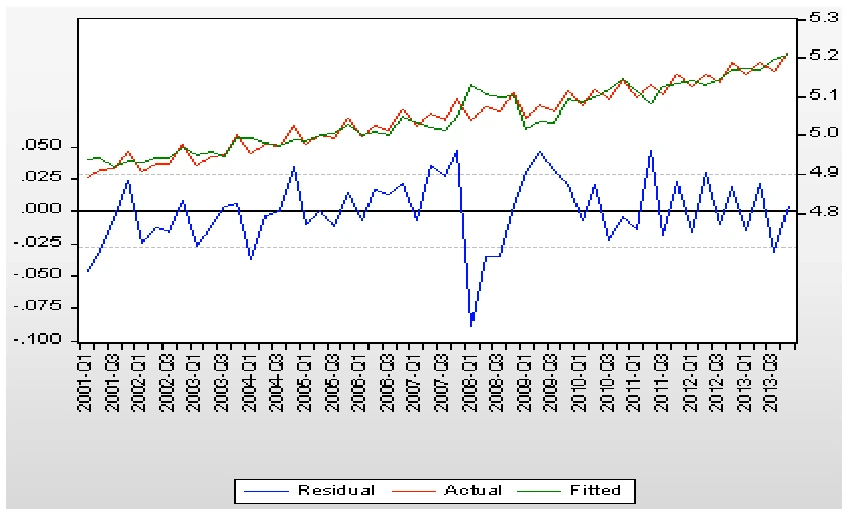
To test the forecasting performance of the simultaneous equation models, Root Mean Square Errors (RMSES) and Theil’s Inequality Coefficients were generated from ex post forecast. Figures 1 and 2 show the forecasted and actual values of the model for TV and GDP as well as their respective RMSE and Theil’s Inequality Coefficient.


Out of sample observations, representing four (4) quarters, were included in forecasted values to test the reliability of the model. Based on the forecasting results, the Two Stage Least Squares (TSLS) models have reasonably high forecasting ability. The models tracked the historical data series of the predictands or dependent variables. This is also evident from their low RMSEs and Theil U coefficients which are both closed to zero, characteristics of good predictive performance.
To rule out the possibility of estimating spurious relationships among the variables comprising the ln TV and ln GDP models, the Johansen Cointegration test was applied systematically by using the Dickey-Pantula procedure. By checking the Trace Statistics of three (3) recommended options beginning from the most restrictive to the least restrictive, it was found that cointegrating relationships exist for both ln TV and ln GDP models. This result rules out any spurious relationship and that are indeed that are genuine long run or equilibrium relationships among the variables of the models.
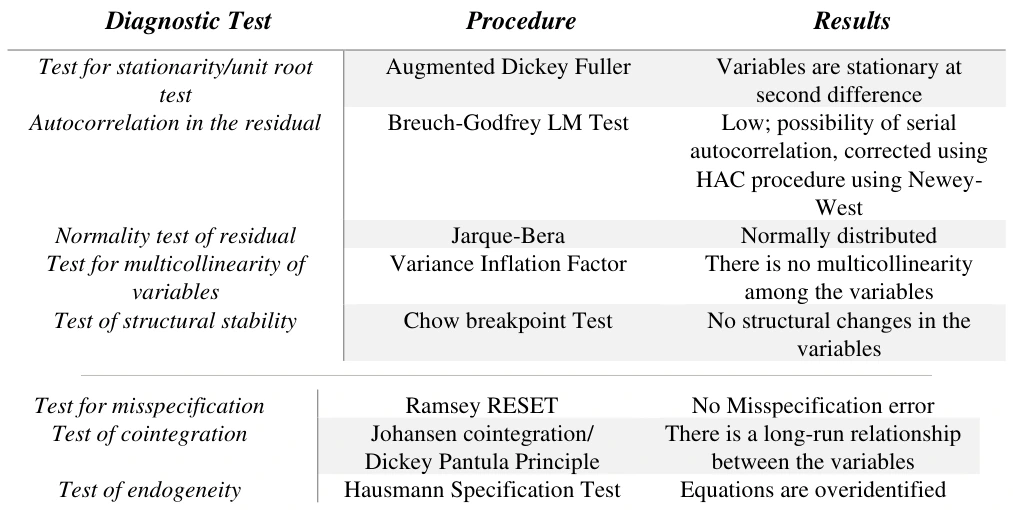
Other statistical tests were used in order to ensure the reliability of the regression model. Summary of the results are as follows:
Accessible table text
| — | Diagnostic Test | — | — | Procedure | — | — | Results | — |
|---|---|---|---|---|---|---|---|---|
| — | Test for stationarity/unit root | — | Augmented Dickey Fuller | Augmented Dickey Fuller | — | — | Variables are stationary at | — |
| — | test | — | — | — | — | — | second difference | — |
| Autocorrelation in the residual | Autocorrelation in the residual | — | Breuch-Godfrey LM Test Low; possibility of serial autocorrelation, corrected using HAC procedure using Newey- West | — | — | — | — | — |
| — | Normality test of residual | — | — | Jarque-Bera | — | — | Normally distributed | — |
| — | Test for multicollinearity of | — | Variance Inflation Factor There is no multicollinearity among the variables | — | — | — | — | — |
| — | variables | — | — | — | — | — | — | — |
| Test of structural stability | Test of structural stability | — | Chow breakpoint Test | — | — | — | No structural changes in the | — |
| — | Test for misspecification | — | Ramsey RESET No Misspecification error | — | — | — | variables | — |
| Test of cointegration | Test of cointegration | — | — | Johansen cointegration/ | — | — | There is a long-run relationship | — |
| — | — | — | — | Dickey Pantula Principle | — | — | between the variables | — |
| — | Test of endogeneity | — | Hausmann Specification Test Equations are overidentified | — | — | — | — | — |
5. Conclusions & Recommendations
The Gravity model has become a popular framework for assessing the impact of different factors that affect trade flows bilaterally and multilaterally. This paper also addressed a common problem in the Gravity model in estimation when using zero trade value. By using weighted average tariff rates, the effects of tariff elimination were more accurately reflected in the data of the model even with zero trade value. The Gravity model was also linked to and was used as an economic development model to determine the overall impact of JPEPA to the Economic Growth of the Philippines.
Based on the findings, decreasing the average tariff rates on the products that are heavily traded or have high trade value significantly affected the export of the Philippines to Japan after a one period lag. This supports the principle that lower trade cost increases export of a country. Using the weighted average tariff rate is important since JPEPA’s tariff staging have various tariff elimination scheme.
The Japan-Philippine Economic Partnership Agreement have several components that promoted economic partnership between the two countries. Its significant positive coefficient indicated that its implementation led to trade creation. Notwithstanding its favourable effect on trade, its effect on Philippine GDP was found to be negative after establishing its link with aggregate output via a simultaneous equation approach. This finding maybe attributed to the fact that Philippine product exports to Japan are less diversified and with low value added. The preferential tariff which was an outcome of JPEPA could partly explain the continuing decline in average tariff and this exerts a favourable effect on export trade.
On the other hand, the negotiations between Japan and ASEAN countries which led to the implementation of the ASEAN-Japan Economic Partnership Agreement resulted in trade diversion as far as Philippine exports are concerned. This is manifested by the negative effect of AJCEP on the estimated Gravity Model implying a shifting away of Japanese importation from the Philippines to other, perhaps more efficient and less costly partner in ASEAN.
As a predictor of Philippine GDP, the results from TSLS show that trade value TV has a positive and significant effect on aggregate output which is expected although JPEPA has a slight negative or adverse effect. Likewise AJCEP also exerts a positive effect on Philippine GDP. Aside from exports, increase in trade value also increases national income and economic activities in the domestic markets resulting to higher GDP growth.
Although, JPEPA may be used as a model or template of future trade agreements that the Philippines may enter into, it must take into account that it may be able to increase trade value but its significant effect on Philippine GDP may not show positive and significant results if goods traded have low value added.
The negative but significant effect of employment on Philippine GDP appears inconsistent with expectation as economic theory posits that as employment increases, output will naturally increase as well. However, in the case of the Philippines, the negative relationship between employment and GDP may be a manifestation of the “jobless growth phenomenon” and “job mismatch” that the Philippines continues to experience. Another possible explanation is the use of employment index as indicator for labour instead of actual number employed from the labour force. The huge disparity in growth in capital and growth in employment as shown in Table 4.1 could also be a possible reason.
The implementation of a trade agreement like JPEPA may be successful in increasing trade value but it may not be enough to induce economic growth. The negative relationship found between JPEPA and Philippine GDP may be due to the type of commodities being exported to Japan. In terms of overall development impact for the Philippines, the implementation of AJCEP yields a positive significant effect on its GDP. This may indicate or suggest that entering into more trade agreements may contribute more to the country’s development.
The model using weighted average tariff rates may also be used by other researchers in assessing gains from trade brought about by other regional trade agreements that involve tariff elimination. It can also be used as a basis for countries to engage into more trade agreements with other countries in order to increase their export potentials.
Since Japan is a major market of Philippine export commodities, the positive effect of JPEPA on trade may be beneficial for the Philippines despite its weak or negative, albeit insignificant, effect on aggregate output growth for the country.
Based on the findings of the study, bilateral trade agreement is able to expand the export of the Philippines with its trade partner, Japan. Based on the export data of Philippine export to Japan, there are certain commodities that were initially decreasing prior to the agreement that significantly increased, seven years since the implementation of the agreement i.e. meat and edible meat offal (15,3312.2%), umbrellas, sun umbrellas, walking-sticks, whips, riding-crops and parts thereof (1,878.1%), explosives; pyrotechnic products, matches, pyrophoric alloys, certain combustible preparations (1,091.7%).
It is also recommended that the Philippine government negotiate for more bilateral trade agreements with other countries in order to boost product export and expand the market base of Philippine exporters. It is further recommended to pursue assessment of other trade agreements undertaken by the Philippines to support this conclusion.
Future Research
For future research involving determination of the effect of trade agreements on the country’s economic development, it is recommended that different models for GDP estimation be employed. For example, the actual level of employment instead of the employment index could be used as predictor in the determination of aggregate output. To account for the dynamics and interaction of the different variables employed in models similar to this paper, Vector Autoregression (VAR) or Vector Error Correction Model (VECM) may be used. Shipping cost may also be used as an alternative proxy for distance in the gravity model. Non-tariff barriers such as strict implementation of health and safety measures on products may also restrict importation and may be considered as additional cost for distance.