 Journal of Global Trade, Ethics and Law
1. Introduction
In December 2019, a novel coronavirus disease (COVID-19) was first identified in Wuhan, China, rapidly evolving into a global pandemic with unprecedented health and economic consequences. As of 31 March 2024, over 774 million confirmed cases and more than seven million deaths had been reported globally to the World Health Organization (World Health Organization 2024). The pandemic surpassed in scale and speed earlier major coronavirus outbreaks, such as SARS (2002–2003), which involved 8,096 probable cases and 774 deaths (World Health Organization 2003), and MERS (since 2012), with over 2,600 confirmed cases and an approximately 37% case fatality ratio (World Health Organization 2025). In doing so, it exposed long-standing structural vulnerabilities and capacity limitations in health systems (Legido-Quigley et al. 2020; World Health Organization 2020). The COVID-19 pandemic revealed the ‘Achilles' heel’ of modern health systems: structural deficits in surge capacity, fragmented decisionmaking, supply-chain resilience, and crisis coordination. In principle, the health systems’ responsiveness appeared efficient under normal conditions but proved ill-prepared for a prolonged, high-intensity shock, particularly under high-transmission scenarios (World Health Organization 2020). The unprecedented scale and duration of COVID-19 transformed these vulnerabilities into economic stress through labor shortages, mobility restrictions, and disruptions to essential services, reinforcing the tight interdependence between public health capacity and macroeconomic stability.
Consequentially, governments across major regions implemented large-scale containment measures, including lockdowns, travel restrictions, and temporary shutdowns of economic activity, which were adversely affected by both demand contraction and disruptions in global supply chains (Deb et al. 2022; Musella 2023; United Nations Conference on Trade and Development 2020; Xu et al. 2020). Furthermore, consumption, retail trade, and contact-intensive service industries were particularly affected as consumer confidence deteriorated and mobility collapsed. Travel bans and flight cancellations severely disrupted international tourism and air transportation. In contrast, international trade was adversely affected through synchronized demand contraction and global supply chain breakdowns centered on China's manufacturing hubs. Unlike conventional recessionary episodes, these concurrent demand–supply shocks generated inflationary pressures in selected sectors despite collapsing economic activity, giving rise to what has been conceptualized as stagpression—a novel economic condition characterized by the overlap of recessionary dynamics with structural economic degradation and heightened uncertainty, limiting the effectiveness of traditional monetary and fiscal stabilization tools (Ruiz Estrada et al. 2021). The transformation of the public health emergency into a systemic economic shock triggered one of the most severe, synchronized global economic contractions in modern history.
This paper proposes a complementary policy-modeling framework to analyze the economic consequences of large-scale infectious disease outbreaks. The Economic Crisis from Massive Contagious Infectious Diseases Simulator (ECMCID-Simulator) investigates how pandemic-induced shocks affect four strategic sectors of the economy – tourism, international trade, air transportation, and electricity consumption – through key macroeconomic channels, including economic activity, labor market conditions, financial market performance, foreign direct investment, and aggregate output. The ECMCID-Simulator analyzes the dynamic propagation of pandemic-induced shocks and their cumulative socio-economic effects under conditions of extreme uncertainty. Developed within a multidimensional coordinate space, it captures behavioral change, systemic risk, and nonlinear shock transmission within a Dynamic Imbalanced State (DIS) framework (Ruiz Estrada and Yap 2013) and under the Omnia Mobilis assumption (Ruiz Estrada 2011). On this basis, the ECMCID-Simulator generates policy-relevant insights for crisis management strategies that aim to mitigate economic damage while preserving systemic resilience.
The paper is organized as follows. Section 2 offers an overview of the relevant literature. Section 3 describes the underlying model. Section 4 presents the model across seven historical periods, providing graphical results and their corresponding interpretations. The discussion then situates these findings within broader geopolitical and economic trends, while the conclusion summarizes the study's contributions, outlines policy implications, and suggests directions for future research. Section 5 summarizes and provides policy recommendations.
2. Relevant literature
Pandemics have periodically shaped human societies, producing profound demographic, social, and economic disruptions. Historical evidence documents a succession of major outbreaks, including the Plague of Athens (430–426 BC), the Antonine Plague (165–180), the Justinian Plague (541-750), the Black Death (1347-1351), and the Spanish Influenza (1918–1920) (Huremović 2019). The aforementioned events serve as benchmark episodes for understanding, managing, and preparing for systemic health shocks. However, recent outbreaks have generated observable disruptions across output, labor markets, trade, tourism, and financial systems, allowing for empirical investigation of pandemic-induced economic shocks (Baldwin and Weder di Mauro 2020; Lee and McKibbin 2004; McKibbin and Sidorenko 2006; World Bank 2014). During the 2003 SARS outbreak, estimates suggest that GDP declined by approximately 1 percent in China and around 0.5 percent across affected Southeast Asian economies, while global macroeconomic losses were estimated to range between USD 40 and 54 billion. The crisis severely disrupted regional tourism activity, with international arrivals declining by roughly 41 percent and an estimated 3 million jobs in tourism-related sectors affected (Brahmbhatt and Dutta 2008; McKercher and Chon 2004). The 2009 H1N1 influenza pandemic similarly generated substantial tourism-related revenue losses in Mexico, where approximately 1 million fewer overseas visitors resulted in estimated losses of about USD 2.8 billion (Rassy and Smith 2013). The 2014 Ebola epidemic led to sharp economic contractions in Guinea, Liberia, and Sierra Leone, with estimated cumulative GDP losses of around USD 2.2 billion by 2015, driven primarily by declines in privatesector activity, trade, and agricultural production (World Bank 2014). These episodes consistently reveal sharp short-term contractions and heterogeneous medium-term recovery patterns, particularly in highly interconnected and mobility-dependent economies.
While earlier pandemics reshaped economic structures through population collapse and long-term adjustments in labor and productivity, modern pandemics increasingly operate through highly integrated global systems, amplifying their economic impact via mobility restrictions, supply-chain interruptions, and financial market instability. The historical record thus illustrates that pandemics are not isolated health events but systemic shocks whose economic consequences evolve with the degree of economic integration and institutional complexity.
3. The Economic Crisis from Massive Contagious Infection Diseases Simulator (ECMCID-Simulator)
Consider a multidimensional, interlinked coordinate space constructed as the Cartesian product of the individual n-dimensional strategy spaces of n players. The formation of this interlinked coordinate system is based on Ruiz Estrada's (2017) Econographicology framework. An n-dimensional state vector captures the cumulative effects of prior strategic interactions in each dimension. Within this framework, n-dimensional equilibrium points represent both symmetric and asymmetric viral behaviors occurring simultaneously across space and time. The projection of these n-dimensional state vectors onto a multidimensional Euclidean n-sphere manifold embedded in a Euclidean (n+1)dimensional space provides a richer geometric representation of system dynamics. This multidimensional formulation jointly represents endogenous and exogenous variables and captures the full complexity of simultaneous strategic interactions and economic dynamics across varying spatial and temporal configurations. Conventional twodimensional Euclidean representations cannot adequately capture these dynamics.
The ECMCID-Simulator consists of four strategic economic sectors, denoted 𝛥𝑆𝑖, which collectively represent the principal transmission channels of pandemic-induced economic shocks. Each strategic sector is modeled as a general axis originating from a common epicenter and structured by multiple interconnected sub-axes corresponding to sector-specific economic components. Along each general axis, the model incorporates multiple refraction windows (or quadrants), each defined by an X-axis representing time (years) and a Y-axis representing the primary variable(s) under consideration. These subaxes are linearly linked along the general axis, allowing the simulator to capture the cumulative and sequential escalation of pandemic shocks within and across sectors.


The model operates under the Omnia Mobilis assumption (Ruiz Estrada 2011; Ruiz Estrada and Park 2018), which posits the continuous, simultaneous observation of all variables in real time. This assumption allows the ECMCID-Simulator to generate a large, evolving multidimensional surface that represents the aggregate economic response to a contagious disease shock. The surface originates at the epicenter of the multidimensional coordinate system and propagates outward along successive sub-axes within each general axis. The terminal sub-axis assesses the economic significance of simulating each general axis, as the cumulative impact of pandemic-driven disruptions fully materializes. Analytical results can be derived either axis-by-axis, to assess sector-specific dynamics, or by examining the entire multidimensional surface, which captures the simultaneous and interconnected effects of the pandemic across the economic system.
The empirical application focuses on the four strategic sectors of the Chinese economy that were directly and indirectly affected by COVID-19 containment measures: tourism growth rate, 𝛥𝑆1, air transportation growth rate, 𝛥𝑆2, international trade growth rate, 𝛥𝑆3, and electricity consumption growth rate, 𝛥𝑆4. These four strategic sectors were selected based on their economic relevance, exposure to mobility restrictions to be examined in connection with COVID-19 cases growth rate, 𝛥𝐶. The former is the model's epicenter and it is subject to dramatic, uncontrolled, and unpredictable fluctuations, including periods of expansion, contraction, or stagnation (Ruiz Estrada and Yap 2013). A sharp acceleration in the infection growth rate in China can trigger widespread, simultaneous disruptions across all four sectors, with demand contraction constituting the dominant transmission channel.

The model assumes that pandemic is materialized by economic waves. These waves are represented by a large surface plotted within the same graphical space. Each general axis, corresponding to a strategic economic sector, is decomposed into five sub-axes representing key macroeconomic dimensions: the demand growth rate, 𝛥𝐷, unemployment growth rate, 𝛥𝑈𝐸, stock market performance growth rate, 𝛥𝑆𝑀, foreign direct investment growth rate, 𝛥𝐹𝐷𝐼, and the contribution of each strategic sector to China's GDP growth rate, 𝛥𝑂. The calculation of 𝛥𝑂 follows Expression (2).
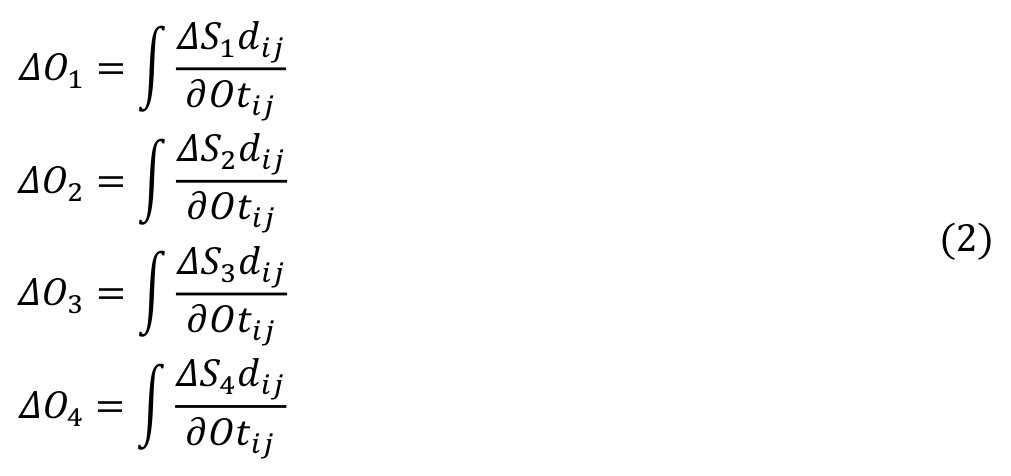
Each variable is operationalized as a percentage deviation from its pre-pandemic baseline, allowing for comparability across sectors and time. Each strategic-sector variable corresponds to an observable macroeconomic indicator. Tourism growth is measured using year-on-year changes in tourism revenues and passenger volumes. Air transportation growth reflects annual changes in passenger traffic and flight activity. International trade growth is based on the annual growth rate of total exports and imports in value terms. Electricity consumption growth is measured using aggregate electricity generation and usage statistics. Labor-market effects are proxied by unemployment growth rates, financial-market performance by changes in major Chinese stock indices, and investment dynamics by foreign direct investment inflows derived from balance-ofpayments statistics. All variables are expressed as percentage deviations from their prepandemic baseline to ensure comparability across sectors and time.
Endemic infectious diseases trigger complex and nonlinear economic responses that unfold across multiple channels and evolve over space and time. Outbreaks and epidemics constitute rare, high-impact events whose economic effects are highly heterogeneous, volatile, and context-dependent, varying across sectors, regions, and crisis phases. The magnitude and duration of the health shock, the structural characteristics of the affected economy, population density, geographic exposure, and timing all shape how economic variables respond. While direct medical and hospitalization costs can be measured with relative precision, the indirect economic effects—transmitted through trade, labor markets, mobility, and investment—are inherently more difficult to quantify due to their nonlinear interactions and overlapping transmission mechanisms. Partial differentiation is therefore employed to isolate the marginal impact of changes in the infectious disease shock on each economic dimension, allowing the ECMCID-Simulator to capture sectorspecific sensitivities and disentangle complex interdependencies without imposing restrictive equilibrium assumptions.
When these marginal effects aggregate across dimensions and sectors, they generate asymmetric fluctuations of differing periodicity that manifest as dynamic economic waves. Such waves amplify throughout the economy and may produce a smash effect, a sudden and systemic disruption triggered by low-probability, high-impact events (Ruiz Estrada 2013). While Kondratieff wave theory (Kondratieff 1922; Schumpeter 1954) characterizes long-run business cycle phases – expansion, peak, contraction, trough, and recovery – the smash effect captures crisis dynamics arising from improbable and unpredictable events such as epidemics, natural disasters, or terrorist incidents. In parallel, Black Swan theory (Taleb 2007) situates such events within a broader historical and theoretical context, emphasizing their unpredictability and disproportionate consequences. Despite its wide acceptance among finance professionals, Black Swan theory offers limited analytical insight into the full spectrum of social, economic, cultural, and environmental impacts of such shocks due to its lack of formal modeling structure.
The primary objective of the ECMCID-Simulator is not to forecast precise equilibrium outcomes but to assess the relative magnitude, direction, and persistence of economic disruptions under alternative pandemic scenarios, thereby supporting policy evaluation and crisis management. Unlike equilibrium-based macroeconomic models, the ECMCID-Simulator applies the Dynamic Imbalanced State (DIS) framework to represent the economy as a system characterized by continuous instability, nonlinear adjustments, and evolving behavioral responses. Consistent with the Omnia Mobilis assumption, all variables in the system are allowed to adjust simultaneously over time, reflecting the highly uncertain and rapidly changing conditions observed during pandemic episodes. Within this framework, pandemic shocks are interpreted not as one-time static disturbances but as dynamic economic waves that propagate across sectors and macroeconomic channels.
The numerical values reported below do not represent observed sectoral outcomes in China during 2020–2021. Instead, they correspond to stress-test scenarios generated by the ECMCID-Simulator under hypothetical high-intensity pandemic waves, designed to evaluate directional responses, relative magnitudes, and sectoral asymmetries.
4. Assessing the Impact of COVID-19 on 4 Strategic Sectors of the Chinese Economy
This paper examines the macroeconomic impact of the COVID-19 shock on the Chinese economic activity, labor, financial markets, investment flows, and aggregate output, drawing on the empirical studies by Baldwin and Weder di Mauro 2020, Eichenbaum, Rebelo, and Trabandt 2021, and Gereffi 2020. The analysis covers the period 2019–2021, capturing pre-pandemic conditions, the initial infection shock, and the early recovery phase. Data are compiled from multiple official and verifiable sources, including the National Bureau of Statistics of China for macroeconomic indicators (National Bureau of Statistics of China n.d.); the China Statistical Yearbook for comprehensive annual data across sectors (National Bureau of Statistics of China 2024); and the Civil Aviation Administration of China for air transport statistics (Civil Aviation Administration of China n.d.). International economic indicators are drawn from the World Bank Open Data Platform (World Bank 2025) and the International Monetary Fund's statistical databases (International Monetary Fund 2025). Epidemiological data are derived from WHO situation reports and the WHO COVID-19 dashboard, which provide confirmed case and mortality counts reported by Member States (World Health Organization n.d.).
Tourism indicators include tourism revenues and passenger volumes; air transportation data consist of passenger traffic and flight activity; international trade variables are based on export and import volumes; and electricity consumption is measured using aggregate electricity generation and usage statistics. Financial market performance is proxied by major Chinese stock indices, while FDI flows are derived from official balance-ofpayments statistics. All data series are standardized and aligned temporally to ensure internal consistency. Where high-frequency data are unavailable, annual or quarterly averages are employed, and interpolation is avoided to preserve data integrity. Computation is implemented in Wolfram Language (Mathematica 10) via a standardized pipeline.
Conventional macro-stress tests rely on detailed sectoral balance sheets, bank-level exposures, or high-frequency financial data. The proposed stress-test approach instead focuses on macro-level transmission channels observable across countries and crises, emphasizing robustness under data constraints. This framework aligns with earlier pandemic-related macroeconomic analyses that prioritize scenario consistency and structural plausibility over granular calibration (McKibbin and Sidorenko 2006; World Bank 2014). The omission of institution-specific balance-sheet effects avoids overfitting and maintains comparability across heterogeneous economic structures, particularly in emerging and data-scarce contexts.
Study contribution lies in integrating epidemiological shocks, supply-chain disruptions, and demand contractions within a unified macroeconomic simulation environment. Prior studies typically isolate individual channels, such as trade disruptions (United Nations Conference on Trade and Development 2020), tourism collapse (McKercher and Chon 2004), or health-system pressure (World Health Organization 2020). The present model evaluates their joint amplification effects under adverse scenarios. This holistic treatment enables the identification of nonlinear outcomes that are not apparent in single-channel analyses and provides a transparent benchmark for policy evaluation. The stress-test results should therefore be interpreted not as point forecasts, but as structured counterfactuals that clarify the relative vulnerability of economic systems to compound pandemic-type shocks, complementing rather than substituting existing macro-financial stress-testing methodologies.
Figure 2 displays pandemic-induced economic wave dynamics affecting final output contributions across four strategic sectors of the Chinese economy during 2020–2021. The model algorithm aggregates 1,500 simulated values, produced by selecting five core macro-sectoral variables, each decomposed into 300 sub-variables, yielding one parameter per sub-variable. Each parameter is encoded using a binary activation rule (0/1) that indicates whether a given sectoral or institutional condition is inactive or activated under a specific stress configuration. These parameters are evaluated iteratively across 16 refraction windows, each representing a distinct temporal–structural configuration of the shock environment. Within each refraction window, the model simultaneously applies sector-specific percentage deviations from pre-pandemic baselines and computes multidimensional interactions across variables to generate a vector of stress-test outcomes. Repeating this process across all refraction windows yields the full set of 1,500 simulated values. Consistent with prior applications of the inter-linkage coordinate space framework (Ruiz Estrada and Koutronas 2016; Ruiz Estrada et al. 2021), all equations are transformed into a single algorithmic structure and executed using deterministic and fuzzy simulation routines, allowing visualization of extreme, yet internally consistent, stress scenarios rather than observed outcomes.
A hypothetical 65% increase in aggregate consumption demand in China leads to sectoral contributions to output growth across tourism, international trade, air transportation, and electricity consumption. The magnitude of this shock is intentionally simulated as an upper-bound stress scenario rather than a realistic forecast, allowing the simulator to reveal nonlinear sectoral asymmetries and transmission mechanisms under extreme but analytically informative conditions. The impact on the 4 sectors and their aggregate impact on GDP will be also significant:
(i) In the tourism sector, demand is projected to contract by 75%, the unemployment rate to rise to 10%, the stock market index to decline by 35%, and foreign direct investment to fall by 25%. Consequently, this sector's contribution to China's GDP growth remains relatively limited, at 0.3%. (ii) In the international trade sector, demand falls by 40%, unemployment rises to 15%, stock market index drops by 25%, and FDI shrinks by 35%. The sector's contribution to China's GDP growth is about 2.5%. (iii) In the air transportation sector, demand is projected to decline sharply by 85%, the unemployment rate to rise to 20%, the stock market index to contract by 45%, and foreign direct investment to fall by 40%. As a result, this sector's contribution to China's GDP growth rate is minimal, at approximately 0.2%. (iv) Finally, under the stress-test scenario, the electricity consumption sector exhibits a simulated increase of 65%, with no increase in unemployment, a 55% gain in the stock market index, and a 50% rise in foreign direct investment. This sector contributes approximately 1.5% to China's GDP growth rate. Elevated electricity demand is partly attributable to extensive quarantine measures and the surge in demand for health and related essential services across China.

5. Comments and Remarks
This paper introduces a multidimensional policy-modeling framework to assess the macroeconomic consequences of pandemic shocks under conditions of extreme uncertainty. The ECMCID-Simulator enables the systematic exploration of alternative scenarios and impact intensities, allowing simulations to evaluate the economic effects of epidemic outbreaks at the national, regional, and global levels.
Simulation findings reveal pronounced sectoral heterogeneity in economic responses: contact-intensive sectors, such as tourism and air transportation, experience sharp, immediate contractions, while electricity consumption and other essential activities display relative resilience. These asymmetric outcomes underscore the critical role of sector-specific exposure to containment measures and mobility restrictions in shaping the aggregate economic impact of pandemics.
The simulated sectoral responses are benchmarked against established empirical estimates to ensure consistency with the literature on pandemic economics. For the tourism sector, the stress-test contraction of approximately 75% exceeds observed declines of roughly 50% during the COVID-19 pandemic in China and about 41% during the SARS outbreak, positioning the simulation as an upper-tail scenario consistent with extreme mobility restrictions (Brahmbhatt and Dutta 2008; McKercher and Chon 2004).
In air transportation, the 85% demand contraction aligns with the upper end of global aviation shutdowns observed during early COVID-19 waves, when passenger volumes declined by 60–90% across major markets. For international trade, the simulated 40% contraction does not reflect China’s realized 2020 performance but represents a counterfactual synchronized global collapse scenario, consistent with stress-test approaches used in earlier pandemic simulations (McKibbin and Sidorenko 2006; World Bank 2014).
In contrast to contact-intensive sectors, electricity consumption exhibits relative resilience in the simulation, reflecting the prioritization of essential services and critical infrastructure during lockdowns. This pattern is consistent with official statistics showing limited volatility in China’s aggregate electricity demand during COVID-19, despite sharp sectoral reallocation between industrial and residential use (McKibbin and Sidorenko 2006; National Bureau of Statistics of China 2024; World Bank 2025)
The ECMCID-Simulator contributes to the literature by offering a transparent, nonequilibrium approach that emphasizes nonlinear dynamics, directional validity, and robustness rather than econometric parameter estimation. By mapping sectoral shocks into a multidimensional coordinate space, the framework enables intuitive visualization of economic waves and facilitates systematic comparison across scenarios. Qualitative validation against macro-epidemiological models and empirical studies confirms the consistency of the simulator's results in terms of both sign and relative magnitude. Detailed documentation of data sources, variable definitions, and computational steps further ensures replicability and adaptability, while supporting the analysis of crisis management and stabilization strategies.
Finally, these simulations support the design of policy responses aligned with specific scenarios and positions along the economic wave cycle, ranging from broad macroeconomic interventions to targeted, sector-specific measures for tourism, international trade, air transportation, and electricity consumption. Ultimately, the formulation and effectiveness of such policies depend on the institutional structure and governance capacity of public management systems. While not intended as a closed-form forecasting model, the ECMCID-Simulator provides policy-relevant insights into crisis management and offers a flexible foundation for extending pandemic-impact analysis to other countries and future systemic shocks.
Funding The research received no specific grant from any funding agency in the public, commercial, or not-for-profit sectors.
Conflicts of interest/Competing interests The authors state that there is no conflict of interests. The funders had no role in the design of the study; in the collection, analyses, or interpretation of data; in the writing of the manuscript, or in the decision to publish the results.