 Journal of Global Trade, Ethics and Law
1. Introduction
On the topic of research diversification, scholars frequently debate whether better results in terms of future research advancement are accomplished through diversification or specialization, as explored by Abramo et al. (2019). The analyzed dualism is a longstanding economic issue that has intrigued scholars for centuries (Wang and Nie 2019). This debate lies at the core of strategic decision-making, with increasing interest in the choice between concentrating resources in a specific sector to achieve the economies of scale necessary for firm survival and growth or diversifying economic activities across multiple fields to mitigate corporate risk and enhance enterprise success. (Wang and Nie 2019). This tension reflects the ongoing struggle between the pursuit of excellence in a particular activity and the requirement of mitigating risks associated with overreliance on a single sector, a debate that societies have been dealing with since the most ancient times—finding solutions that have led to the most diverse outcomes in terms of both economic and social structures—, with early forms of division of labor being attested, for instance, in ancient Greece, with the population being employed, alternatively, in agriculture, crafts, and trade. In more recent times, this debate has taken on a renewed importance, with industrial and post-industrial economies being marked by growing global interconnection and rapid technological advancements.
While Kaulich (2012) notes that diversification of product and exports can indeed make a country less prone to negative economic shocks, it is unquestionable that specialization is a key driver of efficiency and innovation, particularly in densely populated regions where competitive advantages may be maximized.
Additionally, a region’s dominance in particular industries, especially if characterized by a concentration of enterprises in related fields, fosters innovation, which involves the exchange of knowledge between actors and institutions and, as such, it can be thought of as a collective learning process that occurs in a network of interconnected participants (Fritsch and Slavtchev 2010). Specializing can create competitiveness because it propels continuous product amelioration while also enabling the invention of new products and tapping into unfamiliar market niches. Moreover, it enhances responsiveness to the everchanging customer needs in the business community. Consequently, firms are set to compete effectively and expand their knowledge across markets. Concentrating all their resources on the development of a specific sector allows firms to successfully employ an economically targeted and specialized strategy, thus preventing resource dispersion over different industries, which in turn promotes advanced technology that is resourceful, refined and sophisticated. Such firms can also maintain a better hold of competitive edge over their rivals by sticking to the most beneficial areas therein. On the other hand, when entering related or unrelated sectors, firms should continuously and steadily grow in their main activities to keep pace with markets’ demand (Wang and Nie 2019). Considering all these factors, it is also important to recognize the role of trade theories in explaining patterns of specialization. For this reason, it is crucial to examine the relationship between agglomeration and industry concentration, alongside the role of comparative advantage described by political economist David Ricardo in 1817 (Ricci 1999). As posed by agglomeration effects, firms operating in close proximity benefit from shared resources,
knowledge exchange, and increased productivity; at the same time, Ricardo’s model on comparative advantage specifically elucidates how nations gain from trade by specializing in industries on which they hold a competitive edge, thereby enhancing returns, fostering product differentiation, and stimulating monopolistic competition, while also affecting trade costs (Ricci 1999). Such synergistic effects between agglomeration and comparative advantage illuminate the dynamics of specialization and its impact on global trade patterns. In accordance with Ricardo’s ([1817] 2004) and Heckscher and Ohlin’s (1933) early trade theories, the concept of comparative advantage was determined by disparities in productivity or the relative availability of production factors. Nevertheless, in the Ricardian model, the size of a country does influence the benefits from trade, with smaller countries often gaining more in relation to their size because their relative prices in autarchy tend to be further from the new world relative price established by trade. In the Heckscher-Ohlin framework, the size of a country does not directly impact comparative advantage: this is because countries can have different sizes but similar relative factor endowments, which determine the pattern of specialization (Ricci 1999). Indeed, goods are produced at reduced transportation costs, encouraging a focal point (Dornbusch, Fischer and Samuelson 1977). Simultaneously, the presence of demand externalities encourages greater producer collaboration, which could result in industrial concentration.
Conversely, neo-protectionism and mercantilism can, indeed, encourage more diversification than economic and industrial specialization and free trade, even though these two aspects are not directly oriented towards economic diversification as a primary objective. Neo-protectionism entails state intervention in international trade relations to preserve economic influence and address social issues (Panchenko and Reznikova 2017), whereas the mercantilist doctrine advocates for a nationalist economic stance that strategically enhances exports while minimizing imports in order to maximize the nation's resource base and unilateral trade benefits. This economic strategy seeks to prevent account deficits by building up monetary reserves through favorable trade balances, primarily by exporting finished goods. Historically, mercantilist policies pursued a “favorable” trade balance, primarily to attract precious metals such as gold and silver, thereby enriching the national treasury. Furthermore, these policies were designed to bolster domestic employment by protecting home industries from foreign competition, as Smith extensively discussed in his analysis of economic behavior that influences national prosperity (Smith [1776] 1904). Together, neo-protectionism and mercantilism usually promote policies that shield domestic industries from foreign competitors or unfair trade practices, supporting those companies’ growth through tax incentives, subsidies, or other supportive measures (Panchenko and Reznikova 2017). This approach can boost economic diversification by investing in new sectors or by promoting existing industries (McCusker and Morgan 2001), and by mitigating dependency on vulnerable sectors or exposure to foreign competition. Historical mercantilism favored resource accumulation and market dominance through monopoly policies and aggressive trade practices, with diversification being a strategy to fully leverage the resources gathered and to subsequently secure a competitive advantage across different sectors. On this note, several modern economic theories focusing on monopolistic competition (Helpman and
Krugman 1985; Melitz 2003) delve on the notion of intra-industry trade, i.e. the exchange of similar goods between countries within the same industry. Another key perspective is offered by Adam Smith’s theory of absolute advantage as discussed in The Wealth of Nations (1776), where specialization is seen as essential for economic efficiency, with individuals having a tendency to focus naturally on their strongest skills thereby maximizing their earnings and ultimately contributing to economic growth and societal well-being.
Thus, individuals become specialized because they can locate a gap in their skill set which allows them to barter with one another in relation to specific aspects. They, therefore, improve on their tasks through the division of labor, by increasing innovation and enhancing the overall economic performance of the entire society. Yet, studies have consistently shown a strong correlation between income levels and export basket diversification, though the evidence is not always conclusive (Bahar 2016). As previously stated, it is worth noting that as countries increase their economic diversity and wealth, they become increasingly interconnected in the global economy. This enhanced integration enables them to deliberately refocus on certain items while leveraging their comparative advantages through international trade. Within the framework of general equilibrium, global integration has the potential to accelerate knowledge dispersion and increase production through diversification rather than concentration (Bahar et al. 2014). Delving further into this issue, Keynes (1933), based on his direct experience with severe economic shocks (most notably the Great Depression in 1929), rejects productive specialization—fearing that it would lead to trade imbalances and the emergence of new economic shocks—in favor of national diversity, which, he argued, would enhance countries’ resilience.
This paper is structured in two main parts: the first section (parr. 2, 3, and 4) begins with a brief introduction to the concept of resilience, followed by a comprehensive review of the existing literature on diversification as an economic development strategy. Additionally, through reference works, it explores export diversification and the application of the Hirschman-Herfindahl Index (HHI). The second part (par. 5) of the paper specifically focuses on Italy, presenting a case study that examines the application and impacts of diversification in the Italian regions and provinces. This bifocal approach not only enriches the theoretical understanding but also aims to offer an applied and concrete perspective through the analysis of a well-defined national context. This paper applies the Herfindahl-Hirschman Index (HHI) as a foundational measure of economic concentration. Building on this, three distinct diversification indices are developed to assess geographic diversification of export destination, sectoral diversification of export, and geographic diversification of import origin. To achieve this, dynamic data was gathered within Italian regions and provinces (Barbieri et al. 2024). However, it is important to acknowledge the limitation of this approach, particularly regarding the relatively small geographic areas represented by regions and provinces, which might lead to less precise estimates due to sample size constraints (Ghosh and Rao 1994).
2. Complexity and the Vital Role of Diversification in Today’s
Landscape
Recently, the world had to face some urgent problems: markets have been overturned since the pandemic and its aftermath, while Russia’s invasion of Ukraine also had a great impact on them. In contexts of this kind, resilience is an aspect that proved itself to be beneficial: but what exactly is resilience? The term refers to a component of a region’s economic potential that can shield its economy from negative external shocks or minimize the magnitude and scope of the consequences of said shocks (Bogdański 2021).
Reflecting on Harry Markowitz’s seminal “Portfolio Selection” theory (1952), which posits that diversification reduces risk, its principles extend beyond financial markets to regional economics. In this context, sectoral diversification plays a crucial role in reducing disparities in regional gross value-added growth rates. Conroy (1974; 1975) adapted this theory to demonstrate how diversification within regions could reduce employment instability during times of economic stress. By diversifying their industrial base, regions can reduce the impact of sector-specific downturns, leading to more stable employment levels. Building on these foundations, this study develops a comprehensive industrial diversification estimate. Its focus on absolute growth contributions, rather than sector-specific shares, helps better understand how diversification can serve as a buffer against the type of economic disruptions recently experienced. This method helps to measure the real impact each sector has on economic growth, thus determining which sectors are most resilient and those that are more prone to economic shocks. Analyzing this point further, Walker et al. (2004) define economic resilience as a system’s ability to absorb disturbances and reorganize during change while maintaining essentially the same purpose and identity. It denotes a system’s capacity to sustain a positive functioning condition, rather than deteriorating into a less functional state when confronted with external threats or challenges. Resilience is acclaimed as pertinent to every current global crisis, whether political, biological, or educational in character (Jackson 2020). At its core resilience relies on its adaptive capacity, which refers to the ability of economic systems to adjust and evolve in response to external pressures while maintaining stability (Simmie and Martin 2010). This perspective emphasizes that regions and industries with greater adaptability—whether through diversified supply chains, institutional flexibility, or knowledge diffusion—are better equipped to withstand economic shocks. However, resilience is not the only aspect that has been reconsidered. In recent years, there has also been a renewed interest in diversification, especially among academics and broker research (Banz 2001), with scholars often debating whether diversification should focus on specific regions or sectors. In the midst of these debates, both academic and practical perspectives have increasingly aligned with economic complexity theories, a shift that is largely due to the growing recognition that traditional economic models—with their emphasis on specialization and efficiency—may no longer be sufficient to navigate the complexities marking contemporary global economy. More particularly, economic complexity theories offer a deeper understanding of the role of varied and interconnected economic activities in contributing to an economy’s growth, stability, and resilience in the face of economic disruptions.
The Wealth of Nations, mentioned previously, underscores the importance of a myriad of interrelated economic activities in creating stronger communities that can withstand shocks resulting from any kind of economic disruptions. Populations with high concentrations of different kinds of productive activities redistribute resources efficiently and adapt to production changes easily: during these times, there are few reasons why an economy should solely rely on internal transformation. This is how this wider generality should result in the spread of wisdom and competence, thereby enhancing innovation in economies, as well as their adaptability to new challenges. When one sector falters, it is this interconnectedness that allows for other sectors to intervene. Again, new industries and innovations can only be created by mixing different kinds of abilities: this gives support to the growth and stability achieved in the long run. Essentially, an economy that has diversified adequately is likely less vulnerable to disturbances of global origin compared to non-diversified ones based on old economic thoughts that emphasize efficiency through division of labor alone without incorporating critical aspects of today’s turbulent market cycles. This perspective has revived interest in strategic diversification, where the synergy between related and unrelated diversification activities is seen as crucial for fostering economic resilience and adaptive capacity in response to global economic shifts (Banz 2001). The role of diversification has been reconsidered in relation to the major events that have happened in recent times. Locations, sectors, and enterprises have all been affected differently, thus leading investors to wonder where to seek refuge. In this case, the basic answer is diversification (Kellands 2023), that, in turn, can be linked to the concept of resilience, as it improves the transfer and dissemination of external shocks in many directions (sectors and branches) of the economy, resulting in a speedier economic recovery and adaptation to changing conditions (Nazarczuk et al. 2020).
In a rapidly globalized economy filled with political and financial vulnerabilities, a region’s ability to promote financial development while enduring external shocks is critical. Areas with a high concentration of linked sectors are more vulnerable to outside shocks due to the risk-spreading effect. Similarly, firms with highly concentrated activities are also at risk (Joya and Rougier 2019; Prasanna et al. 2011). Moreover, diversification can generate new areas of expertise through the combination of diverse skills (Saviotti et al. 2020).
Resilience also refers to an economic ecosystem’s capacity to adjust and evolve. At the core of this evolution lies the idea of geographic and sectoral diversification. This notion embodies adaptability, akin to viewing economic events as “evolutionary processes” (adaptive economic changes), where markets act as selection mechanisms, much like the environment does in the biological realm. This perspective finds its roots in the works of Penrose (1959), Winter (1935), and Nelson and Winter (1982), who emphasized the importance of trial and error, survival of the fittest, and the replication of effective techniques in business evolution theory. This stands in contrast to the neoclassical concept of firms as consciously optimizing production functions, marginal costs, demand functions, and revenues. Furthermore, diversification is most likely to produce economies of scale in research and development (R&D) and it implies that a company with a diverse product offering has numerous options to capitalize on the findings of a research program (Jovanovic and Gilbert 1993). This is because the paths in which research will create
outcomes are highly unpredictable. As a result, the broader the scope of activity, the more likely it is that a technological discovery or development will fit into the firm’s existing product structure (Jovanovic and Gilbert 1993). On a different note, evolutionary perspectives (which have recently gained quite a lot of attention; Nelson 2020) embody a valuable tool for interpreting the mechanisms of economic adaptation and survival in the everchanging contemporary economic landscape. This evolutionary approach, deeply rooted in the principles articulated by Hayek (1988), emphasizes how firms and economies, much like organisms in nature, evolve through learning and adaptation. More particularly, Universal Darwinism, an extension of these ideas, suggests that Darwinian principles of variation, selection, and retention, far from being limited to biological entities, are equally applicable to economic systems at both macro and micro levels (Hodgson 2002).
Evolutionary frameworks help explain not only economic balances and imbalances but also highlight the intrinsic capacity of firms to adjust to new environmental pressures by diversifying their activities and strategies in order to spread risks and increase resilience, thus mimicking biological diversity which enhances survival prospects in the face of external shocks. Diversification strategies are informed, then, by the understanding that complex economic ecosystems—much like their biological counterparts—are better equipped to handle changes and disruptions if they comprise several interconnected elements rather than a single, unitary entity.
Hayek ([1976] 1982; 1988) and Campbell’s (1974; 1987) framework for cultural evolution extends Darwin’s theory to the inheritance of civilization, encompassing institutions, customs, practices, tools, and methods of performing activities. It also involves the selective accumulation of skills, technology, behavioral patterns, beliefs, organizational structure, and economic systems. Cultural evolution can be seen as a method of acquiring knowledge through iterative experimentation and learning from the tools, rules, belief systems, and cultural achievements of previous generations (Krstić 2012). However, challenges such as monopolies and oligopolies can modify the competitive environment, while moral hazard and tax evasion can skew the selection process, allowing inefficient enterprises to remain in operation (Rogers 1972).
Diversification is closely linked to complexity, which may be affected, as explored by Ben Saad et al. (2023), by spatial heterogeneity and discontinuity. If the profound economic transformations faced my most global economy have created opportunities for both developing and developed countries alike, only few actually manage to adapt to these new conditions, resulting in significant differences in growth rates among countries that have been largely discussed in theories of economic growth. Economic progress necessarily involves the adaptation of production processes, with enhanced productive capacities, greater product diversity, and increased export competitiveness culminating in the trade of more complex products whose added value generates advantage to the exporting country (Ben Saad et al. 2023). Product composition reflects, in turn, the productive knowledge of countries (Hausman and Hidalgo 2013), which may as well exhibit levels of productive complexity comparable to those of regional spaces beyond national borders, thus giving credit to the hypothesis of interdependencies existing at transnational level (Ben Saad et al. 2023).
Complex systems theory in economics has become well-known research tool, employed in economic geography, international development, and innovation (Hidalgo 2021). Furthermore, complex systems in economics provide a framework for understanding social issues like growth, development, technological change, income inequality, spatial disparities, and resilience as visible results of hidden systemic interactions. Geographical heterogeneity (spatial discontinuities) and temporal heterogeneity (historical discontinuities) in the processes of complexification of regional productive systems can either spur regional economic convergence, reinforced by strengthened regional cooperation, or instigate a regional dynamic of competition and economic predatory behavior (Ben Saad et al. 2023). These methods draw their scientific foundation from multiple studies conducted in different states and cities on a wide variety of economic activities.
Economic diversification has traditionally been employed to promote positive economic expansion and development. In the context of climate change adaptation, its importance grows as a strategy to move away from susceptible products, markets, and jobs and towards revenue sources that are low-emission and climate resilient (United Nations Framework Convention on Climate Change [UNFCCC] n.d.). This process, by which locations engage in new economic activities, is thought to be a combination of related and unrelated diversification, with the first occurring especially in low-complexity contexts. The study by Pinheiro et al. (2022) indeed concludes that the less complex an economy is, the less diversification options it has to shift to unrelated activities, thereby being more tied to relatedness. Related diversification is the most common between the two. Countries (Hidalgo et al. 2007; Pinheiro et al. 2022), regions, and cities (Boschma and Capone 2015; Pinheiro et al. 2022) have been shown to be more inclined to engage in activities that are related to those currently existing in them. However, while the principle of relatedness has been successful in establishing economic path dependency in countries and regions, there is still much to learn about scenarios in which economies engage in unrelated activities (Boschma 2016; Pinheiro et al. 2022). It is important to consider that unrelated diversification is difficult to achieve because becoming competitive in new activities necessitates the acquisition of new capabilities, ranging from human capital to institutions, which can be demanding to amass all at once (Hausmann and Hidalgo 2011). Thus, unconnected diversification is not only uncommon, but also a risky development strategy. Even though related diversification is more frequent than unrelated diversification, the latter is gaining significant attention as a crucial strategy for economic renewal and long-term development. Studies like those by Saviotti and Frenken (2008) have highlighted how unrelated diversification can prevent economic lock-in by diversifying investment into new and innovative unrelated sectors, thus fostering new avenues for growth and adaptation. This aspect of diversification strategy underscores a key shift in economic thinking: the need to continuously evolve and innovate, avoiding over-dependence on traditional industries that might no longer guarantee sustainable growth. Using Penrose’s (1959) resource-based perspective, unrelated diversification can be described by an organization’s “three pillars”: firstly, dynamic capacities; secondly, absorptive capacity; and thirdly, weak ties. The three pillars’ job is to uncover new resource applications or uses in market failure scenarios
known as ‘incomplete’ markets. This model allows for greater diversification than Penrose’s (1959) and other resource-based models (Teece et al. 1980). Furthermore, unconnected diversification can be advantageous, as demonstrated by Desmond W. Ng (2007), who, in his study, elaborates on how such diversification strategies, albeit complex, can yield significant competitive advantages by leveraging the discussed pillars in diverse market environments. As a matter of fact, Frenken et al. introduced the concept of “affiliated variety” (Frenken et al. 2007), which promotes job creation and indigenous growth by fostering knowledge exchanges within a sector. This concept can be used to test the belief that industrial clusters can benefit from a wider range of products and services, as greater diversity increases inter-industry knowledge spillover. However, a consensus on the importance of diversity for economic development has not been reached yet. Most research supports the thesis of variety leading to employment growth, but some suggest it is more pronounced in knowledge-intensive industries. They argued that knowledge from one industry is more valuable and can be utilized more effectively by another related industry.
Nevertheless, Boschma and Capone (2015), criticized unrelated diversification, arguing that it ignores key components that influence industry relatedness, such as institutions, infrastructure, and the combination of production factors. Moreover, they argued that institutions inform on the direction of diversification, thus determining whether countries gain a competitive advantage from new sectors either close or far from their present industrial framework. Pinheiro et al. (2022) discovered that nations with intermediate levels of economic growth and greater levels of human capital enter more unrelated products. Their research found that countries with greater diversification levels in unrelated businesses, enjoy a small but significant increase in economic growth compared to their counterparts with comparable levels of income, human capital, capital stock per worker and economic complexity. Indeed, the pursuit of diversification into unrelated products should result in higher export product-sophistication and increased value-added (Hausmann et al. 2006). This elevation in complexity not only boosts productivity, but also enhances the overall export value, thereby reinforcing the interconnectedness between diversification, complexity, and economic growth.
Delving deeper into this matter, Songwe (2019) suggests that disparities in export success and product sophistication propose the possibility of further diversification, vertical integration, and globally competitive regional value chains. The likelihood of countries surviving in global value chains is intricately linked to commodity and trade specialization. Countries that supply advanced commodities are more likely to maintain their position in the network, while those with lower manufacturing requirements face a lower risk of failure in trade relationships (Lall et al. 2006). Research on international production fragmentation emphasizes the importance of coordination across value chain trading partners (Arndt and Kierzkowski 2001). The complexity of knowledge is determined by regional economic actors’ capabilities and organizations. A broader and diverse knowledge base leads to more complex and integrated understanding sets, forming long-term regional advantages. For example, European regions diversify their creative efforts by growing into complex technical industries, which are more appealing but require more management (Becker and Murphy 1992).
Another important topic analyzed in this paper is Italy’s case study. Sbardella and Pietronero’s (2021) research analyses regional differences in Italy and discovers that the complexity of the production system is intricately related to regional performance in this country. These findings confirm the existence of the North-South economic divide, as seen by the different levels of complexity of each region’s production system, which has a direct impact on the depth and breadth of the skill level underlying local economies.
Sbardella and Pugliese (2018) study the impact of economic fitness (that is, a measure of productivity found using advanced network techniques) on economic development. They use the Economic Fitness and Complexity (EFC) algorithm to predict the suitability of a country c (Fc) and the quality (complexity) of a product p (Qp), by non-linearly coupling fitness and complexity. Furthermore, Sbardella et al. (2017) used the Fitness and GDP per capita to examine the complicated link between a country’s growth and industrialization and economic inequality. They discovered that the movement of pay disparity with industrialization follows a longitudinally consistent trend.
3. The Role of Export and Geographic Diversification in
Economic Development
Export diversification has once again become a key focus thanks to its role as a vital driver of economic growth, particularly in regard with boosting productivity, harnessing economies of scale, reducing income volatility, and, more generally, generating positive spillover effects across various industries.
Industries oriented towards export can undergo dynamic learning processes by interacting with foreign markets and facing global competition (Newfarmer et al. 2009). Export diversification is commonly considered a factor of economic growth, as it leads to the improvement of productivity, the use of economies of scale and the reduction of fluctuation. Indeed, expanding horizontally into new export sectors may yield beneficial spillover effects for the rest of the economy. Similarly, vertical diversification from primary to manufactured exports has been associated with economic growth, as primary export industries typically lack significant spillover effects (Herzer and Nowak- Lehnmann 2006). In theory, this should guarantee a greater per capita income growth. In this regard, technological developments and infrastructure expenditures over the past 20 years have made it possible for numerous developing states, even those with the least resources, to diversify their exports. States with low incomes and heavy reliance on commodities have long attempted to improve their export diversifications as means of regaining their lost growth momentum and simultaneously reducing income insecurity. Economic development refers to a systemic change in a country’s production from “poorcountry products” to “rich-country products”. This transition typically calls for the creation of flexible export demand in international markets, which allows for countries to reel in the benefits of those markets without preoccupation for their adverse trade terms. Sectoral diversification enhances industry growth via innovation, while geographic diversification stabilizes economies by spreading activities across markets (Jiraporn et al.
2008). It is critical to investigate the valuation implications of both industrial and geographic diversification concurrently (Jiraporn et al. 2008), considering that a company might diversify across different product markets, geographic borders, or both (Berger et al. 1995). Generally, industrial diversification can be considered as a value-reducing approach. In this context, agency theory and inefficient resource allocation are the primary explanations for the diversification discount. On the other hand, empirical study on spatial diversity has yielded inconclusive outcomes. To further explore this topic, a significant amount of literature in the business and trade domain focuses on examining the relationship between the geographic and product diversification-performance (Boehe and Jiménez 2016; Borda et al. 2017; Geringer et al. 2000; Hennart 2007; Hitt et al. 2006; Li et al. 2012; Qian et al. 2013). The conclusion was that, although exports and multinational foreign investments share certain similarities, their distinct characteristics limit the applicability of findings from one context to the other (Solano et al. 2019).
Furthermore, it is important to understand the relationship between sectoral and geographic diversification. In line with Gerard et al. (2002), who observed that geographic diversification prevails over industry diversification under short sale restrictions, it was then highlighted the significance of country diversification compared to industry diversification at the national level (Ehling and Ramos 2005). Recent studies (Solano et al. 2019; Qian et al. 2013; Qian et al. 2010) examined firms’ diversification strategies within a single geographic region versus those spanning multiple geographic regions. It was soon discovered that intra-regional diversification allows firms to penetrate similar markets with lower marginal costs (Johanson and Vahlne 1977; 2009), whereas inter-regional diversification may pose challenges in terms of organization and management (Fernández Olmos and Díez-Vial 2015; Thomas 2006).
Siegel et al. (1995) pursued two main objectives. First, they sought to resolve the inconsistencies and gaps in the definitions and measures of economic diversity and diversification. In this context, diversity refers to the variety within an economic system, while diversification describes the process of achieving this variety, typically through changes in sectors and markets. Second, they proposed a framework that clearly highlights the relationship between a region's evolving economic structure and its performance. This was carried out through the exploration of the terms of ‘diversity’ and ‘diversification’, used in similar contexts but different in meaning. To explain this point further, economic diversification can be defined as a systematic process of change that transfers resources from primary (natural) to secondary (manufacturing) and tertiary (service) sectors; leading to increased diversity. This transformative movement is grounded on the assumption that there is an evident unevenness in the structure of the economy, which supports the development of some industries while obstructing that of others. In this respect, certain connections between economic variety and stability have been researched by means of interregional comparisons. Scholars developed a range of scalar indicators of regional economic diversity to investigate these theories: instead of utilizing regional economic integration (REI, i.e. a regional trade agreement that aims to lower or eliminate tariffs and non-tariff obstacles to the free flow of products, services, and factors of production between countries), researchers have examined the link between diversity and growth by analyzing employment or income growth (Wagner and Deller
1993; 1998). Most economic diversity definitions and metrics, however, lack a solid conceptual basis: for this reason, industrial organization theory uses concentration indicators to measure market dominance, and diversity is frequently linked to a varied industry. Although the connection between stability and diversity are yet to be properly formalized, researchers have long been testing the assumption that a diversified economic activity in each region contributes to stabilizing the economic performance of said region.1
As described by Kluge (2018), “Neither portfolio theory nor input-output analysis has provided fully convincing diversification measures due to methodological problems and issues of data availability.” Therefore, the author contends that these methods have not been widely adopted by experts and that in more recent works (such as Brown 2012; Chandra 2003; Essletzbichler 2007; Ezcurra 2010) researchers seem to be rediscovering the Herfindahl Index, which can be used to measure diversity in a single area economy. In doing so, it is possible to show that a smaller index value entails less employment concentration and, thus, more diversity. On the contrary, a higher index value implies greater concentration, meaning that employment is unevenly distributed among different sectors. Finally, the aforementioned indicator was also used by Ezcurra (2010) to measure the level of industrial diversity in different regions of the European Union. At the end of his research, he concluded that the higher the index value, the less diverse a region’s sectors are. In this respect, sectoral diversification can be expected to increase a region’s overall financial stability, thereby working as an insurance.2
In this framework, a heated debate commonly referred to as MAR vs. Jacobs arose. This was the clash between so-called MAR theories, that is, the theories of Marshall, Arrow, and Romer, and Jacobs’s theory. The former argued that the concentration of an industry in an area promotes knowledge spillovers between firms and facilities innovation in that specific industry within that region. This specialization promotes the transmission and sharing of knowledge, ideas, and information of, whether tacit or codified, as well as goods and processes, through imitation, business interactions, and skilled worker
1 Wagner and Deller collaborated on several works, notably A Measure of Economic Variety: An Input- Output Approach (1993), which explores economic diversity as a means of achieving stability. While previous studies have proposed links between diversity, stability, and economic activity, empirical evidence remains limited. This study argues that disparities in findings arise from differing conceptualizations and measurements of economic diversity. By integrating multiple metrics that characterize the (I - A) matrix in regional input-output models relative to a base economy, a more comprehensive measure of diversity can be achieved.
2 The method’s implicit premise is that the chosen base economy is diversified and serves as a reasonable reference economy. The paper explores numerous techniques to quantifying regional economic diversity, proposes a new way of thinking and analysing economic diversity, and empirically evaluates its diversity index for the United States and its 50 states. Measuring the Effects of Economic Diversity on Growth and Stability (1998) investigates the role of economic diversity in ensuring regional stability and prosperity. Conventional definitions of diversity are frequently restricted and fail to take into consideration interindustrial linkages. An alternate technique to conceptualize and compute variety for the 50 states is described and computed, demonstrating that variety within the theoretical construct of input-output is associated to higher degrees of stability and growth.
circulation between firms, without monetary transactions (Beaudry and Schiffauerova 2009; Martin and Ottaviano 1999). On the other hand, Jacobs claimed that the most important sources of knowledge spillovers are outside the industry in which the firm operates. This is caused by the fact that, since cities have the greatest diversity of various information sources, they are also source of creativity. Jacobs’ thesis highlights that a geographic region’s diverse industries produce knowledge externalities, which lead to inventive activity and economic success. The proximity to a different industrial fabric promotes possibilities to replicate, share, and recombine ideas and techniques from many industries, a concept also explored by Beaudry and Schiffauerova (2009). In the end, according to De Groot et al. (2016), the numerous empirical investigations on MAR and Jacobs that have been conducted since the initial study by Glaeser et al. (1992) have reached dissimilar conclusions, with an equal number of studies supporting or rejecting MAR and Jacobs’ theories.
4. The HHI and Its Application to Export, Import, and Sectoral
Export
As noted by Ben Saad et al. (2023), export diversification may be evaluated through a variety of concentration indices, such as the Gini coefficient and the Shannon entropy. However, the most commonly used of such methods is certainly the Hirschman- Herfindahl Index (HHI), which plays a crucial role in assessing market competitiveness, particularly in the context of mergers and acquisitions (M&A) transactions (Roberts 2014). Initially proposed by economist Albert O. Hirschman in his book National Power and the Structure of Foreign Trade (1945) illustrating market concentration, the HHI was later refined by Orris C. Herfindahl in his 1950 doctoral dissertation at Columbia University, (Concentration in the U.S. Steel Industry), where he analyzed market concentration. By comparing a company’s size to that of a specific industry, the HHI is primarily used to evaluate the former’s market competitiveness. However, it should be noted that, through the same index, it is also possible to assess the extent of industrial diversification (Wu et al. 2022).
Some scholars have questioned the index’s ability to effectively explain the role of market share inequalities in the banking system (Alegria and Schaeck 2008; Hannan 1997). Unlike traditional indexes, the HHI offers a more comprehensive assessment of concentration levels by considering all firms and assigning greater weight to larger enterprises. This is because it provides a more complete picture of the industry’s true status, considering all firms. It also allows for a greater weighting of major enterprises’ influence on the sector against smaller firms. However, in the lack of prior knowledge of all firms’ real market shares, the difficulty of its calculation makes it an ineffective, if not misleading, estimation tool (Carluccio et al.).
Within this context, Albert Hirschman’s work of 1945 regarding the dynamics national power in international trades introduced the reciprocal of the HHI, which assesses both geographic and sectoral diversification, providing an easily interpretable indicator of
economic activities. Hirschman’s approach diverged from previous concentration measures by assigning higher weighting to larger enterprises, reflective of their substantial market share. Market conditions are determined by variables such as quantity, size, entry, and service differentiation. On the other hand, firm behavior, product quality, production, profit, and distribution efficiency all influence competitiveness. Concentration ratios and HHI indices serve as industry benchmarks, highlighting the dominance of major firms. Understanding both opportunities and risks is paramount in competitiveness analysis, with mergers often intensifying concentration while diminishing competition.
To assess the extent of diversity and systemic risk in the construction business, it is important to measure market concentration, if market share is concentrated it means that one firm possesses most of it. High market concentration results in larger shares for certain organizations than others in a similar line of business. However, when there is low concentration, each company selling similar products faces an equally competitive environment within the entire industry. In this case, the HHI can be used as an indicator of market concentration since the index can be calculated as a positive number (the HHI typically ranges from 0 to 10,000, or from 0 to 1 in decimal notation). The HHI quantifies market concentration by squaring the market share of each firm within an industry and summing these squared values. HHI is used to examine the possibility of two rival firms to combine. However, to identify how the market impacts merger performance, a specific method is adopted. First, competition authorities obtain the information by developing a description of the researched market and analyzing its competitive circumstances. HHI values below 1000 often indicate a competitive market, while those exceeding 2000 suggest critical competition dynamics (Bardellone 2022). Nevertheless, establishing a precise correspondence between the numerical HHI value and the qualitative indication of market concentration remains elusive. Antitrust authorities, such as the U.S. Department of Justice, utilize the HHI to evaluate potential merges and their impact on market competition. Then, market shares and concentration measurements are used to assess a company’s market power or the intensity of its competitive constraints. Finally, Cournot’s quantitative competition technique is used to create a model based on the idea of market concentration and HHI where enterprises manufacture identical items at fixed marginal prices. This concept connects average margins to HHI, which quantify demand price elasticity. When one company controls a substantial portion of a market, other smaller companies earn a sizable HHI payment, making market power impractical. Stigler’s study shows that homogenous product marketplaces correspond with HHI, while Cournot’s approach shows that price increases relate to index disparities. When the market is extremely concentrated, agreements that are inversely related to the stability of coordinated behavior can detect and discourage deceitful enterprises. Wealth is anticipated to fall with concentration.
Furthermore, the Herfindahl-Hirschman Index is used to quantify the concentration of the construction industry. The identification of regions is done to balance the need to concentrate facilities and organize them appropriately with the evolving service requirements in the production system. They allow various parties to use facilities “continuously” in the case of operator aggregation and concentration based on multi-
customer and multi-product operating models. The number of elements in a series, namely the concentration of which is being measured, is thus an important consideration. This is particularly true when concentration denotes “control by a few”, as in the case of market phenomena.
Hirschman stated that “One of the well-known conditions of perfect competition is that no individual seller should command a significant share of the total market supply; this condition entails the presence of both relative equality of distribution and of large numbers”. Hirschman (1945) asserts that in a situation of perfect competition, the industrial concentration index should decrease as the number of firms and their equality in the distribution of market share increases. As a result, in an economy where one sector completely dominates, the concentration index attains a value of unity and decreases with increased diversification. In the article written by Toby Roberts (2014), the limitations of the HHI Index are analyzed. The focus is on the application to mergers within network industries.
(1)
2 𝑛
𝑄⋅100)
where n is the number of firms, 𝑞𝑗 is the output (or sales, profits, etc.) of the j firm, and Q is the industry’s total output. He demonstrated that his index could be expressed equivalently as
(2)
𝑛
where v represents the coefficient of variation, equal to σ/ μ, or the standard deviation of the series divided by its arithmetic mean. By breaking down the index into two components, (one dependent on the number of firms, n, and the other dependent on the relative inequality of market shares, v), Hirschman fulfilled his self-imposed criteria. The index grows smaller as n increases and larger as v increases.
After 5 years, Orris Herfindahl came up with a similar approach by suggesting an index to illustrate the disparities in the Lorenz curve’s depiction of industry concentration:
2 (3)
This index shares similarities with Hirschman’s Index, differing only in scale and sign of the square root. Like Hirschman, Herfindahl argued that the correlation between the number of enterprises and the coefficient of variation might be used to establish his index. However, he outperformed Hirschman in terms of his understanding of the index’s legal applications. Herfindahl’s Index offers several benefits, but the most important one is that it gives large businesses more weight. Other advantages include the fact that it requires little publicly available data for calculation making the calculating process straightforward. The latter, although it is very easy to calculate, fails to account for market complexity and does not produce an accurate evaluation of monopolistic and competitive market conditions. Its disadvantages, thus, result from the inability to identify the market in question.
Let us consider a scenario where the HHI is used to assess an industry with ten active firms, each with a roughly 10% market share. Using the fundamental HHI calculation, it appears that the market is highly competitive. However, one company may control up to 80%–90% of the market for a single market sector, such as the sale of a specific item, granting it a near-total monopoly over the production and sale of that commodity. Another disadvantage is the influence of regional factors, which arises when businesses within a particular industry operate only in specific regions of the nation while holding a roughly equal market share. As a result, each company has a monopoly on the market where it operates. For these very reasons, for HHI to be used correctly, additional factors must be considered, and markets must be precisely defined (Woerheide and Persson 1993).
(4)
2 𝑁
Where: DI = Diversification Index HI = Herfindahl Index The percentage of the portfolio’s market value that is (in decimal notation) allocated to security I, where N is the total number of securities in the portfolio and 𝑊𝑖 the proportion of portfolio market value invested in security i.
The main purpose of this index is to change the index value so that 1.0 represents maximum diversification and 0 represents a portfolio with only one security, that is, no diversification. The index values of nine sample portfolios are shown in Table 1A, to help the reader better comprehend the various indexes. The first portfolio, called Portfolio A, only includes one security, and lacks diversification as a result. On the other hand, Portfolio I, the eighth one, has 100 securities that are equally allocated. In our first index,
the portfolio with a single asset has an index value of 0, whereas the one with 100 stocks has an index value of 0.99.
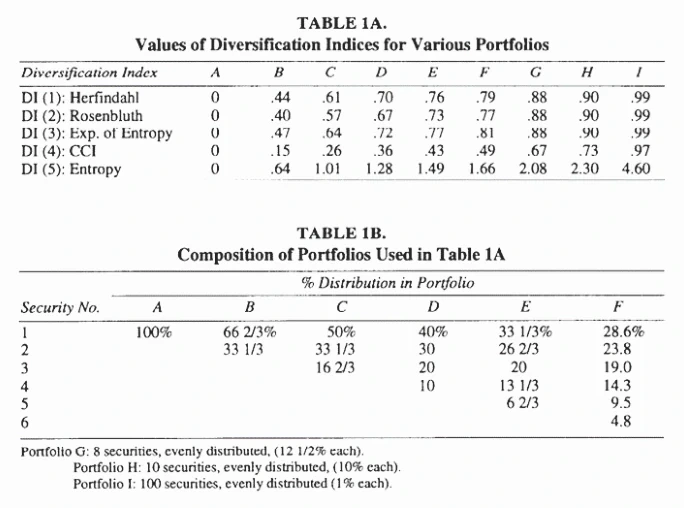
portfolios used in Table 1A (Woerheide and Persson 1993).
The HHI for Coeweb data must be adjusted to reflect evolving export destinations across provinces, with the goal of creating a diversification index for both export destinations and sectors akin to the HHI. By capturing shifts in export patterns, this index provides insight into the degree of diversification across regions. A criticism of the HHI argues about a structural measure applied uniformly across industries, it misses the industry-specific nuances relating structure to market power and thus wholly fails to provide regulators with useful information. For example, HHI provides no information about barriers to entry, economies of scale or scope, rapidly changing technology, or firm-specific characteristics, all of which may bear on the degree of competition in the industry. Given that the HHI quantifies concentration, interpreting it inversely offers great insight: higher HHI values means less diversified export geography with provinces’ rankings remaining unchanged. These territories characterized by ports, complicated economies, and strong industrial bases are clearly the most diversified.
Regions vary not just in terms of productive diversification but also in their economic structure. Different perspectives, such as internal regional processes and dimensions requiring further research, pose challenges for conventional financial analysis techniques. Additionally, we can evaluate how each region deviates from the average across other
product categories, such as industrial groups or Pavitt categorization. This more in-depth study allows us to track the diverse effects of the pandemic on manufacturing sectors. A check was introduced to control for the abbreviation of regions. Since several regions have merged over time, we assigned two residual values, 98 and 99, to a group of different provinces. The HHI serves a useful role in measuring changes in industrial concentration. In many industries it provides a reasonable initial indication, prior to an efficiencies calculation, of harm to consumers from potential consolidation.
5. Diversification Types: Geographic (Origin and Destination) and
Sectoral. A Focus on The Italian Provinces
Geographic diversification is a valuable and effective strategy to pursue during economic downturns. Studies confirm the importance of understanding the overall impact of product or geographic diversification on corporate performance by investigating their interplay, a relationship that, as suggested by research in this area (Hautz et al. 2014; Kuppuswamy and Villalonga 2016; Rajan et al. 2000) may be influenced by the business environment itself.
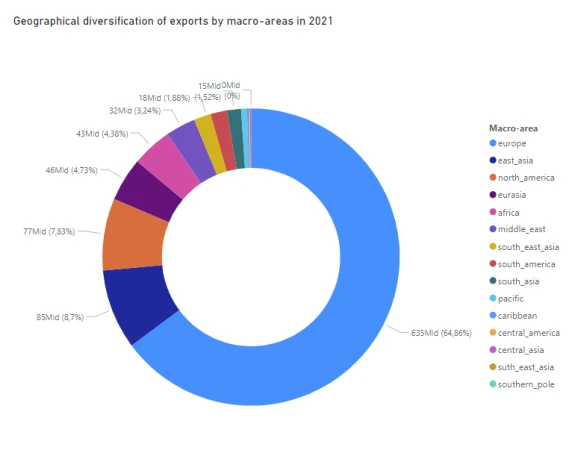
globe. Italy is divided into twenty first-level administrative divisions called “regions,” which may be informally grouped into three main areas, namely the North (comprising Liguria,
Lombardy, Piedmont, Aosta Valley, Veneto, Friuli-Venezia Giulia, Emilia-Romagna, and Trentino-Alto-Adige), the Center (with Tuscany, Lazio, Marche, and Umbria), and, finally, the South along with the Islands (Abruzzo, Basilicata, Calabria, Campania, Molise, Apulia, Sicily, and Sardinia). The economic situation is marked by a significant gap between the northern and southern regions, with disparities in growth, GDP, unemployment, and capital formation (Daniele and Malanima 2011; Ciaschini et al. 2022) further worsen by the 2008 financial crisis (Franco 2010).
Differences exist not only in the economic field, but also in other domains, such as in the healthcare system. However, this is also due to regional economic inequality (Lucchini et al. 2009). Nonetheless, the dualism between Northern and Southern Italian territories has been an object of concern for decades, as the disparities between them are significant and seemingly intractable, despite extensive efforts to find a solution. Before Italian unification, inequalities between regions were far less pronounced and did not involve the North-South divide, with roughly equal average incomes. This began to change by the end of the nineteenth century, when the Northern areas, such as the famous industrial triangle (Milan, Turin, and Genoa), embarked on the so-called “industrialization process”, with industrial progress that can be thus considered as the primary cause of today’s inequities between North and South (Daniele and Malanima 2011).
In our endeavor to compare diverse specialized provinces, we have devised three diversification indices for the year 2019 utilizing Coeweb (Barbieri et al. 2024). Diversification indices for each specific province (or region) can be calculated in terms of sector, export destination, and import origin through the reciprocal of the Herfindahl- Hirschman Index (HHI), which provides a more intuitive measure of diversification, with higher values indicating greater diversification, and lower values suggesting higher concentration:
𝐸𝑋𝑃 𝑝𝑟𝑜𝑣𝑖𝑛𝑐𝑒, 𝑠𝑒𝑐𝑡𝑜𝑟𝑖 𝐸𝑋𝑃 𝑝𝑟𝑜𝑣𝑖𝑛𝑐𝑒, 𝑎𝑙𝑙 𝑠𝑒𝑐𝑡𝑜𝑟𝑠 ∗100)
In the formula above, S is either the share of a province’s exports or imports to a certain country in the world, or the share of a province’s exports in a sector compared to other sectors. The HHI index has a maximum value of 10,000 (calculated as 100 × 100).
For instance, if the province of Rome exclusively exports in a single sector, we will have:
𝐸𝑋𝑃 𝑅𝑜𝑚𝑒, 𝑠𝑒𝑐𝑡𝑜𝑟𝑖 𝐸𝑋𝑃 𝑅𝑜𝑚𝑒, 𝑎𝑙𝑙 𝑠𝑒𝑐𝑡𝑜𝑟𝑠 ⋅100 = 100
However, the index obtained is a concentration index. In order to get the diversification index it is necessary to take the reciprocal:
𝐻𝐻𝐼𝑠𝑒𝑐𝑡𝑜𝑟𝑎𝑙, 𝑅𝑜𝑚𝑒 (6)
𝐷𝑖𝑣𝑒𝑟𝑠𝑖𝑓𝑖𝑐𝑎𝑡𝑖𝑜𝑛 𝑖𝑛𝑑𝑒𝑥𝑠𝑒𝑐𝑡𝑜𝑟𝑎𝑙,𝑅𝑜𝑚𝑒=
Thus, in the aforementioned example, the diversification index for the province of Rome is:
𝐷𝑖𝑣𝑒𝑟𝑠𝑖𝑓𝑖𝑐𝑎𝑡𝑖𝑜𝑛 𝑖𝑛𝑑𝑒𝑥𝑠𝑒𝑐𝑡𝑜𝑟𝑎𝑙,𝑅𝑜𝑚𝑒=
It is possible to observe that by taking the reciprocal, the diversification index must range from 0.0001 to an arbitrarily large number. The formulas above referred to the regional diversification index for export by sector. However, the same formula can be applied for import by origin:
(5b)
𝐼𝑀𝑃 𝑝𝑟𝑜𝑣𝑖𝑛𝑐𝑒, 𝑜𝑟𝑖𝑔𝑖𝑛𝑖 𝐼𝑀𝑃 𝑝𝑟𝑜𝑣𝑖𝑛𝑐𝑒, 𝑎𝑙𝑙 𝑜𝑟𝑖𝑔𝑖𝑛𝑠
∗100
and for export by destination:
(5c)
𝐸𝑋𝑃 𝑝𝑟𝑜𝑣𝑖𝑛𝑐𝑒, 𝑑𝑒𝑠𝑡𝑖𝑛𝑎𝑡𝑖𝑜𝑛𝑖 𝐸𝑋𝑃 𝑝𝑟𝑜𝑣𝑖𝑛𝑐𝑒, 𝑎𝑙𝑙 𝑑𝑒𝑠𝑡𝑖𝑛𝑎𝑡𝑖𝑜𝑛𝑠
∗100
In both cases, the diversification index is calculated in the same way as in the case of export by sector.
Since economics is not a static science, but rather one that constantly evolves due to changing trade agreements and other socio-political factors, it is crucial to examine connections from another perspective, namely as a system of relations among numerous countries, referred to as “linkages”. Hirschman (1945) describes linkages as “unique constellations of experiences and consequences of direct and indirect effects’’: an investment in a particular market indeed leads to changes that affect the economy in a succession of ripple effect events in different sectors. Interdisciplinarity, alongside a
multidisciplinary perspective, is crucial in economic approaches: the first attempt to combine the two was carried out precisely by Hirschman in his book National Power and the Structure of Foreign Trade (1945).
6. Statistical Analysis
Shifting the focus on Italian provinces can help study diversifications and market structures. Compatible development can be accomplished at both sectoral and territorial levels through coordinated efforts within a logistical system. This coordination can enhance the region’s competitiveness, attract new investments, and spark major endogenous and self-propulsion growth processes (Gereffi et al. 2005). On a similar note, dialogue should be encouraged between entities, stakeholders, and the public to identify specific problems and articulate possible solutions.
Graph. 2: The diversification of five Italian provinces (Treviso, Ferrara, Milano, Vicenza, Venezia)
compared using the HHI index. Invariance encompasses study of transportation and logistics, which create and attract traffic flows, as well as the benefits and drawbacks of the latter. The input cost differential between alternative localization solutions can be used to deduce the localization indifference or “Muth condition” for productive activities (Muth 1969). Companies can plan production and distribution processes over long distances using global networks of industrial relations, transportation, and logistics infrastructure, as well as internationalscale facilities and information systems. The process of analyzing and assessing
alternative routes and logistical solutions that substitute all-road traffic with multimodal/intermodal transportation is referred to as “transversality.”
Specialization and variety in urban production structure are crucial for regional and urban economies, contributing to technological externalities into localization and urbanization effects (Isard [1965] 1972). The concentration of printing activity within a specific region, for instance, improves information spillovers and encourages innovation. This form of externality has been identified with Marshall (1890), Arrow (1962), and Romer (1986) (1, according to Glaeser et al. 1992). As noted by Jacobs (1969), the highest sources of knowledge spillovers are often located outside the innovating firm’s industry (Beaudry and Schiffauerova 2009). The empirical literature, particularly influenced by Glaeser’s work, has focused on measuring specialization and diversity in urban life using positive indicators whose variability is determined by the robustness and accuracy of quantitative analyses. On this note, Salvati and Zitti (2009) argues for assessing factors such as the geographic environment of economic activities as well as the size of the enterprises located in the corresponding area. In Italy, regional authorities serve as levels of territorial subdivision, while enjoying—as public entities acknowledged by the Constitution (Art. 114)—legal standing and broad autonomy. Among the primary structural constraints in Italy, the 34th Italy Report by independent research institute Eurispes—a reputable source of regional analysis—claims that social and economic fragmentations, despite being among the most visible issues, are also the least addressed. Further inconsistencies include 41% of Italy’s population residing in economically depressed areas. Notably, regional disparities in GDP per-capita persist, with Italy’s population distribution reflecting substantial economic imbalances since 1973.
The Coeweb NACE codes are classification codes used to categorize economic activities in the EU, widely applied in trade, businesses, and statistics to standardize data across countries. Coeweb refers to the Eurostat trade database, which includes data on imports and exports and helps analyze trade flows. These codes allow policymakers to assess which industries contribute the most to exports and imports, track changes in industrial activity, and guide decisions for diversification or investment.
The data available on Coeweb focuses on customs-based information, leading to greater import and export values in bordering Italian regions. Coeweb tracks domestic trade flows at the province level, with province 98 reflecting residual values related to electricity and natural gas, and province 99 indicating changes over time in some provinces. This information provides insight into provincial trade activities across Italy.
Additionally, the TEC platform presents a comprehensive view of Italian trade, encompassing all manufacturing enterprises in importing and exporting goods. A zero value in the platform indicates manufacturing activities with no trade involvement. In conclusion, despite the pandemic’s challenges, Italian export sectors have remained resilient. However, it is essential to approach the data with an open mind and acknowledge the limitations of customs-based analysis to gain a deeper understanding of the nuances within trade activities across Italy.

by Italian area.


for every Italian region. We have calculated the reciprocal HHI and the difference with the regional average given by provincial aggregation. One notable outcome is that diversification tends to rise as value moves from the provinces to the regional level. This is interesting, and the Island- Regions give a specific illustration in this regard, as their exports are more geographically diverse than those of their respective provinces, probably due to the fact that they are islands. Moreover, moving to sectoral diversification, regional sectors tend to have a higher diversification value than the provincial average in Apulia and the Center-North, while being slightly negative for the Islands.
The previous sections address the debate between specialization and diversification as economic strategies, highlighting how diversification is essential for reducing risks and increasing resilience, while specialization fosters efficiency and innovation. The analyses presented in the following paragraphs provide practical contributions to this discussion, showing how the most digitalized Italian regions also tend to be more economically diversified. This finding is particularly significant within the context of the previously discussed North-South divide in Italy and demonstrates that diversification is not just a theoretical concept but a tangible strategy achievable through targeted investments and technology.
Geographical and sectoral diversification of imports and exports is thus assessed by means of the reciprocal HHI along with the impact of digital technologies (such as corporate websites) on economic diversification itself. The resulting findings provide insights into regional dynamics, highlighting how disparities stem not only from structural factors but also from uneven investments in technology and resources supporting diversification. Consequently, these findings also reinforce the making a point of Italy as a key example of the challenges and opportunities of economic diversification in a digital, globalized context, with technological advancement—especially the growing use of websites— influencing significantly market diversification. In the next paragraphs, we will thus examine the relationship between the reciprocal HHI (by sector, region, and export), and the Italian firms’ website diffusion index(corresponding to the percentage of firms with more than ten employees in the industry and service sectors equipped with a website) in a three-year period (2019-2021).
The website diffusion index showed a moderate positive correlation for the average reciprocal HHI of exports: 0.700 for 2019 and 0.828 for 2020. The coefficient of determination for R² equaled 0.490 for 2019 and 0.686 for 2020, which means about 49% and 69% of the variance of the average reciprocal HHI is explained. This would suggest that firms with stronger website usage drive up the average reciprocal HHI. The COVID- 19 pandemic may have influenced such a tendency in 2020, through furthering the adoption of websites, and concentrating exporters in sectors where websites are well overrepresented. The correlation turned to be positive in 2021, though in a lowered degree of 0.629, and the R² was at 0.395, meaning that 40% of the variance of the average mutual HHI was explained by the website diffusion index. This year might have just gathered the undertaken trends in 2020, with online presence continuing to bring benefits to firms, but at less pronounced incremental effects.
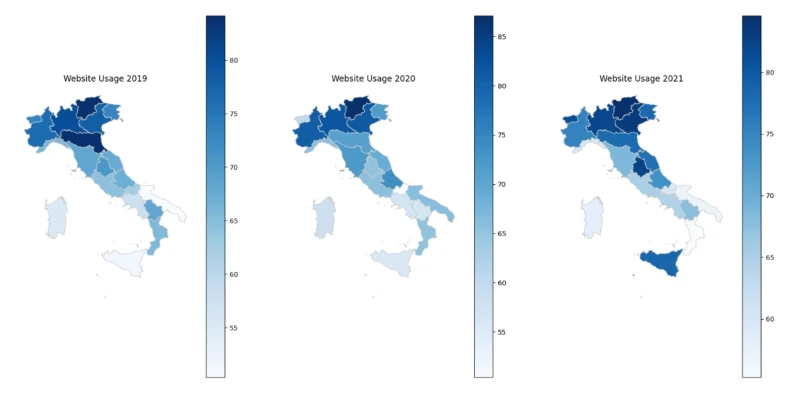


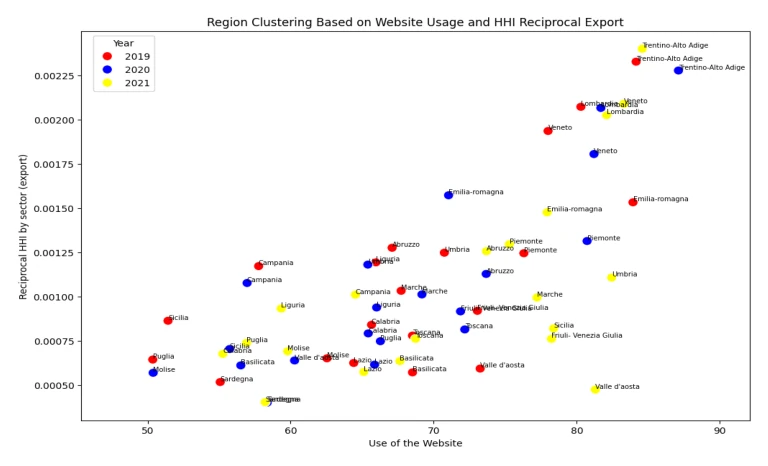
2021. On a more general note, some regions exhibited a significant improvement over time, with Umbria and Piedmont increasing, for example, website adoption and reciprocal HHI between the 2021 and the benchmarking estimations, and Campania reporting an exceedingly remarkable growth in website adoption (and, therefore, positive reciprocal HHI growth) throughout the whole triennium. Higher degrees of digitization and market diversification observed in northern Italian regions are probably due to the strong industrial presence and technological investments: on the contrary, southern regions showing low digitization and very little market diversification, hint toward an area to be possibly exploited. In fact, it has been commented that in the regions of Umbria, Piedmont, and Campania, great improvement has been registered with technology takeup and the development of digital presence, taking this as a sign of returns from investment in technology and initiatives.
7. Conclusions
In conclusion, this study has provided insight into the concept of productive diversification by developing different indexes—including the Hirschman-Herfindahl Index (HHI)—to measure diversification in imports and exports by sector and geography.
Analyzing data from Italian provinces using the Coeweb’s NACE codes3, this study found that the use of different diversification indexes alongside the HHI provides a more comprehensive understanding of productive diversification, empowering policymakers and analysts with additional tools for measurement.
Furthermore, this research introduces a gravitational index to measure the complexity of production systems, akin to Hidalgo and Hausmann’s Index, offering a nuanced understanding of a region’s productive capacity and growth potential. By considering both diversification and complexity, policymakers and analysts can thus make betterinformed decisions regarding economic development and growth strategies. The research underscores the importance of diversification in fostering sustainable economic development and advocates for a multifaceted approach to capture its complexity effectively. Therefore, by employing assorted diversification indexes and the gravitational index, this study aims to provide a more comprehensive understanding for analysts and policymakers.
Moreover, an important goal of the article is to highlight regional economic patterns in Italy, particularly through HHI-based assessments. The use of graphs and data visualization enhances the clarity of the findings, particularly in relation to website adoption in Italian regions, which emerges as a relevant factor regarding diversification. The study also highlights the importance of interdisciplinarity in economic approaches, with Hirschman’s model serving as a significant tool for understanding market concentration and competitiveness. Additionally, examining linkages among countries as a system of relations helps to comprehend the effects of changing trade agreements and other socio-political factors.
Overall, this research contributes to understanding productive diversification and emphasizes the significance of interdisciplinarity approaches. The development of various diversification indexes and the usage of the Hidalgo and Hausmann’s Index offer valuable tools for further economic analysis. Future research could delve deeper into the relationship between productive diversification and economic resilience, exploring how varying diversification strategies impact regional development under various contexts, ultimately providing insights for promoting long-term economic success.
Acknowledgments We thank the European Youth Think Tank cultural association for providing us with workspaces and offering us a stimulating context for the development of our collaboration on this article.
Funding The research received no specific grant from any funding agency in the public, commercial, or not-for-profit sectors.
3 The acronym NACE refers to the different statistical categories of economic activities adopted since 1970 in the EU. It is the main platform for the collection and analysis of statistical data about national accounts, labor market, companies etc. (Eurostat n.d.).
Conflicts of interest The author(s) states that there is no conflict of interests.