 Journal of Global Trade, Ethics and Law
Introduction
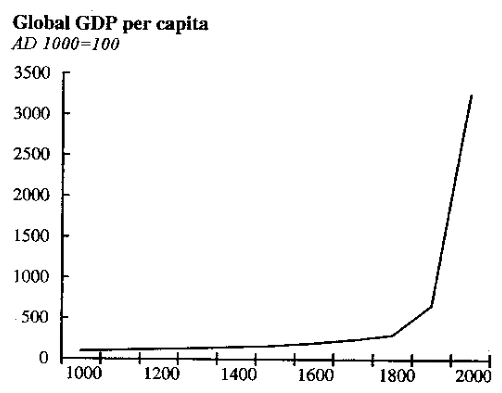
Although it is impossible to be confident about the quality of long-run historical data, the per capita world gross domestic product (GDP) changed very little between the birth of Jesus and 1500 CE: from about $90 (in 1990 dollars) to about $140. For the first eighteen centuries of the past two millennia, the per capita world GDP increased at a snail’s pace, at a rate of about 0.1% per year. From 1800 to 2000, its growth has exploded (at an annual growth rate of 1.2% or 12 times 0.1%), following an exponential path -more precisely speaking, largely in the so-called “developed” countries.1
In 1800, the per capita world GDP increased to $600 (in 1990 dollars). In 2000, it rocketed to $6,500. [Note: If the per capita GDP were used as a proxy for the average living standard, it would take 700 hundred years to double the living standard if it grew at an annual rate of 0.1%, and slightly less than 60 years if it rose at an annual rate of 1.2%, respectively.]
1 See Maddison, Angus, The World Economy: A Millennial Perspective and Monitoring the World Economy, 1820-1992.

As Chart 1 shows, the last 200 years to 2000 registered a sharp acceleration of economic growth from the previous 1800 years. [Chart 1 does not plot for the first millennium; the line, if plotted, would be flat at an incredibly low per capita GDP.] Since 1800, the per capita world GDP has increased annually at a rate of twelve times over the preceding 1800 years of 0.1% per year, owing to massive investment in physical and human capital, and enormous technological progress under the so-called Industrial Revolution, driven by the development of modern capitalism. The standard of living of the “average” person in the world rose by 11-fold from 1800 through 2000.
The scale of the rise in living standards during the past two hundred years was remarkable. In the early 1800s:
(i) The average life expectancy was 40 years. Chart 2 displays the rise of the life expectancy of the “average” female from 40 years in 1600 to 84 years in 2000. To know about the male life expectancy, subtract 4 to 6 years from the female data for each year. [Note: I used to ask my students in class, “Why do males live shorter than females every year?” Predominant answers from (markedly female) students (admittedly, a biased sample?) were: “On the average, men are inferior to women in many aspects – emotionally, intellectually, morally, and physically except in violence and animal brutishness, and that’s why men live shorter than women. Savvy?”]
(ii) Even in the most advanced countries, it still took around half the workforce to feed everyone. (iii) Working hours were very long, around 80 hours per week. (iv) Vacations and retirement were virtually unknown. (v) Child labor was common. [Can you believe this? John Locke, the noted British political philosopher urged (in 1697) parents to put their children to work at AGE THREE, lest they have only bread and water to eat and drink.] The dramatic gains in living standards achieved in the past 200+ years, however, have not been evenly distributed. In Western Europe and the United States, living standards have increased almost 20 times since 1800, but in some African countries, they have barely doubled.
Any happy-sounding (from the developed countries’ perspective) historical report must end here, for no other reason than that the above historical economic picture demonstrates mainly the bright side of the two hundred+ years of capitalist development and hides its dark side.
1. Humans have Changed the Nature of the Earth Fundamentally and Irrevocably
The 200+ years of capitalist development altered the nature of the Earth fundamentally and seemingly irrevocably. The effects of human economic activity have been so extensive that the Nobel Laureate in Chemistry Paul Crutzen2 introduced in 2000 the term and concept of Anthropocene (meaning the human epoch) at a meeting of the Scientific Committee of the International Geosphere-Biosphere Program in Mexico. He defined it as an era in which human economic activity covered the surface of the Earth completely, leaving no part of it untouched. Man-made materials and wastes, and massive use of fossil fuels, have radically transformed the entire Earth -- especially, increased atmospheric carbon dioxide (one of the greenhouse gasses that absorb the heat given off by the Earth and radiate back into the atmosphere) that causes global warming. Ever since the Industrial Revolution humans have used more and more fossil fuels like coal and oil, releasing unprecedentedly enormous amounts of carbon dioxide into the atmosphere. The density of atmospheric carbon dioxide was about 280 ppm (parts per million) before the Industrial Revolution. By now, the level passed 400 ppm.
In the Pliocene Epoch four million years ago, the average temperature of the Earth was warmer than it is now by around 3 to 4.5 degrees Celsius (or 5.4 to 8.1 degrees Fahrenheit); the ice shelves of Antarctica and Greenland were completely melted, and ocean levels were at minimum 5.8 meters (19 feet) higher than today’s. Will climate change in the Anthropocene Epoch alter the Earth toward similar conditions? Is human
2 Paul J. Crutzen was a director at the Max Planck Institute for Chemistry in Mainz. He received the Nobel Prize in Chemistry in 1995 for his work on ozone depletion.
civilization “facing a threat to its very existence,” as Kohei Saito’s book, Slow Down, eloquently warns?
Especially from the perspective of the so-called “developed” countries, the economic growth brought about by modernization and concomitant technological development has led to affluent lifestyle. The very economic growth itself during the past 200+ years, however, seems to be what is destroying the very basis of human survival. Specifically, the upper class in the developed world (plus the top class of the developing countries) may be able to maintain their luxurious lifestyle even as climate change continues. Many ordinary people, especially those barely getting by each day, will likely continue to scramble to survive, as revealed during the recent COVID-19 pandemic. If one looks at the entire world (humanity), one cannot fail to recognize that the economic system (especially, the current neoliberal version) adopted by humans has imposed severe environmental degradation (climate change, pollution, and rapid depletion of natural resources) on top of economic inequality within most nations as well as between developed and developing countries.
2. What does the global division of labor, a.k.a., “global supply chain” hide?
Because of economic globalization, the world economy has been transformed into a global division of labor, or a big “global supply chain” along the reasoning dubbed “comparative advantage theory” advocated by mainstream economists. For example, following the logic of global capitalism, the U.S., the single largest national economy that accounts for a quarter of the global gross domestic product, moved its manufacturing plants massively to developing countries to take advantage of cheap labor (and extraction of natural resources). More manufacturing (and mining) is performed outside the United States, and the US imports the manufactured goods (and minerals) from abroad. While American consumers have enjoyed the benefits of freer international trade in terms of lower prices of imported consumer goods (and minerals), it is equally true that many American workers have lost manufacturing jobs. The arrival of cheap imports has supplanted manufacturing jobs in scores of communities in America, disrupted workers’ careers, and depressed wages, and worsened economic inequalities. It is no wonder that many ordinary American workers are angry.
The people living in the countries that have managed to belong to this global supply chain have enjoyed relatively more comfortable living standards. The number of such countries is about one-third out of 200-plus countries. In developing countries, especially those economies that have not been successful in getting aboard this global food chain, the people are economically miserable. Moreover, these poor people can watch through television and other mass media how affluent, luxurious life the people in America and other rich countries are currently enjoying. Today the difference in income between poorest two billion people who are trying to survive every day in a fight against hunger and disease and a half billion rich others whose main concern is to second-guess the plot of their favorite soap opera is, on average, 1: 30. So, it was no wonder that Prime Minister Guy Verhofstadt of Belgium declared (in 2002), “the question of the century” is “How can we prevent a violent class struggle between the world’s poorest and richest people?”
The above exposes only one dark aspect of economic globalization. The other dark aspect is climate change, which is closely connected with environmental degradation and rapid depletion of natural resources. Climate change has struck the world increasingly year by year. It will continue to raid both rich and poor countries unless effective policies and actions are taken globally and conscientiously.
The comfortable lifestyle in developed countries, particularly the USA, is based on the extraction of energy and non-renewable natural resources from developing countries and sweatshops in the latter for exports to the former. It is resulting in rapid environmental degradation in the latter countries. If one borrows the words of Immanuel Wallerstein, an American sociologist, capitalism relies on an opposition between “core” (aka, “Global North”) and “periphery” (aka, “Global South”). The former extracts cheap labor and natural resources from the latter. This process also enables the former to dump what economists call “externality” (pollution and depletion of natural resources) on the latter.
As a result of globalization, capitalism’s global reach has extended to almost all corners of the world, and the new frontier to exploit seems to have been disappearing rapidly. (Some say the digital frontier may be the latest and last front of capitalism.) Capitalism’s exploitation is not just the cheap labor of the developing countries but also their environment. If the world aims for unlimited growth, the current global system will most likely place the world’s environment (especially, of developing countries) in danger, eventually posing a threat to humanity’s existence on the small Spaceship Earth.
3. Is there any viable solution to humanity’s existential issue?
In recent years, I have had opportunities to attend several lectures or presentations (held in the US) addressing ecology, SDGs (Sustainable Development Goals), and environmental protection. The lecturers or presenters and the attendees appeared to have nothing but noble intentions toward the Earth. It was disappointing, however, that the lecturers and attendees seemed overly complacent, or were seemingly belittling the serious challenges humanity faces. In response to questions like “What kind of solutions or actions do you suggest for humanity to adopt or do, to be freed from the environmental crisis?”, the typical speaker’s answers (with approving nods from the audience) boiled down basically to the following:
- Keep recycling things; keep using reusable shopping bags and cotton T-shirts. • Reduce beef consumption and become vegetarian. • Replace gasoline-powered vehicles with electric cars and so on. They sounded complacent pronouncements with good intentions, reminding me of the adage, “The road to hell is paved with good intentions.”
For example, by urging consumers in affluent economies to “keep using reusable shopping bags and cotton T-shirts,” these speakers may help to reduce the current environmental problems a bit and generate a sense of accomplishment. But they seem either oblivious of or are not interested in addressing the violence against the people and environment of the Global South that is involved in producing reusable bags or T-shirts, which must lead to more use of materials and energy (generated with fossil fuels). If this is not a kind of “Greenwashing,” what is?
Electric vehicles indeed emit no carbon dioxide. The production of electric cars and storage batteries, however, uses fossil fuels and non-renewable natural resources, which will not stop environmental degradation and depletion of such natural resources. For instance, producing electric cars (e.g., Tesla) requires large amounts of rare metals. It requires, among others, lithium. The ecological scholar, Kohei Saito, reports:
“Lithium deposits can be found in many regions along the Andes Mountain range [extending from South and North through Argentina, Chile, Bolivia, Peru, Ecuador, Colombia, and Venezuela] … Lithium becomes concentrated in the groundwater beneath dry regions over a long period of time. Lithium-rich brine is pumped from beneath salt lakes, and then the lithium is extracted by evaporating the remaining water… A single corporation can extract 1,700 liters [442 gallons] of groundwater per second. The drainage of such a huge volume of water in an area that’s already so dry will obviously have a great impact on the region’s ecology. For example, the population of Andean flamingos who depend on the shrimp who live in this briny water is decreasing. Further, the rapid drainage of groundwater is causing shortages in the fresh water accessible to residents of the area… Basically, the effort to combat climate change is causing even more intense extraction and exploitation in the Global South to meet the demands for a different resource meant to replace oil… Another necessary element for manufacturing lithium-ion batteries is cobalt ... Almost 60 percent of the world’s cobalt is mined in the Democratic Republic of Congo… The mining is being conducted in dangerous tunnels that lack necessary safety measures… In the worst cases, mining accidents lead to miners being buried alive. The deaths of children among these workers have led to international condemnation. On the other side of this global supply chain is not only Tesla but Microsoft and Apple as well … The problem is not confined to lithium and cobalt. The demand for iron, copper, and aluminum has also risen as the GDP has continued to grow.” (See Saito’s Slow Down, pp. 46-49.)
The above-mentioned American lecturers/presenters on environmental issues and their audiences do not seem to understand that the way of life enjoyed by the people living in America and other rich countries places a heavy burden on developing countries, where people suffer serious air and water pollution and other environmental aggravation, notwithstanding their poor living standards. Humanity’s failure to act in defense of the Earth also reflects “a fundamental problem of motivation” in addition to the sad reality that “not enough people yet understand the dangers or know about what to do about them.” As Alan Thein Durning pointed out, many people “do not care enough because they do not identify themselves with the world as a whole. The Earth is such a big place that it might as well be no place at all.” (See Durning’s book, This Place on Earth, p. 7.)
American societies are often called “materialistic.” As pointed out by Durning in his How Much Is Enough?: “in a deeper sense they are the opposite,” because materialistic people would care about and care for “material” things, not just consume them. Durning cites what poet-farmer Wendell Berry said in his Home Economics (San Francisco: North Point Press, 1987): “Our economy is such that we ‘cannot afford’ to take care of things: Labor is expensive, time is expensive, money is expensive, but materials [including natural resources] – the stuff of creation – are so cheap that we cannot afford to take care of them.” How a society treats metals, chemicals, paper, and other materials is a fundamental determinant of its impact on the natural realm. The industries that extract and process raw materials are among the most polluting, energy-intensive, and ecologically destructive of all human endeavors. If materials are “the stuff of creation,” then rich nations like America are not “materialistic” enough.
Toward the end of a recent lecture on ecology, some attendees asked the lecturer “What do you suggest we should do to eliminate ecological dangers?” While the lecturer was pondering over the question, I suggested to the audience that the most effective solution would be “degrowth” (in English), “décroissance” (in French), or “decrescita” (in Italian.) The degrowth movement aims to reshape society away from its current trends of environmental damage, alienation, and inequality towards establishing communities that promote harmony, respect for the environment, and extension of local democracy by enabling labor to employ capital instead of capital employing labor.
When another attendee asked, “What would degrowth entail?”, I replied: “It would most likely entail adopting Buddhist economics (the lifestyle of the Buddha and his followers) as suggested by E. F. Schumacher (1911-1977), the German-British economist and the author of Small Is Beautiful (1973), if we want to survive as a species.” Specifically, Schumacher, who was known as a devout Christian, advocated for the world to adopt the Buddhist points of view regarding “the function of work,” “the pattern of consumption,” “the standard of living,” and “the use of natural resources.” Schumacher realized that it was not the Third World which should learn about the high technology of the West, but rather the West which should learn from the spiritual perception of the East.
One can add that any successful degrowth would necessitate massive redistribution of income and wealth domestically and globally to “prevent a violent class struggle between the world’s poorest and richest people” warned by Belgian Prime Minister Guy Verhofstadt in 2002. Such redistribution would coalesce with what I call Pope Francis’ ‘Lion’s roar of four No’s’:
No to an economy of exclusion No to the new idolatry of money No to a financial system that rules rather than serves No to the inequality that spawns violence. It should be noted that the visions of Pope Francis and Schumacher (and other communitarians) regarding the future of our society must be the one in which every man and woman are real people and should not be treated as cogs in vast machines and gapfillers in automated production processes. Moreover, people should claim freedom and autonomy and recognize responsibility for their thoughts, intentions, and actions. America’s famed sociologist Veblen supposedly called the implicit assumption that people do not matter “crackpot realism.” One would add another crackpot realism in today’s neoliberal economic context: Our finite Earth is endowed with infinite material resources, and consumption is the be-all and end-all of human life.
4. Concluding Remarks
One may explain humanity’s failure to act in defence of the Earth “as a problem of knowledge: not enough people yet understand the dangers or know what to do about them.” But doesn’t this humanity’s failure reflect a fundamental problem of motivation? In other words, people know enough, but they do not care enough. “They do not care enough because they do not identify themselves with the world as a whole. The Earth is such a big place that it might as well as no place at all.” (See Alan Thein Durning’s This Place on Earth, p. 7)
The mainstream (neoclassical) economics enamored with Newtonian mechanics has become “fragmentary and reductionist” (physicist Fritjof Capra’s words). Preoccupied with maximizing individual utility and efficiency, it has failed to recognize the economy as one aspect of a whole ecological and social fabric. Mainstream economists have belittled and ignored ecological economists like Nicholas Georgescu-Roegen, a notable pioneer in Bioeconomics. They have neglected ecological/economic/political/social interdependence and did not pay any attention to Alfred Marshall’s famous tenet that economics ‘is a branch of biology broadly defined.’ In other words, the economic process is part and parcel of the human biological domain. Instead, they have become unsuspecting agents of destruction by transforming their society (e.g., today's America) into a commodity-centered society. As a result, ethics and politics have become servants of economics, reducing justice to the commodification of everything (including the livable environment) society needs. Politics and ethics need decolonization from economics. For many years, mainstream American economists have built highfalutin economic growth models on the foundation of their intellectual disease (called “physics envy”) and have been hiding behind such models their sophomoric ineptitudes of mathematical obscurity of Nobel-Prize-winning proportions. No matter what these models have kept saying about the need for economic growth, we, the earthlings, need a bit of horse sense: It is wrong to suppose that the human species has any special privilege to escape extinction. Degrowth or growth will soon be a life-or-death question for humanity.
According to French philosopher Michel Foucault (1926-1984): “As the archeology of our thought easily shows, man is an invention of recent date. And one perhaps nearing its end.” In 1966, he wagered that “man would be erased, like a face drawn in sand at the edge of the sea” -- in the last sentence of his book, The Order of Things – An Archaeology of the Human Sciences. Would any independent-minded, moral, and rational being find such a disappearance of the human species from the Earth regrettable? Is there more reason why humans are on the Earth than there is for animals or plants, stones, rivers, seas, and the air? Isn’t it our collective responsibility for us to make the late philosopher lose his wager, for the sake of our descendants’ survival and well-being?
Funding The research received no specific grant from any funding agency in the public, commercial, or not-for-profit sectors.
Conflicts of interest The author(s) states that there is no conflict of interests.