Durham & Thunmann
Diamond open access No APC ISSN 2977-0025
Journal menu
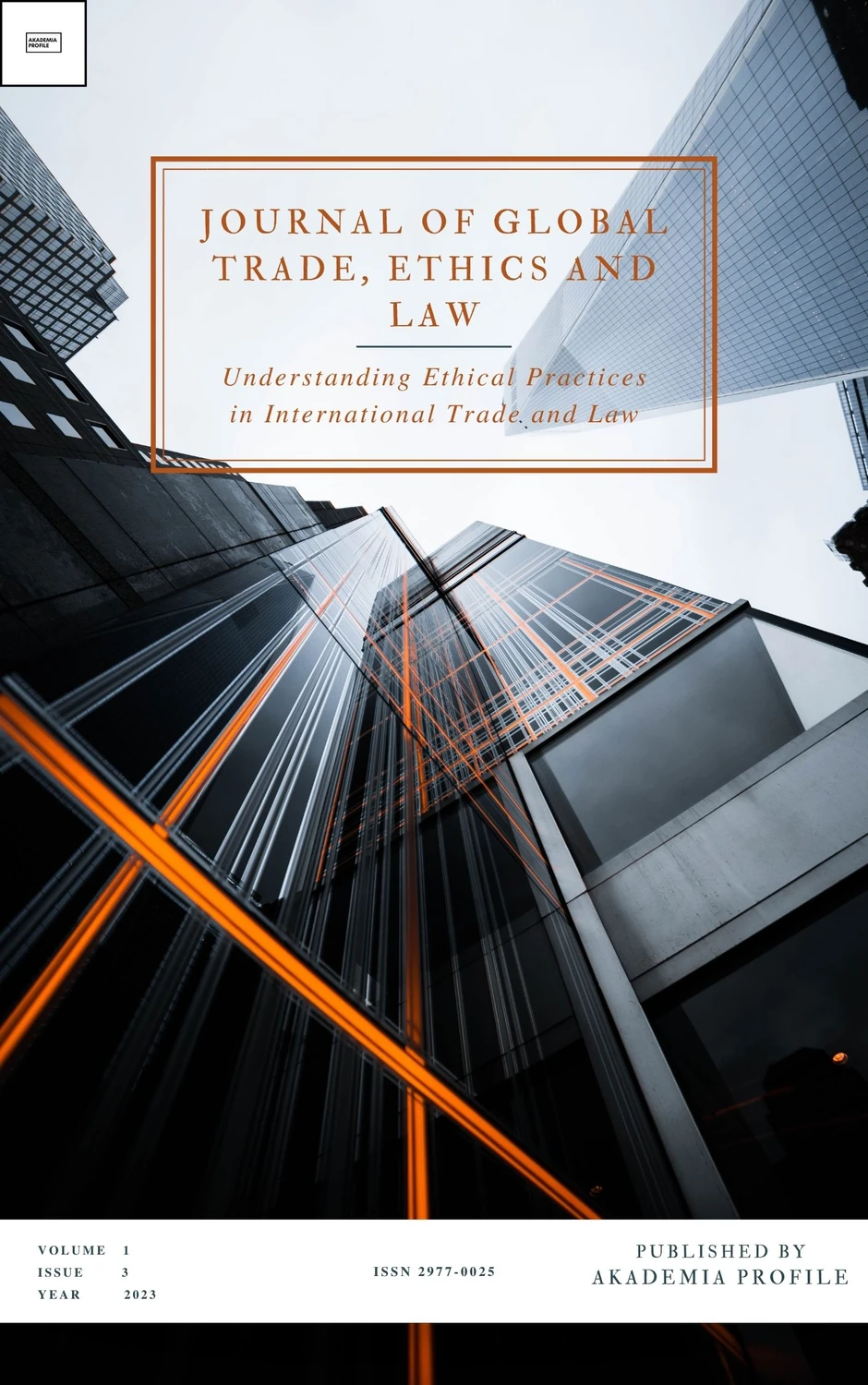
Cover of Journal of Global Trade, Ethics and Law, volume 1, issue 3

Volume 1 · Issue 3 · 2023

A published issue in the JGTEL archive. Article-level records are being consolidated into the new platform.

Published
26 October 2023
Articles
2
Access
Open access

Research articles

Search all articles
  1. 01

    Research Article · Pages 1–25

    Business and Consumer Uncertainty During the Pandemic: A Sector Analysis in European Countries

    Oscar Claveria

    This paper examines the evolution of business and consumer uncertainty at sector level amid the coronavirus pandemic in 32 European countries and the European Union. Since uncertainty is not directly observable, we approximate it using a geometric discrepancy indicator. This approach allows us quantifying the proportion of disagreement in business and consumer expectations of 32 countries. We have used information from all monthly forward-looking questions contained in the Joint Harmonised Programme of Business and Consumer Surveys conducted by the European Commission: the industry survey, the service survey, the retail trade survey, the building survey and the consumer survey. First, we have calculated a discrepancy indicator for each of the 17 survey questions analysed, which allows approximating the proportion of uncertainty about different aspects of economic activity, both form the demand and the supply sides of the economy. We then use these indicators to calculate disagreement indices at the sector level. We graphic the evolution of the degree of uncertainty in the main economic sectors of the analysed economies up to June 2020. We observe marked differences, both across variables, sectors and countries since the inception of the COVID-19 crisis. Finally, by adding the sectoral indicators, an indicator of business uncertainty is calculated and compared with that of consumers. Again, we find substantial differences in the evolution of uncertainty between managers and consumers. This analysis seeks to offer a global overview of the degree of economic uncertainty in the midst of the coronavirus crisis at the sectoral level.

  2. 02

    Research Article · Pages 26–35

    Forging a Moral Basis for Emerging Economies

    Yeomin Yoon

    Aristotle said that politics is the master science. What he calls politics is not what is now called political science but the culmination of ethics. Per Aristotle, economics, a dimension of ethics, posits the eudaimonia (human flourishing or well-being, erroneously translated as happiness) or summum bonum for human society and describes the regional structures of human social existence. Economics cannot, therefore, be a positive science but must be a normative science. Morality has disappeared from economics being taught at American universities. The prevailing paradigm adopted by mainstream economics is Homo economicus, which is the “wrong reduction of a man.” Such a gross reduction of a human into a rational agent who maximizes his utility subject to the given budget constraint leaves dormant higher human values (compassion, empathy, brotherhood, and sisterhood, to name a few), and this mechanical decision-maker is likely to destroy himself and the society in which he operates. Economics (taught and practiced in America) is the fish that has jumped out of its pond and is now dying of thirst. Ethics is the water that gives it life. The best way to save it is to bring economics back to the pond where it belongs. What is truly needed is a paradigm shift in the teaching and practice of economics. Last but not least, economists in emerging countries should forge a moral basis for their national economy and form a vision of how to construct a system of political economy that will achieve the maximum well-being of the citizens and social justice. In doing so, they should synthesize their normative value judgments with scientific perspectives in economics. Old, labeled models like capitalism and socialism are modifiable constructs.