 Journal of Global Trade, Ethics and Law
1. Introduction
The trade policy community responded to the 13th Ministerial Conference (MC13) of the World Trade Organization (WTO) with gallows humour and resignation. What was on the table in Abu Dhabi amounted to administrivia1, most of it was contested, and what was not even in the room let alone on the table were all the elephants – data, artificial intelligence (AI), subsidies galore (technology, green, national security), weaponization of trade through supply chain restrictions, and tariffs rising due to trade wars. What awaits beyond Abu Dhabi is a possible second term for Donald J. Trump as US President, which could spell the formal end of the trade system as we have come to know and love/hate it.
There is no shortage of narratives advancing explanations for why the rules-based system is facing pushback and most of them are not of recent provenance. Dani Rodrik’s “globalization went too far” tome was published in 1997 and his claim that hyperglobalization was too weakly embedded in governance systems to be stable could always be cited if it failed (and sure enough, Harvard Kennedy School recently put out a polycast titled “He predicted globalization's failure, now he’s planning what’s next”; Ranalli 2022). The same could be said of the realpolitik perspective that the trade peace hypothesis that allegedly underpinned globalization was false and would eventually fail (John Mearsheimer did just that in his 2019 article, “Bound to Fail”). In betwixt and between, any number of prominent commentators from Joseph Stiglitz to Marianna Mazzucato to Robert Lighthizer have picked at the system for the discontents and disconnects to which it gave rise. And there are various ad hoc explanations for the current crisis from China eating the West’s cake by gaming the system with unfair trading practices, to the system having been ambushed by Adam Tooze’s “polycrisis”, to accidents of history. If you read enough of these, you wonder how such an unloved thing come to be in the first place or could exist for so long.
In this note, I start from the premise that the rules-based system was expected in our times and more precisely was endogenous to the economic and technological conditions
1 The main “money” issues on the table at MC13 were the accession of Comoros and Timor-Leste, two of the smallest and poorest countries in the world (accomplished); extension of the moratorium on tariffs on electronic transmissions, which according to Andrenelli & Lopez-Gonzalez (2023) avoids annual tariffs worth about $1.3 billion a year (accomplished); implementation of the agreement on fisheries subsidies agreed at MC12, which according to Sumaila et al. (2019) would most likely impose sustainability obligations on about $22 billion a year of the total estimated $35 billion in annual fisheries subsidies deemed to be contributing to overfishing but not actually eliminate them (failed – as of 1 July 2024, the agreement had only 52 of the 109 ratifications required to come into force and MC13 failed to reach agreement on additional disciplines under negotiations on subsidies contributing to overcapacity and overfishing); and an agreement to update disciplines on agriculture primarily related to “public stockholding for food security purposes” (failed). Issues that did not involve financial concessions or market access included the adoption of the plurilateral services trade facilitation reference paper on domestic services regulation (accomplished) and the finalization of the Agreement on Investment Facilitation for Development (IFD), which articulate what are primarily good regulatory practices but do not actually liberalize services trade or investment (accomplished); restoring a functioning dispute settlement mechanism (failed); and several initiatives on trade and the environment (including fossil fuel subsidies and plastics) which were discussed but not materially advanced (failed). The total amount of money at stake is rounding error at the 2nd decimal point in percentage terms on the value of annual global trade in goods and services.
under which it came to be. This goes beyond arguments such as Baldwin (2016) that a rules-based system was sustained because it had escape hatches (which implicitly undermines the very notion of a rules-based order). I suggest what those conditions were and trace the demise of the system to changes in those conditions due to the steady upward flight of the arrow of technological progress. I then draw conclusions (as preliminary as these may be) for the prospects of a rules-based system going forward – and how the WTO might adapt to stay in the game for the longer term.
2. Technological Conditions and the Rules-Based System
2.1. The Kaldor Facts and the GATT
The governance regime established by the General Agreement on Tariffs and Trade (GATT) and embellished through eight rounds of multilateral negotiations, culminating in the WTO Agreement, was in hindsight ideally and perhaps uniquely suited to the economy in which it arose and for which it was tailored.
In particular, the maturing postwar industrial economy in which the GATT rounds were negotiated featured constant returns to scale and stability of the shares of national income flowing to capital and labour. Originally derived by Nicholas Kaldor from long-term data for the United States and United Kingdom (see Kaldor 1961; Jones & Romer 2010), these conditions were found to apply more generally and thus came to be treated as “stylized facts” that shaped the models built to explain economic growth. These conditions imply competitive market conditions and by extension only a limited presence of economic rents. When computable general equilibrium models were developed for trade, they assumed constant returns to scale in production and perfect competition in product markets, reflecting this understanding.
Within this economy, which in the 1950s and 1960s featured national systems of production behind still relatively high tariff borders and limited mobility of capital, technology that would ultimately enable globalization was marching on. Particularly important innovations were the intermodal container (1956),2 air cargo transport (which really started with the introduction of the Boeing 747 wide body jet in 1970),3 and communications technology advances (in particular radio frequency identification or RFID, the first commercial applications of which date back to the late 1960s).4
2 While containers had a long history of development, the container revolution – really the intermodal revolution – is credited to American trucking entrepreneur Malcom McLean, who acquired a shipping company, Pan Atlantic, and retrofitted its tankers to transport what became the ISO standard shipping container, which could be easily transferred from ships to trains or trucks. The first experiment in this intermodal transport was conducted on 20 April 1956 (Transportation Research Board 1992). It caught on and McLean’s company, renamed Sealand, became a multinational operating worldwide. The container/intermodal innovation is widely credited with revolutionizing goods transport, logistics, and the efficient re-design of port facilities.
3 The Boeing 747 wide-body passenger jet with its large cargo hold and extended range debuted in 1970. It enabled “just in time” inventory management for high-value cargo.
The evolution of production from the vertically integrated national production systems of the 1960s to the global system of production powered by these technological developments was sufficiently advanced by the early 1980s to give rise to the term “supply chain management” (SCM), which appears to have first been used in print in 1982.5 By the time we get to Punta del Este in 1986 and the launch of the 8th and final GATT round, the book, The Global Factory, by Joseph Grunwald and Kenneth Flamm had already been published.
Here it is salient to observe that the policy setting also became progressively conducive to the development of globalization, but this appears in retrospect to have been as much by default as by design. The early GATT rounds concluded in rapid succession had made a good start to reducing tariff walls to an average of about 15% (Hoekman & Kostecki 1996, 18), but only the first two achieved significant tariff reductions. The founding round, which saw the adoption of the US Reciprocal Trade Agreements Act as the template for the GATT, could not only claim to be the original mega-regional trade agreement due to its limited membership, but also the first explicitly geopolitical trade instrument of the modern era through its exclusion of the communist bloc. The Annecy Round, which was the first actually conducted under the GATT, did achieve significant reductions but the next three rounds (Torquay, Geneva and Dillon) were disappointments for trade policy. In the case of the Dillon Round, trade policy took a step backward for geopolitical reasons (accommodation of European agricultural protectionism to enable the Common Agricultural Policy as a necessary contribution to consolidating the European Communities as a bulwark against communist bloc expansion). Moreover, in considering the contribution of trade policy to globalization, it is instructive to read the United States’ take on the state of play at the end of the Dillon Round. The Economic Report of the President released in January 1963 opens its discussion of the state of the international economy as follows:
“The international economy has undergone a remarkable transformation in the past decade.
For many years after World War II, import quotas, discriminatory trade practices, and
exchange restrictions on all forms of international payments characterized the bulk of international transactions. Though further progress needs to be made, much of this restrictive
legacy has now been swept away.” (Council of Economic Advisers 1963, 91)
4 Commercial applications of RFID technology started in the 1960s with the establishment of the companies Sensormatic and Checkpoint, which provided electronic article surveillance (EAS) equipment for anti-theft and security applications. The utility of RFID for tracking and inventory management to support the evolution of just in time production was greatly increased by the introduction of the personal computer in 1981. The first patent with the term RFID was awarded to Charles Walton in 1983.
5 Supply chain management appears to have been coined by Keith Oliver, a consultant at Booz Allen Hamilton, in an interview in the German journal Wirtschaftswoche in 1982, and later picked up in English language media and trade literature. Once conceptualized, the concept of SCM expanded to include procurement, production planning, inventory management, etc.
The next two rounds, Kennedy and Tokyo concluded in 1967 and 1979 respectively, introduced formula-based tariff cuts and realized by far the largest tariff reduction to date (Kennedy), and greatly expanded the membership through a mass accession of developing countries (Tokyo). But the dominant issues were not establishing the framework for a seamless globalization; rather they were balance of payments and trade deficit concerns not to mention a laundry list of administrivia housekeeping issues (for a detailed review of the context for these rounds, see Curtis 2002).
Thus, the interesting story is not how trade policy created the basis for globalization –technology was doing that – it is why trade policy did not get in the way? Why was it convenient and acceptable to a broad array of states to sign onto the GATT and its codes even as the world was dealing with the polycrisis du jour of the time (cold war, hot war, collapse of Bretton Woods, oil price spikes, exchange rates in chaos, race riots, middle east in crisis, Latin America and Africa about to go bankrupt, grade school kids being taught to get under the desk in case of nuclear attack – am I missing anything?)
The short answer I would argue is the Kaldor facts. The maturing industrial economy of the postwar era featured, as a broad generalization, constant returns to scale and a stable division of the share of national income flowing to labour and capital. These are markers of a competitive economy in which there are limited incentives for strategic behaviour by governments. If capital and labour are paid their competitive rental cost in producing widgets and gidgets along with thousands of other tariff-line items, why would a government express particular desire to have their country specialize in widgets in particular and expend political capital and financial subsidies to corner the market on that product? They wouldn’t. And in fact, they don’t – outside of the Trump Administration (remember washing machines?), ministers of industry typically don’t get out of bed for competitive markets.
Passive acceptance of the structural evolution of the economy is what really characterizes the rules-based system. The readiness to adopt formula-based tariff cuts in the Kennedy Round underscores this. Thousands of tariff lines and one formula for all.6
As a bit of digression, it is also interesting to note what the theory of trade agreements has to say about the problem that the GATT/WTO solves: Bagwell et al. (2016) review this literature and conclude it is the terms of trade problem implied by the theory of optimum tariffs. Optimum tariffs theory (Johnson 1953) states that a country that applies a tariff makes terms of trade gains to the extent that its foreign suppliers cut their price to maintain market share. While domestic consumers pay higher prices, the tariff portion flows to the government and stays in the importing country – the importing country itself pays a lower price for the imports. Accordingly, there is always an incentive to renege on bargains and raise tariffs as US President Nixon did with the Nixon Measures in 1971 and as Donald Trump threatens to do if he wins the presidency in 2024. The dynamic problem with reneging is that, if and when trading partners counter, the terms of trade gains evaporate and the mutual raising of tariffs causes real losses in economic efficiency (for a quantitative demonstration of this, see Ciuriak & Xiao (2017), a study that runs a Nixontype 10% surcharge imposed by the United States on its imports and retaliation thereto by its trading partners). But one wonders how often a GATT trade negotiation session started by someone saying “Alright, let’s get down to business. Remember, what we’re trying to solve is the terms of trade problem implied by optimum tariff theory”. Yet this rationale is attributed more weight in the literature generated in the heyday of trade agreements than the alternative hypothesis that trade agreements address the exportsubsidy/profit-shifting problem, which emerges when economic and technological conditions induce strategic trade policies.7
6 The adoption of a flat tariff, including in the extreme the flat zero tariff of unilateral free trade, is an expression of the same indifference to industrial structure. A version of unilateral liberalization that eliminates tariffs on all production inputs while retaining tariffs on “sensitive sectors” is a qualified expression of such indifference to structure.
Whatever the reason (terms of trade anxieties, commitment issues, or a desire to stay out of ruinous price/subsidy wars), the readiness of countries to enter into binding agreements that limit future strategic behaviour across a broad range of products has an important implication in that it results in a reduction in political risk for firms making a commitment to international trade. As modern heterogeneous firms trade theory (Melitz 2003 and others) and the related empirical literature shows, the commitment to enter international markets entails sunk costs that can be quite considerable, including adopting technology suited for mass production for larger markets and the various “beachhead” costs absorbed in establishing a market presence abroad. Political risk comes on top of that and raises the “hurdle rate” for return on the investment to trigger the decision to enter into trade. Real options theory chimes in here by pointing out that the commitment to trade agreements reduces the real option value of waiting for more information and thus incentivizes entry.
Entry into trade is associated with a lot of good things at the firm level including increased research and development spending, scaling up through access to foreign markets, and increased efficiency from accessing global inputs. Innovation and scaling are classic industrial policy problems for governments. Under economic and technological conditions in which the economy is populated by firms operating at scale and international trade is delivering the full panoply of goods and services that only a globalized system of specialized companies can offer, the need for governments to step in to fill gaps is largely obviated. Economic doctrine evolved, essentially reverse engineering the implied role of the private sector and of the public sector. The result was the OECD consensus on “soft” vs. “hard” (alternatively “horizontal” vs. “vertical”) industrial policy. And so the winter of industrial policy set in as globalization deepened.
7 Export-subsidy/profit-shifting problems can arise from incentives to capture international market share in a given product/sector. Such incentives include: capturing international rents in increasing returns sectors (e.g., Brander and Spencer 1985); and capturing “learning by doing” benefits, an oft-heard rationale for clawing back manufacturing (in particular by the Trump administration, which used the threat of tariffs to incentivize cautious foreign manufacturers to locate plants in the United States rather than, say, Mexico or Canada, or to try and service the US market from abroad – see Crowley and Ciuriak 2018 for a discussion of such “weaponization of uncertainty”). The other main rationales developed in the literature explaining why there are trade agreements are less relevant here. These include: (a) the commitment hypothesis that governments use agreements to shield themselves from lobby pressures for protectionist measures or to put through unpopular domestic reforms; and (b) the role of preferential trade agreements (PTAs) in deepening integration beyond what can be achieved multilaterally.
To summarize, under competitive market conditions, markets allocate production and market share efficiently and indeed fairly. Under the principle of comparative advantage, all nations find their niche and share in the benefits through trade. In the absence of economic rents, it is convenient for nations to allow markets to determine which products are produced how and by whom, and for commercial disputes to be settled by legal principles. Globalization evolved primarily because of enabling technological change and the choices made by millions of trading firms. Governments did not get in the way (and indeed got out of the way) because the evolving economic and technological conditions were removing reasons to intervene, not creating them. In this narrative, globalization did not go too far – it went exactly as far as economic and technological conditions allowed and made sense. We can call this the Amadeus Principle, after the famous exchange between Wolfgang Amadeus Mozart and Emperor Joseph II: “Too many notes, dear Mozart, too many notes.” “Just as many as necessary, Your Majesty.”
As a final digression to foreshadow where this discussion is going, just months after the launch of the technology that would come to symbolize the globalized system of production, which in turn would inspire the creation of the WTO and the pronouncement of the “made in the world” production system – i.e., the first successful intermodal shipping experiment on 20 April 1956 (note 3 above) – the study of artificial intelligence as a discipline was kicked off at the Dartmouth Summer Research Project on Artificial Intelligence, 18 June through 17 August 1956. Just as globalization was being born, so was its potential ultimate nemesis. Coincidence, but ironic. Charming photo. Little did they know.

2.2. The Transition to a Knowledge-Based Economy and the WTO
Around 1980, things started to change – and not because Margaret Thatcher and Ronald Reagan veered towards neoclassical economics as is often maintained. Notice that change was “in the air” for deeper reasons is provided by a series of papers in the late 1970s and early 1980s that introduced “new trade theory”, 8 which is based on firms facing increasing returns, product differentiation and imperfect competition. These conditions imply the existence of economic rents. Shortly thereafter Brander & Spencer (1983, 1985) set out how strategic trade behaviour can be motivated by these conditions, triggering a contest by nations to capture the rents. The term “strategic trade policy” was coined to describe this behaviour (Krugman 1994).
A second marker was the passage by the Carter Administration of the Bayh-Dole Act in December 1980 to encourage commercialization of university-conducted research. The importance of science and technology for national security was drilled home for the US government by the Sputnik surprise in 1957 and was reflected in short order by the establishment of the Defense Advanced Research Projects Agency (DARPA) in February 1958 with a mission “to make pivotal investments in breakthrough technologies for national security”; and a few months later by the transformation of the National Advisory Committee for Aeronautics into the National Aeronautics and Space Administration (NASA). Japan’s industrial challenge in the 1970s in a similar fashion generated a sense of angst for the United States about its competitiveness on the commercial front (see Thierer 2021 for a review of US discourse at the time). Bayh-Dole was part of a wider shift in US policy to strengthen capacity for innovation to boost global competitiveness.
The Act itself had two important effects. First, by vesting patent rights in governmentfunded research in private hands, it created “freedom to operate” (FTO) for US companies enjoying the ownership of these assets. Second, by the same token, it denied FTO to foreign companies, forcing them to work around privately held US IP. This quickly took on great significance with the release of the IBM personal computer (PC) in 1981, followed shortly by the release by John Walker’s Autodesk in 1982 of computer-aided design and manufacturing (CAD/CAM) software for the PC. These technological steps revolutionized industrial design and in effect enabled the industrialization of research and development (R&D), accelerating the pace of innovation. In an age of accelerated innovation, the steeply rising patent totals generated by the world’s leading innovator imposed a rapidly growing negative externality on the rest of the global economy. Importantly for the present discussion, the legal protection against infringement of IP enables international rent capture by the IP holder.
The acceleration in innovation is clearly seen in patenting activity, which started to turn up in the United States, the leading edge innovator, around 1980 and then steepened sharply (Figure 1). The vertical green lines are the NAFTA, WTO and China WTO accession shocks respectively to provide reference points.
8 The standard references are Krugman (1979, 1980 and 1981); Dixit & Norman (1980); Lancaster (1980); Helpman (1981): and Ethier (1982). A parallel thread in the industrial organization and business literature focused on multinational enterprises (MNEs). Major contributors to this literature include Hymer (1960/1976); Caves (1971); Buckley & Casson (1976); and Dunning (1977).

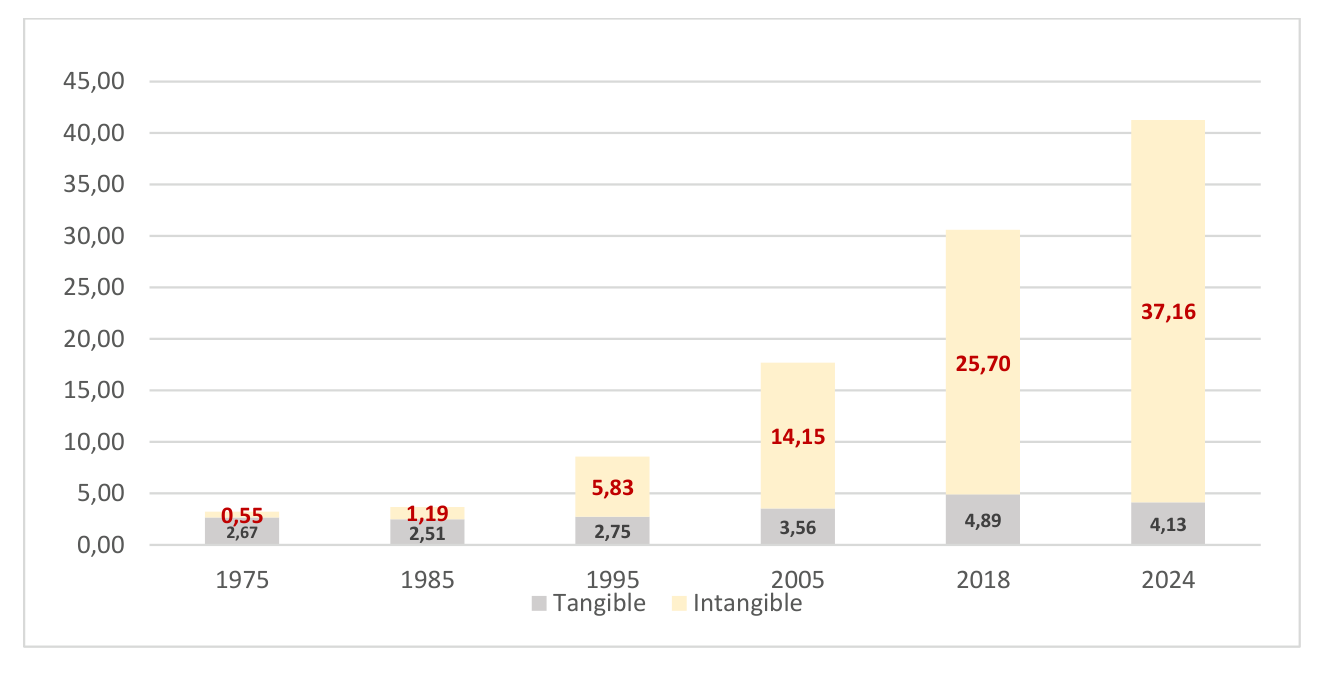
At the same time, the share of intangibles in corporate assets started to increase sharply (Figure 2). In 1975, the intangible share was 17% of the S&P 500 market capitalization; in 1995, when the WTO opened its doors for business, it was up to 68%.
And, of particular importance for the present discussion, the capital share of income started to rise on trend (Figure 3) as an increasing share of capital assets gained exclusive FTO rights. By the same token, the labour share fell. The Kaldor facts were no more. The vertical green lines are the NAFTA, WTO and China WTO accession shocks for reference.
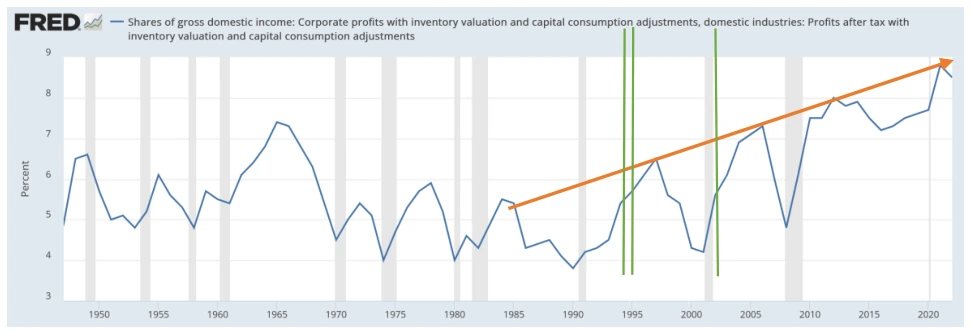
In short, there was a phase change in the behaviour of the economy circa 1980 that coincides with the start of the transition to a knowledge-based economy, a transition that was driven by a fundamental change in technological conditions (not, I reiterate, by a change in ideological persuasions or trade policy).
The changes wrought by the change in the technological and economic conditions were pervasive. Consider for example the geopolitical implications. The United States was back on its heels in the 1970s. A short two decades after Bayh-Dole, the Economist gushed over this piece of legislation as “Innovation’s Golden Goose”:
“REMEMBER the technological malaise that befell America in the late 1970s? Japan was busy snuffing out Pittsburgh's steel mills, driving Detroit off the road, and beginning its assault on Silicon Valley. Only a decade later, things were very different. Japanese industry was in retreat. An exhausted Soviet empire threw in the towel. Europe sat up and started investing heavily in America. Why the sudden reversal of fortunes? Across America, there had been a flowering of innovation unlike anything seen before” (The Economist 2002).
US income distribution dynamics also changed around 1980 – but not for the better:
“Before [1980], families at all levels saw their incomes grow more or less in tandem with the growth of the economy as a whole. After 1980, however, the lion’s share of gains went to the top end of the income distribution, with families in the bottom half lagging far behind.” (Krugman
2014).
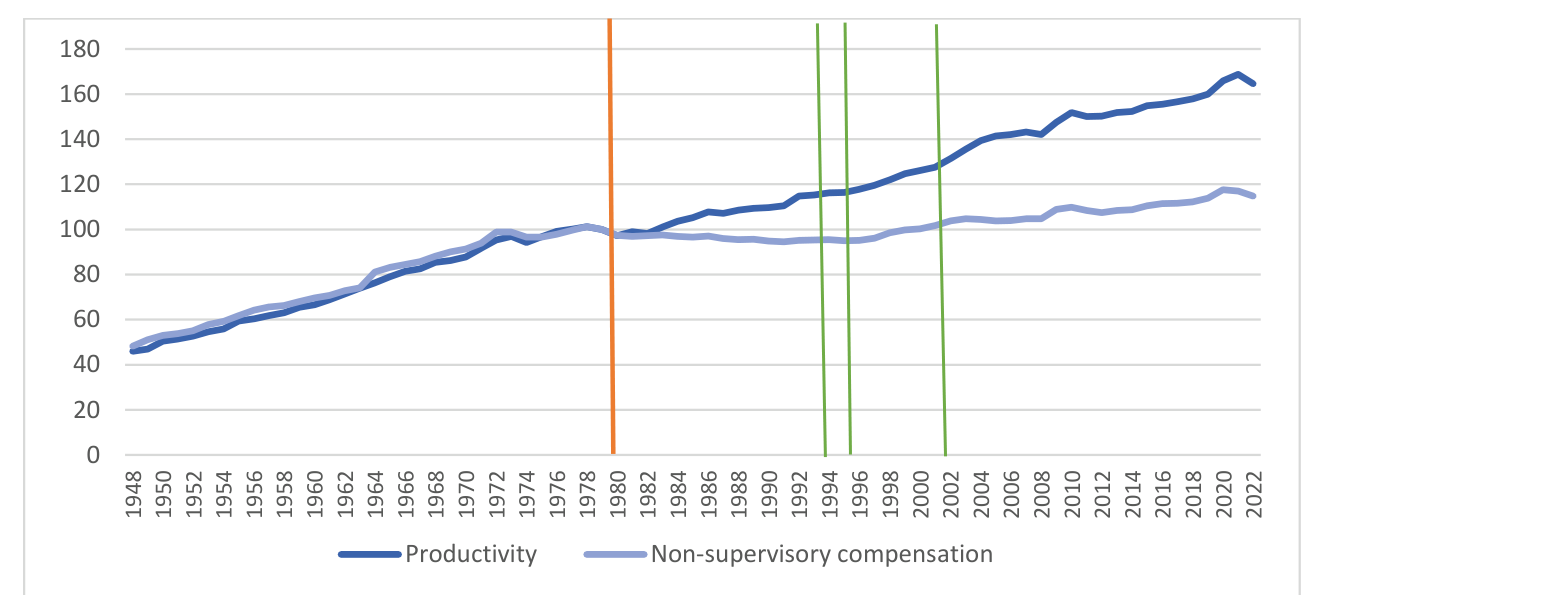
This largely reflected the emergence of a gap between productivity and compensation for non-supervisory employees (Figure 4). The Economic Policy Institute attributes this gap to the dismantling of all the policy bulwarks helping to ensure that typical workers’ wages grew in line with productivity, in areas ranging from macroeconomic stabilization to antitrust (Economic Policy Institute 2022).
The change in the composition of productive assets was reflected in the contribution of jobs to manufacturing output in the United States.
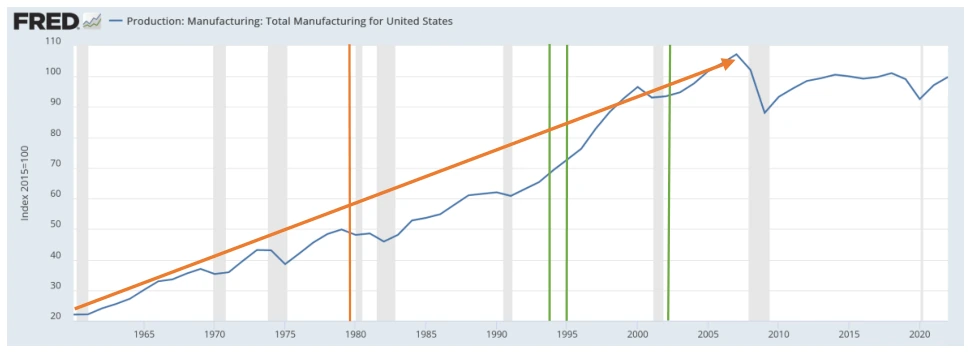
Manufacturing output did not change its general upwards growth trajectory after 1979 (Figure 5) – including after the China WTO accession “shock” – but manufacturing employment peaked in 1979 and then trended down (Figure 6). The decline during the China shock period was more or less on trend. Notably, the decline in manufacturing employment followed a downward ratchet pattern with steep declines followed by less than complete rebounds. The downward ratchet at the time of the 2001 recession was not followed by a rebound, just a shallowing out of the decline.
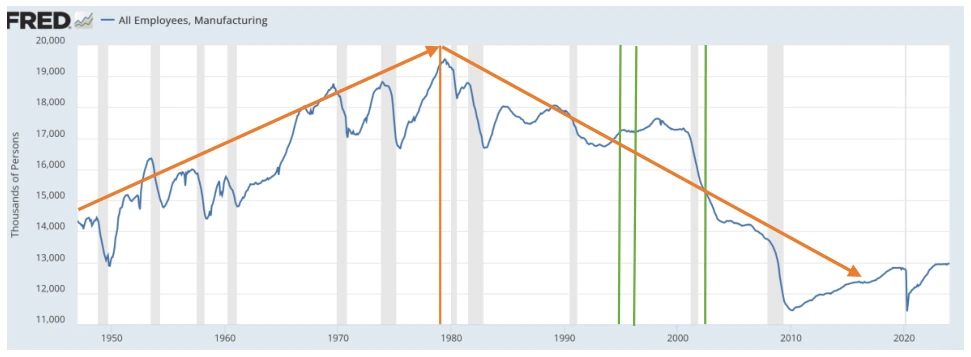
US household wealth did not decline after 1979 – it rose steeply, riding the post-1980s bull markets. While US manufacturing did not suffer a brownout following the transition (to this day, the United States is 2 ½ times as manufacturing-intensive on a per capita basis as China), US industrial towns did not share in the wealth because tasks were being transferred to capital and wage bills were redirected to returns to that capital, which largely accrued to the top percentiles of wealth distribution.
Michael Porter was the guru of the age and midwifed the transfiguration of unloved industrial policy into radiant innovation policy with its “diamond” (Porter 1990)9 and
9 The Diamond Model explains a nation’s competitive advantage in a global context through four conditions: (a) factor conditions (the country's endowments in terms of natural resources, infrastructure, skilled labor, and capital); (b) demand conditions (sophisticated domestic demand pushes companies to improve); (c) related and supporting industries (i.e., close linkages with suppliers and alliances with other firms, with a special role assigned to universities and research institutions); and (d) firm strategy, structure, and rivalry (in particular, intense domestic competition helps spur innovation and efficiency). Complementing the diamond conditions, Porter assigns a catalytic role to government.
“triple helix” (Etzkowitz 2003)10 and so forth. Since capital is mobile and universities are not, innovation systems and the clusters that sprang up like mushrooms after the rain11 coalesced around university towns and these centres blossomed even as industrial cities rusted.
The transition to the knowledge-based economy also had profound implications for trade policy.
First, the growing rent capture by IP meant that comparative advantage in the industrialized countries shifted towards knowledge-based activities, including high-value manufacturing protected by IP and away from basic manufacturing. As a necessary corollary, comparative advantage in basic manufacturing shifted elsewhere. As it turned out, that “elsewhere” was mainly in East Asia.
As a digression, comparative advantage works at the national level as an internal competition for productive resources, with the more efficient or profitable sectors gaining at the expense of less efficient and less profitable sectors. Basic manufacturing and traditional services in America and other advanced economies lost out to protected IP, not to foreign competition. That is not of course how domestic firms or politicians tend to see things. The shift in wealth was internal to the advanced industrial countries and not, for example, an outflow to China. It is instructive in this regard to consider that China’s share of global equity market value is closer to its share of international IP receipts, a marker of control of valuable IP, than it is to its share of manufacturing (Table 1). The “West” (the advanced industrial countries) accounts for a substantially greater share of global manufacturing than China with a smaller share of the world’s population and thus is nearly twice as manufacturing-intensive. But the West also accounts for over 80% of global equity market value to China’s 6.8% because the West controls over 90% of global IP earnings. Recall that over 90% of the S&P 500 market cap is accounted for by intangibles. The West dominates high value manufacturing – Nvidia with its US$ 3.32 trillion market cap (as of July 2024) is the poster firm to underscore this point.
10 Etzkowitz describes the triple helix as a convergence of firms, universities and governments. The “entrepreneurial university” incubates technology-based firms; firms raise their technological level by becoming more research-intensive thus moving closer to academia; and the government acts as a public entrepreneur and venture capitalist in addition to its traditional regulatory role.
11 Hospers et al. (2009) identified a slew of cluster initiatives seeking to associate themselves with the Silicon Valley phenomenon, many of them in the United States but many outside. These include Silicon Alley (Manhattan), Silicon Snowbank (Minneapolis-St. Paul), Silicon Desert (Phoenix), Silicon Mountain (Colorado Springs), Silicon Prairie (Champaign-Urbana), Silicon Dominion (Virginia), Silicon Hills (Austin), Silicon Forest (Seattle), Silicon Fen (Cambridge), Silicon Glen (Glasgow), Silicon Bog (Limerick), Medicon Valley (Copenhagen), Silicon Seaside (Norway), Silicon Saxony (Sachsen), Bavaria Valley (Bayern), Silicon Polder (the Netherlands), Dommel Valley (Eindhoven), Silicon Kashba (Istanbul), Shalom Valley (Israel), Silicon Plateau (Bangalore), Media Valley (Inchon), Billi-Can Valley (Arnhel Land—Australia) and Telecom Valley (Minas Gerais—Brazil). The original Global Cluster Initiative Survey (Sölvell et al. 2003) identified more than 500 cluster initiatives worldwide.

Accessible table text
| — | The West | China | The Rest | Total |
|---|---|---|---|---|
| Population | 14.5 | 18.0 | 67.5 | 100 |
| GDP | 58.7 | 17.3 | 24.0 | 100 |
| Manufacturing | 45.7 | 31.7 | 22.5 | 100 |
| Equity market valuation | 81.2 | 6.8 | 12.0 | 100 |
| International IP Receipts | 92.7 | 3.2 | 4.1 | 100 |
The transition to the knowledge-based economy created new defensive and offensive interests in the advanced countries. On the defensive side, as basic manufacturing in advanced countries lost ground due to comparative disadvantage, manufacturers became petitioners for protection – and politicians were only too happy to oblige. There is an important marker for this: the rise of anti-dumping in the United States, the leading user of this instrument, starts around 1980. Alongside the rise in antidumping actions, the 1980s also witnessed the rise of “grey area measures” (voluntary export restraints or VERs and so forth) which worked in tandem with antidumping to artificially create/preserve rents for the protected sectors (Ciuriak et al. 2013).12
On the offensive side, the rising importance of IP created an incentive to increase the strength of IP laws and their enforcement abroad as this promoted international rent capture. The United States moved to do exactly that, starting with the Omnibus Trade and Competitiveness Act of 1988, which introduced the Special 301 Report, first published in 1989. Using Special 301 as leverage, and Fast Track/Trade Promotion Authority marching orders which set out ambitious IP protection objectives for US trade policy, the United States pioneered the introduction of IP protection into trade agreements, starting with the US-Canada Free Trade Agreement in 1989, and the NAFTA that followed. The United States was also the main proponent for the inclusion of Trade-Related Aspects of Intellectual Property Rights (TRIPS) in the 1995 World Trade Organization (WTO) Agreement and pushed strongly for the Anti-Counterfeiting Trade Agreement (ACTA), which however failed to achieve ratification and remains dormant, and the progressive ratcheting up of criminal penalties for infringement in the Trans-Pacific Partnership (TPP) agreement concluded in 2016 (Ciuriak 2019a).
12 The rise of antidumping has an institutional dimension since it follows the consolidation of trade remedy determinations of dumping and injury in the Department of Commerce and the International Trade Commission within that department, effective 1 January 1980 (Irwin 2005). Previously, Treasury had been responsible for determination of whether sales were at less than fair value. Where Treasury had rarely found less-than-fair-value sales, resulting in termination of most cases, Commerce rarely failed to find them. Further, a 1984 legal change encouraged the filing of multiple petitions. The simultaneous rise in the use of grey area measures is not explained by these institutional developments. The changing technological conditions explains both and thus furnishes the more elegant explanation.
The introduction of IP chapters fundamentally changed the nature of free trade agreements (FTAs), since these agreements now enabled international rent capture not by exploiting economies of scale through liberalized trade but by excluding rival products through restricted trade. In the latter regard, the early movers in the knowledge-based economy were able to create “patent moats” that ring-fenced their products and production processes, ensuring their FTO in this space while denying FTO to potential rivals, forcing the latter to work around the established patents. The push for internationalization of IP protection in FTAs thus primarily served to channel international rents into the handful of leading knowledge-based economies. A new fault line thus emerged internationally between the IP haves and the IP have nots.
The failure of the WTO as a trade negotiation forum during the knowledge-based economy follows as a direct consequence of this consideration. To illustrate the value at issue, the United States International Trade Commission (USITC) in an investigation in 2011 estimated that China observing US IP laws could raise the rate of return to US capital by 0.4% (USITC 2011). Standard capital asset valuation methods translate a change in the stream of future returns to capital into a change in the present value of capital. Applying such a calculation to the then-current market cap of the S&P 500 of ca. $15 trillion, Ciuriak (2017) arrived at an implied gain for the valuation of US equities of $345 billion – i.e., the present value of the future stream of rent transfer from China to the United States. Applied to the current market cap of the S&P 500 of over USD 42 trillion, the figure would be much larger. Importantly, IP commitments in trade agreements do not constitute a win-win proposition but a rent transfer. Insofar as the WTO Agreement embodied a bargain of binding dispute settlement and protection from arbitrary sanctions in exchange for TRIPs, it was a one-shot agreement that could not be improved, if rent transfer remained on the table.
Foreshadowing what was to come as the share of economic rents in the system rose, pitched battles were fought over industries that scaled at the global level during this era: these include dynamic random access memory (DRAM) chips, civilian aircraft (Boeing vs. Airbus; later Bombardier vs. Embraer), super computers, and satellites (Ciuriak 2013). The Boeing-Airbus dispute dragged on for some 17 years before the two parties called it off in order to join forces against China’s effort to mount a civilian aircraft program. Meanwhile, the DRAMs case featured the panoply of industrial policy measures including multiple anti-dumping cases, US Section 301 investigations, voluntary export restraints by Japan (raising prices to reduce market share) and eventually the bilateral U.S.-Japan Semiconductor Trade Arrangement. These exceptional cases highlight the difficulties faced by a rules-based order designed for a low-rent world in dealing with a world in which large economic rents are the norm.
The WTO came into being in 1995, some 15 years following the start of the knowledgebased economy era for which it was designed. The World-Wide Web was already five years old in 1995, although not yet commercially a force. In 1996, the first known use of the term “cloud computing” would be made in a Compaq internal analysis (Regalado, 2011). The data-driven economy, in which these green shoots would constitute the forest, was on its way.
2.3. The Data-Driven Economy and the WTO in Crisis
As we fast-forward 15 years from the foundation of the WTO to 2010, the world is emerging from the Great Financial Crisis (GFC). But the truly momentous developments of the late 2000s were not the transient GFC but rather three technological innovations that would shape the world that emerged from the GFC:
- the development in 2006 of deep learning techniques based on stacked neural nets by Geoffrey Hinton at the University of Toronto (Kelly 2014); • the introduction by Apple of the iPhone in 2007 which launched the age of mobile and sent soaring the amount of data continuously accumulated and streamed into the now rapidly expanding cloud (Molla 2017); and • the application by Andrew Ng and his team at Stanford in 2009 of graphics processing units (GPUs) – computer chips designed for the massively parallel processing requirements of videogames – to run stacked neural nets (Kelly 2014).
The transformative impact came rapidly: at a presentation at the Barcelona World Mobile Conference in 2010, Google’s Eric Schmidt announced the arrival of a new age. Schmidt described it as the age of mobile – mobile computing and mobile data networks. He goes on to say that:
“…these networks are now so pervasive, we can literally know everything if we want to. What people are doing, what people care about, information that’s monitored, we can literally know it, if we want to and if people want us to know it.”13
It is more than eye-opening in light of this to consider a story told by Kevin Kelly, the former editor of Wired, of a conversation some years earlier with Larry Page, the cofounder and future CEO of Google, about Google’s free web service:
“Around 2002 I attended a small party for Google—before its IPO, when it only focused on search. I struck up a conversation with Larry Page, Google’s brilliant cofounder, who became the company’s CEO in 2011. “Larry, I still don’t get it. There are so many search companies. Web search, for free? Where does that get you?” … Page’s reply has always stuck with me: ‘Oh, we’re really making an AI.’ ” (Kelly, 2014)
The world for which Google was built had arrived. It was the world of big data, machine learning and artificial intelligence – the data-driven economy (DDE).
There are at least three major ways in which this economy profoundly challenges a rules-based order:
- the problems of establishing a value for data; • the problems of situating data in the trading system; and • the enormity of the economic rents it generates, which predicts conflict.
13 Personal transcript of the Youtube segment by the author, cited in Ciuriak 2023a.
2.3.1. The Value of Data
Data is widely considered the most valuable commodity in the modern economy and a major trade interest for the digital powers. Yet, putting a value on data has proven to be a difficult problem. This reflects in the first instance the way that data is acquired: there are no invoices or receipts to establish a transaction value (Ciuriak 2019; 2023b). By the same token, the value of data is not found in national economic accounts or in trade statistics. It is not part of the discussion of the WTO moratorium on the application of tariffs to electronic transmissions. And it is not part of the base of the calculation of taxes on multinational enterprises (MNEs) to be apportioned to end markets under the OECD/G20 Inclusive Framework for MNE tax reform (Ciuriak & Eurallyah 2021). Data is different from other productive assets and this has been a stumbling block for valuation.
Formal estimates of the value of data based on the costs of capture and curation or on the value of “free” internet services provided in order to capture data have tended to arrive at rather small figures – on the order of 1-3% of GDP (Sargent & Denniston 2023; Fay & Bester 2024; Nakamura et al. 2018) or about $280 to $940 billion for the United States in 2024 based on the IMF’s current projection for US GDP. This is in prima facie terms incongruous with the astronomical amounts of data captured over the course of the short life of the data-driven economy (currently in the hundreds of zettabytes per annum; Duarte 2023) and the transformative impact that data is having on our economy and society, not least as the key input into training AI and the impact which AI applications are having on productivity (e.g., Brynjolfsson et al. 2023).
In Ciuriak (2023b), I argue that the main approaches currently used to establish the economic value of data do not capture the economic rent that data is generating, which is the main contributor to its commercial value. This economic rent can only be seen in the market value of data-rich enterprises. Hence, we must look to the market capitalization of firms, the share of intangible assets in that capitalization, and the share of the intangibles that can plausibly be attributed to data to obtain a sense of data’s true commercial value. Making a back-of-the-envelope breakdown of the value of intangibles into data and traditional IP assets, I arrive at an estimate of 17% of the value of the intangible assets in the S&P500 in 2022. This would put the value at the beginning of 2024 on the order of $6.3 trillion. Comparing this figure to the cost-based estimates cited above, it is clear most of the value is economic rent. This is a problem for the rules-based system – but not necessarily even the biggest one posed for a rules-based trading system, an issue to which I turn to next.
2.3.2. Data in the Trading System
Data occupies a curious position in the trading system. On the one hand, insofar as it constitutes a digital product, it is subject to WTO rules, which are in principle technology neutral if the trade falls under the GATS (see, e.g., Janow & Mavroidis 2019, 2). Moreover, insofar as data flows across borders are intrinsic to enabling a transaction subject to WTO commitments to take place, they are similarly subject to WTO commitments. In this sense, “electronic transmissions”, which include both the data that comprise the digital product and other data associated with transactions that accompany digital products, have always been subject to WTO rules, insofar as these transmissions are intrinsic to the transaction if not the product itself.
At the same time, data is also directly traded in a barter exchange that takes place outside the WTO system of rules. This takes the form of free Internet services in exchange for the data generated by the use of those services, which then can be monetized separately in the other side of a two-sided market (two-sided markets with one side operating on the basis of zero prices are a signature feature of the data-driven economy; OECD 2018).
Notably, the USITC, in its quantification of the impacts of the US-Mexico-Canada Agreement (USMCA), assigned a value of cross-border data flow to each of the over 100 industries in its analytical framework (USITC 2019). US Trade Representative Katharine Tai echoed this in her statement: “Nearly every aspect of our economy has been digitized to some degree” (USTR 2021).
While valuable data is acquired in cross-border transactions, this value is, as noted above, nowhere in the trade accounts. Yet it is the subject of provisions in trade agreements that insist on the free flow of data and restrict data localization (Ciuriak 2023b) and has become the subject of strategic trade policy, whether on national security grounds or data “sovereignty” grounds or simply on revenue capture grounds. And given the absence of a WTO agreement on data and digital trade, all of this is taking outside the multilateral rules-based framework.
And this action is not likely to be brought into the multilateral framework any time soon: at the WTO Ministerial 13 in Abu Dhabi, issues such as cross border data flows, data localization requirements and access to source code for algorithms were off the table (Rockwell 2024). Moreover, the WTO work program has not even settled on how to classify digital products: as services subject to GATS, as goods subject to GATT (and implicitly potentially subject to tariffs), as intellectual property (e.g., instructions for 3D printing), as ancillary data flows that are intrinsic to GATS/GATT covered transactions and hence subject to WTO commitments, or as none of the above? This surely is a critical first step to making the WTO fit for the digital age because the GATS/GATT commitments were made in an age when data did not have immense value.
2.3.3. Conflict is predicted
While the WTO has failed to create a framework in which data could be properly treated as a traded product, countries have not been oblivious to the reality that economic rent has beeen flowing abroad to digital platforms operating on a non-taxable virtual basis in their economies, even if they have not framed the issue in terms of data rents. As countries moved to impose digital services taxes, which led to threats of trade retaliation, the negotiating action unfolded under the auspices of the OECD/G20 Inclusive Framework.
Importantly, this OECD/G20 framework addresses only profits on operations and not the value of data (Ciuriak & Eurallyah 2021). The sharing of data rents still needs to be sorted out through negotiation. Exactly where this would have taken the system is now, however, a moot point since the national security issues that data and its derivative AI applications raise would almost certainly have led to conflict independently of the value of data rents. Under the combined weight of these issues, the WTO was sidelined.
2.4. AI and the Future of the Regulation of Trade
Two streams of technological change that can be traced back to 1956 provide neat rhetorical bookends for this discussion of the rules-based system: the first was the Pan Atlantic Steamship tanker, Ideal X, leaving New York on 20 April sailing for Houston with 58 loaded truck-trailer vans above deck, launching the intermodal container revolution; the second was the convening of the Dartmouth Summer Research Project on Artificial Intelligence, 18 June through 17 August 1956. The first led to the world of globalized production for which the WTO rules-based system was designed, the second would finally arrive in a major way only in 2023 when generative AI made its big splash, at a time when the WTO was already marginalized and wholly unready to address the commercial consequences of the new economic age that AI was ushering in, as underscored by the outcome of the WTO’s 13th Ministerial.
The range of possible implications of AI currently under discussion is breathtaking –everything from massive productivity gains that spell the end of work as we know it to an extinction event for humanity. Narrowing this down slightly to the commercial governance issues, an economy in which AI plays a significant productive role as “machine knowledge capital” will feature at least three things that are highly problematic for a rules-based system as we know it.
First, it will feature (already does feature) very large economic rents because of the scalability of AI systems, including in services where AI will serve as a scalable replacement for non-scalable human resources, relieving the growth constraint that societies have historically encountered in moving from industrial to post-industrial services-intensive economies (the “Baumol effect”; Baumol 1967).
Second, it will create (is creating) massive uncertainty for all players – nation states as well as corporations and individuals. Uncertainty acts as a cost for investment as potential investors have an incentive to wait for more information before committing to an investment. Further, as the industrialization of learning through machine learning accelerates innovation (for example the use of AI to identify new materials, new potential drugs, etc.), product life cycles shrink, reducing the time available to recoup investments, which in turn raises the hurdle rate for private investment to go ahead. This implies a much greater role for government, which has a lower social rate of return. The return of industrial policy with a vengeance and at unprecedented levels of financial commitments from governments comes as no surprise when industrial policy is understood to be endogenous to the presence of rents.
Third, it requires a fundamentally new approach to carve-outs for national security and societal sovereignty, although it is necessary to first define the approach to incorporating AI in the trading system before addressing the exceptions.
3. Rules-Based Governance for Rules-Based Economics
The foregoing discussion explains the rise and fall of the rules-based system based on the evolution of technological and economic conditions. The scaling up of the global economy in the early postwar era for the most part eroded rents in the industrial economy and left nations largely indifferent to industrial structure, at least in principle. Conversely, the rise in the pace of innovation with the dawning of the knowledge-based economy starting around 1980, which stands out as a watershed year across a wide range of economic and technological indicators, witnessed the beginning of a new rise of economic rents accruing primarily to IP but also in sectors that scaled at the global level.
The rules-based system adapted to the post-1980s shift with the creation of the WTO with its TRIPS Agreement and a strong dispute settlement mechanism. While the hard cases resisted settlement by arbitration, these were the exceptions not the rule. However, the arrival of the data-driven economy around 2010 introduced major new sources of economic rents, triggering a strategic contest to capture them. Industrial policy action shifted outside the bounds of the system and the WTO has been effectively sidelined. The rise of national security interests with the digital transformation (Ciuriak 2023a) greatly amplified the dynamic. Going forward, the era of generative AI promises to be more difficult in these regards, not less.
This raises the question: are there lessons that we can we draw from this understanding of the past to help us navigate what promises to be a complex and difficult future?
3.1. A “Just So” Story on How the World Got a Rules-Based Trading System
Trade policy is industrial policy and governments are not in general indifferent as to industrial structure, not least because of domestic lobby pressure in whatever industry might be incumbent in a country, but also because of positive externalities and multiplier effects associated with major industrial establishments, the dynamic benefits of capturing market share in increasing returns industries, or simply the desire to have industry take root given the reality of learning curves.
This reality is evidenced in the structure of taxes. Revenue-oriented consumption taxes like value-added taxes tend to be flat with politically-motivated exceptions (e.g., medicines or baby formula). Tariffs are finely sculpted. Artful practices like tariff escalation, fine-tuned to tax away the marginal benefit of processing, restrictive rules of origin (e.g., yarn forward provisions for textiles and clothing trade), tariff-rate quotas to control import market share, specific taxes to provide automatic increases in protection if exchange rates rise, etc., are all tell-tale signs of industrial structure engineering aimed at shaping a country’s position in the global economy.
Given this, a system that aims for a level playing field for traded products and allows pre-agreed rules to regulate conduct, and which therefore is an expression of fundamental indifference to industrial structure, is not something we should expect to see in the normal course.
This prompts the following question: under what conditions would governments be least likely to engage in strategic behaviour in nurturing industrial development and thus most likely to allow a rules-based system to take root and more importantly spread widely to encompass most of the world’s economy? The answer would be when all industries are competitive, companies are covering their cost of capital, workers are being paid their marginal product, everyone is making a living, no-one is getting obscenely rich, and participation in trade is a win-win proposition. This is approximately the pre-1980s world described by the Kaldor facts. In that sense, the postwar economic and technological setting was particularly accommodating for a rules-based system to establish itself, as it did in the late 1970s and through the 1990s with the conclusion of the Tokyo and Uruguay Rounds of multilateral trade negotiations, which greatly expanded the system’s coverage of participating countries while simultaneously expanding the set of rules to be followed.
However, to explain the inspiration for the specific framing of those rules does require acknowledging the historical role of the postwar hegemon, the United States, which provided the legal template for the GATT in the form of the Reciprocal Trade Agreements Act, and perhaps even more importantly a non-economic concept of “fairness” in trade in the metaphor of the level playing field.
As Hudec (1996) explains, “The concept of fairness in international trade policy is almost entirely a U.S. contribution”, evolving from the concept of “fair competition” that was developed for the large, integrated US domestic market:
“The normative assertion behind the idea of fair competition is that merit should determine business outcomes. In other words, businesses should succeed or fail according to their merit as competitors. Competition will be "fair" if none of the competitors has any advantages that are not based on merit. Competition will be fair if the playing field is level.” (Hudec 1996, 7)
As Hudec (1996) further elaborates, the idea of “fair competition” made sense in the internal US market where:
- “Business conditions between domestic competitors are, for the most part, the same. All businesses are subject to the same federal government, providing them with the same type of government benefits and burdens. State governments do differ to some extent, and sometimes differences between states generate business complaints, as in the case of taxes or labor policy. But the disadvantages of such inter-state differences tend to be muted by an underlying acceptance of business mobility as a relevant option - if you don't like it you can move. Another leveling element is the fact that businesses really can compete anywhere within the internal market” (Hudec 1996, 8-9). • The federal government tended not to intrude on business, except to prevent local governments from “tilting” the playing field and to prevent cartels and anticompetitive behaviour. • Government support for business is provided to all competitors on an equal opportunity basis. This is the same principle that underlies the notion of “horizontal” industrial policy, which is an essential underpinning of disciplines on state aid that distinguish between the permitted and the non-permitted.
- There is a skeptical arbiter: “In the rough-and-tumble of business competition, losers will always want to complain about the unfairness of the process and there will always be some difference in business conditions to complain about. Governments cannot run a sensible economic policy unless they are capable of considerable skepticism toward such complaints. The internal U.S. market comes equipped with a considerable supply of such skepticism.” (Hudec 1996, 9). • There is a single currency (hence no exchange rate manipulation internally). While Hudec did not make this point explicitly with respect to the US internal market, it is implicit in the extension of the “fair trade” concept to international trade where the exchange rate comes into play: “For the average business leader, 'unfair is what your government does for you that mine does not do for me.’ As for the nice things one's own government does, well, those are just the well-deserved fruits of having a competent government. These intuitive, perhaps even subconscious, sorting operations produce what feels like genuine convictions of unfairness. Most domestic producers become genuinely livid about the unfairness of a foreign government subsidy, their minds intuitively closed to the possibility, for example, that the subsidy does no more than correct for an overvalued exchange rate.” (Hudec 1996, 12). US business, which evolved with this mindset, was prepared to “…accept the policy of unprotected and uncompensated adjustment to ‘fair’ foreign competition in exchange for effective protection against ‘unfair’ competition” (Hudec 1996, 10).
The GATT was modelled on the US Reciprocal Trade Agreements Act and embodied the US notion of the level playing field. Economic and technological conditions provided the seedbed; the United States provided the seed. And importantly for the formative years of the GATT, exchange rate stability was ensured through the par value system established under the IMF Articles.
Seen in this light, the emergence of a rules-based system may be seen as a Kiplingesque “just so” origin story. This informs the first key takeaway point from this historical review: the economic, technological, and institutional contexts that gave rise to the rulesbased system were not timeless and the WTO Agreement itself is already a makeshift adaptation. This opens up the question of whether the way forward is to attempt to refurbish the current system or to rethink and rebuild anew. Scholarship should have an open mind on this.
3.2. Theory consistency
Not only have the economic, technological and institutional contexts changed almost beyond recognition from those that inspired the existing system, so has trade theory. Modern heterogeneous firms trade theory (Melitz 2003 and others) recognizes and documents the pervasive differences in competitive conditions facing different firms within the same industry in the same country, let alone across countries with differing internal governance, social contracts, financial wiring and natural advantages and disadvantages.
All these issues inflame the current trade conflicts between China and the West and it is not obvious that a theory-inconsistent trade rules template is at all useful in trying to resolve this conflict in an orderly manner.
It is interesting to note that Grossman and Horn (2012) felt compelled to justify the need to ground analysis of the GATT/WTO in economics.
“The necessity of legal analysis needs no justification. But why also base the study in economics? Art. 31.1 of the Vienna Convention of the Laws of Treaties states that an international agreement should be interpreted ‘in the light of its object and purpose.’ There are fundamental reasons why the interpretation of the GATT therefore cannot be adequately addressed without economic analysis.”
One would have thought that that was self-evident but apparently that is not the case. In passing, I note that Grossman and Horn do not mention increasing returns and make only one reference to economic rents. Which leads me to conclude that a proper retrospective economic “scrub” of the current rules-based order, conducted in light of modern theoretical and empirical studies of the functioning of the system is in urgent need. That is a second key takeaway from this review.
3.3. The Dispositive Role of Economic Rents
No-one talks about the rules-based system and economic rents – at least not in the same breath. The rules-based system is about legal commitments made by governments. Even though the subject matter of those commitments is economic in nature, there is very little economics in the discussion of the governance of the system. Economics may come up in discussion of arbitration (e.g., calculating the value of an award may involve economic models and discussion of technical economic issues pertaining to those models) but generally speaking, the set of rules is discussed without reference to economic context.
So why focus on rents? The reason is simple: rules do not adjudicate the distribution of economic rents – economic power does. In economics, situations where market power prevails are not analysed by conventional supply and demand rules – they are analysed using game theories with strong assumptions about the behaviour of the players.
On this basis, I advance the following conjecture: If there is no rules-based system in the underlying economics, it follows it will not be possible to sustain a rules-based system in the governance.
Interestingly, the area of economic law that addresses market power – competition policy – was one of the so-called “Singapore Issues” that was assigned to a working group when the WTO was established. This working group was rendered inactive following the “July 2004 package” adopted 1 August 2004 by the WTO General Council, which stated that competition policy “will not form part of the Work Programme set out in that Declaration and therefore no work towards negotiations on any of these issues will take place within the WTO during the Doha Round”.
Amazingly poor timing. Revival of this working group – formally or informally – to address the issues raised by the modern rent-rich world would be something to consider if the WTO wants to stay in the game. In doing so, the WTO would get in step with the times: there is a broader revival of “demand for antitrust”. Recall that antitrust was developed in the first gilded age of high economic rents; revival of interest in this instrument in the second gilded age thus comes as no surprise (Ciuriak 2024b). The story above for the rules-based system is the international dimension of this.
4. Concluding Thoughts
This paper considers the role played by the evolution of technological conditions in the rise and fall of the rules-based system. The mature industrial economy of the postwar era created an ideal setting for a rules-based system to emerge on two mutually reinforcing grounds. First, the erosion of economic rents in an increasingly competitive globalized system of production reduced incentives for strategic behaviour by governments and increased their readiness to enter into binding agreements that limited future strategic behaviour. Second, the reduction in this source of uncertainty freed up private sector risktaking in investment and research and development, obviating the need for governments to step in to fill gaps.
Economic doctrine evolved accordingly, reverse engineering the implied role of the private sector and of the public sector. The result was the OECD consensus on “soft” vs. “hard” (alternatively “horizontal” vs. “vertical”) industrial policy. The technology-driven emergence of the innovation-intensive knowledge-based economy, starting around 1980, underpinned a new era of rising economic rents and accelerated technological disruption. This induced strategic rivalry, which the rules-based system sought to contain with legal instruments – a strengthened binding dispute settlement understanding and a broadened set of disciplines on industrial policies under the umbrella of the WTO.
However, with the technology-driven arrival of the data-driven economy around 2010, based on a new form of productive asset, data, which did not fit conventional economic frameworks, for which WTO disciplines were lacking, and which generated soaring economic rents, the incentives for strategic behaviour over-boarded the guardrails of the rules-based system and the action moved out of its sphere.
The breakthroughs in generative artificial intelligence in the early 2020s have effectively closed this chapter of trade history by bringing major non-economic strategic considerations to the contest to capture leading positions in the new foundational technologies, by ratcheting up substantially the economic rents that the new technologies promise across the waterfront of industrial activities, and by steeply raising commercial uncertainties for the private sector, inhibiting investment and thus creating powerful new rationales for public sector engagement. By the same token, the economic doctrines developed for the rent-free and low-uncertainty world of the mature industrial economy, including the very idea of a “rules-based system”, are not necessarily appropriate for today’s rent-rich and highly uncertain world of strategic behaviour and need to be fundamentally reviewed on a first principles basis.
Seen in this light, the tepid results of the WTO’s 13th Ministerial are what were to be expected. The WTO will continue as an administrative body for a set of rules to govern that portion of global trade that is based on competitive markets. Restoring the dispute settlement mechanism to deal with this portion of global trade would make eminent sense.
Meanwhile, the adjudication of the rent-rich world of modern technology needs to be developed more or less de novo.
Funding The research received no specific grant from any funding agency in the public, commercial, or not-for-profit sectors.
Conflicts of interest The author(s) states that there is no conflict of interests.